
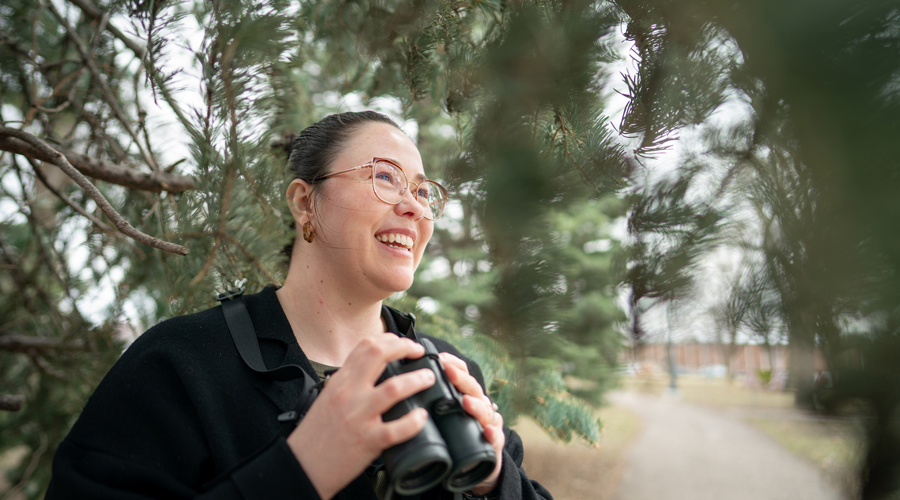
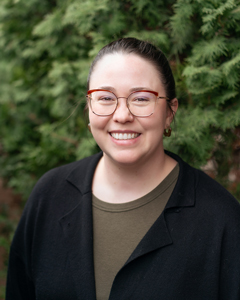
Earth Day is often associated with faraway places and unfamiliar landscapes. But for Madeline Aberg, assistant professor of biology at Augsburg, the natural world worth appreciating is all around.
Growing up, Aberg says she always enjoyed being outside and developed an interest in animals at a young age, frequently visiting northern Minnesota’s state parks along Lake Superior with her family. Despite her close ties to the natural world, Aberg once thought she was limited to simply enjoying it as a quiet observer.
It wasn’t until she began taking a required introductory biology course in college that she started to see a bridge between a cherished hobby and her future career.
“When the professor talked about the research that he did, ecology became a tangible career to me,” she says. “I ended up doing research with that same professor the following summer. We lived out at a prairie site and spent most of the days riding around in this truck, watching bison and observing their behavior. Helping with some of the analysis afterward really solidified my enjoyment of research and that it was something I wanted to pursue more seriously.”
Now preparing to complete her first year of teaching at Augsburg, Aberg aims to help students find their place in the urban ecosystem that surrounds campus.
A familiar fit
Having attended a small liberal arts college in Minnesota herself, Aberg always envisioned returning to a similar environment to teach. That initial desire was later solidified during her PhD program, where she found fulfillment through the face-to-face interaction of working with students while completing the required research components.
The main draw to teaching at Augsburg specifically? Its close ties to the local community.
“There’s this feeling that you’re working with students who are immediately going out and making this area better,” Aberg says. “It feels like there’s a nicely reciprocal relationship there. I was also excited by the idea of doing ecology out of a school that was in an urban environment. Oftentimes if you’re in a city, you’re not necessarily thinking of it as an ecosystem that’s around you. The idea of making those connections more evident to students was really exciting to me.”
This perspective ensures that students don’t feel their daily lives are separate from the environment, but rather that they are active participants in its health.
Coursework in action
Aberg’s courses at Augsburg range from core biology classes to more niche upper division options like Conservation Biology and Ecology. She’s also taught The Biological World, a general education course covering the whole span of biology with “a big focus on getting students to be more aware of the ecosystem that’s around them.”
Students in Aberg’s courses can expect their learning to reach beyond the classroom, with easy application to real-world issues.
“For one of our in-class activities, students wrote up a script that could be used to describe the benefits of the Boundary Waters to someone who was making a policy decision about [a mining project],” she says. “If students felt strongly about it, they could use that script to make a call.”
By providing these tools, she empowers students to turn scientific understanding into civic action.
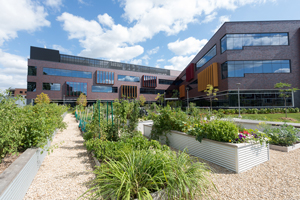
On campus, this work continues in the Augsburg Community Garden, where Aberg has spoken with students and community members who are passionate about food justice and eager to apply ecologically backed gardening techniques to nourish the neighborhood.
By focusing on these intersections, she demonstrates that ecology is as much about people and equity as it is about plants and animals.
Equipping through ecology
Introductory biology courses like those Aberg teaches lay the foundation for many possible pathways for students to take toward a future career in ecology. She says further coursework in biology and environmental studies are good options, while taking advantage of internships and summer research opportunities with faculty members can provide the experience needed to obtain an entry level position in the field.
Aberg says one of her favorite characteristics of ecology is that “it intersects with so many other disciplines.” She emphasizes the importance of statistics and being able to code using R. Another critical competency comes through Geographic Information Systems (mapping): a skill that can be learned through Augsburg’s sociology department and urban studies program.
One thing is clear about ecology: the subject is not one-size-fits-all, nor is the trajectory toward a future career in the field.
“You could have a student who’s really interested in political science but wants to go into environmental law. Within biology, ecologists and conservation biologists are incorporating more genetics into their work. There’s a lot of potential for students who have other interests to find an intersection between their interests and ecology or conservation, both in their personal and professional lives,” Aberg says.
The dueling mandate
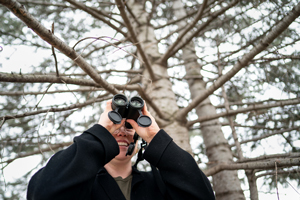
Aberg’s own research focuses on the “dueling mandate” of conservation: the tension between protecting natural areas and allowing for human enjoyment. By measuring the impacts recreationists have on wildlife, she seeks to provide the data needed to mitigate their footprint while still encouraging people to get outside.
Part of that is asking the question, “How do you motivate people to behave sustainably?” While answers may vary from person to person, Aberg suggests a universal theme of connection to place.
“It’s so much harder to make people care about behaving sustainably if they don’t feel that connection—if they feel like their day-to-day life is totally separate from the natural environment they live in—which is pretty easy to feel if you’re not used to tuning in and seeing the ecosystem that’s around you,” she says.
Get involved
This Earth Day, Aberg invites the Augsburg community to explore the connection between recreation and conservation. Beyond the classroom, several Twin Cities organizations offer opportunities to build that connection:
- Minneapolis Parks and Recreation Board: Participate in volunteer opportunities or check out BioBlitz events.
- Friends of the Mississippi River: Help restore and improve the health of the Mississippi River.
- Urban Bird Collective: Join birding events designed for all experience levels.
- MN Department of Natural Resources (DNR): Learn beginner-level outdoor recreation skills through the I Can! program or join community events to meet fellow nature enthusiasts.
You Might Also Like
Caring for campus
- on August 18, 2026
Countdown to liftoff
- on February 25, 2026