
“There are times when I ask a class what they think a librarian does,” says Tanya Gunkel, one of Augsburg University’s outreach and instruction librarians. “At that point, direct eye contact drops, and someone will mumble quietly, ‘ … books?’”
She laughs. “Books are definitely part of it, but we see our job as helping students build lifelong skills that they can use at any job: how to find good information. Our goal is for students to know that they can come here any time, to say ‘I can see myself here.’ We want them to feel like this library is theirs.”
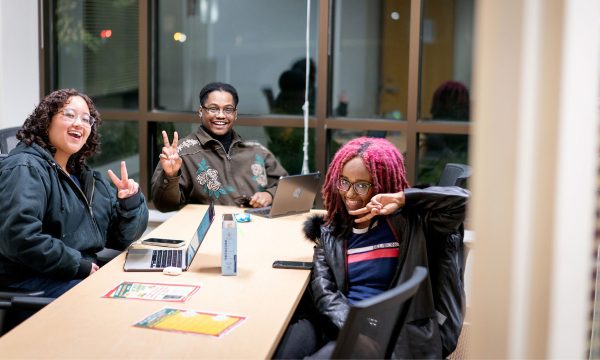
Sitting in the common area on the first floor of Lindell Library, there is a palpable sense that what Gunkel says is true. For one thing, she’s speaking at a normal volume—and she’s not the only one. While there’s plenty of quiet study space in the building, gone are the days of hushed whispers and silent stacks. There are people using this library.
The transformation underway at Lindell isn’t a radical departure so much as a deepening of long-held principles. In 1931, Indian librarian S. R. Ranganathan proposed five laws of library science. His precepts continue to shape the profession nearly a century later, and they are at work in this unexpectedly lively place: a library where community is at the center.
“My absolute favorite thing about the library is the people,” says Augsburg Library Director Sara Fillbrandt. “The heart of the library is the community, and that heart goes home every night. Without them, it’s just a building full of things.”
First law: Books are for use
A major goal of the new instruction and outreach librarian team—Gunkel, Megan Schierenbeck, and Kira Cronin-Hennessy, a trio hired at the same time in 2025—is to make it as easy as possible for students and faculty to get the most out of the library’s resources.
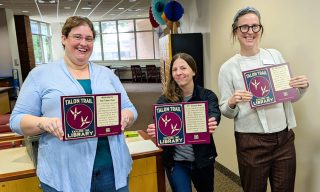
They’re getting creative to do it. Both online and in the library itself, the Talon Trail takes students on a self-guided tour of key resources and points of interest in Lindell, from study spaces with the best natural light to where students can check out a laptop. A new visual menu lays out ways the library can support faculty, from short tutorials on library basics to specialized research guides on topics ranging from medieval history to preserving open data. Fable the Fox, an unofficial mascot designed by Jasmine Yacabalque ’25, beckons library patrons in with his whimsical flair for Scandinavian wear.
Last fall, the instruction and outreach team partnered with AugSem, Augsburg’s required first-year introductory seminar, to bring every AugSem section on a library field trip through the Talon Trail. Among other resources, these visits highlighted the suite of academic supports on the second floor, including TRIO Student Support Services, the Writing Center, and academic advising. The goal was simple: to get new students in the building and help them understand it as a one-stop information hub. In Fillbrandt’s words, “If you don’t know, go to the library.”
“At one point we hit the maximum building capacity with 350 AugSem students in the building,” says Gunkel. “It’s really meaningful knowing that projects like that make an impact, because I see them come back—to ask for help, or play a game, or check out a Chromebook.”
This spring semester, Technical Services Coordinator Kristine Kammueller spearheaded a project to build out a new collection of digital textbooks. The project represents a major shift from past practice, one that’s grounded in broader efforts to address financial need among Augsburg students and families. With 178 titles in the collection, all with multi-use licenses that enable a whole class to use them, the library staff estimate that the collection is providing 25% of textbooks used by Augsburg students for free. “Whatever [digital texts] we can purchase, we do,” says Fillbrandt.
Second law: Every reader, their book
In 1997, Karen Hogan answered a newspaper classified ad for a position in Augsburg’s new Lindell Library building, which had just opened. Her first job in the library involved managing more than 800 titles in the library’s print periodicals collection. Later, she moved into course reserves (“giant file cabinets full of articles”) and electronic databases. Today, as resource sharing coordinator, she manages interlibrary loans, working to connect students and faculty to the resources they need.
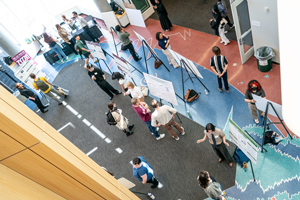
“I love to see them working through a research problem, and to see what projects faculty are working on” via their requests for books and articles, Hogan says. She often attends Augsburg’s annual Zyzzogeton student research symposium to see the finished projects she supported behind the scenes.
Hogan’s career at Augsburg over the past three decades reflects the seismic shifts in technology that have changed so much of culture and education—libraries included. She says the challenge for students, researchers, and librarians has gone from “how do I find it?” to “how do I manage this firehose of information?”
The advent of artificial intelligence has accelerated this shift. A notable impact on Hogan’s work has been helping frustrated students identify and guard against “hallucinatory citations”—real-seeming citations of research works that were invented by AI and don’t, in fact, exist.
In partnership with faculty, Augsburg’s librarians are on the front lines of teaching AI literacy. Their aim in developing Augsburg’s first student-facing AI guide is to nurture students’ critical thinking about generative AI, with a focus on ethical considerations and how to evaluate online information, both in and out of the classroom. Next year, students will be able to enroll in a two-credit course based on modules the library developed around AI literacy—including a section on generative media, a category that includes images, videos, and deepfakes. Additional modules are in the works around mis- and disinformation.
Third law: Every book, its reader
Two years ago, the library team began a massive effort to remove volumes that were more than 20 years old and hadn’t been checked out in more than a decade (a process known in library lingo as “weeding”). This effort reduced the collection from 160,000 volumes to 90,000. But removal from the catalog is not the same as removal from the shelves, notes Fillbrandt. Their physical removal, what student worker Cyril Foday-Kailie ’26 calls “a huge project,” is ongoing. Over the summer, more than 40,000 volumes in poor shape were recycled. An additional 30,000 are in the process of being distributed to Better World Books and other libraries.
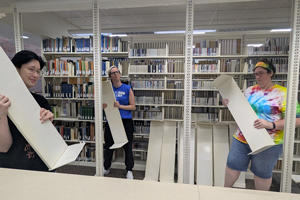
Why reduce the physical collection? Space is a key motivation. Fewer physical volumes means more room on the shelves. The library staff have been intentional about reducing the density of books on shelves to eliminate “title blindness” and make it easier to see what’s on the shelves while browsing. Additionally, the weeding project has allowed the team to remove shelves, open up new gathering spaces, and move items like CDs, DVDs, and reference books out from behind the desk into more accessible areas. (Fillbrandt drops her voice and confesses that her long-term, radical dream is to file the reference collection in with everything else, where it will be available to check out like any other material: one continuous collection filed in Library of Congress order from A to Z.)
Each of Augsburg’s five schools has a dedicated librarian who specializes in subject matter research, from accounting to urban studies, though they are all equipped to help students and faculty who come in with any question. Every day is different, says Gunkel; in addition to sleuthing private company salary data as part of her work with the School of Business, she’s fielded recent questions on topics ranging from adverse childhood experiences to perimenopause.
Computer science major Foday-Kailie sought help from his library colleagues with research into the so-called “Sarajevo Incident”—the assassination of Archduke Franz Ferdinand in 1914—for a history class that required he consult primary sources. Not long after, he was perusing 100-year-old newspapers on microfiche. “All you have to have is the topic,” he says. “They can help you with citations, how to get sources—they can help you thoroughly.”
When Lindell doesn’t have something, another library invariably does. Hogan can find almost anything via interlibrary loan; at present, she’s working on getting a musical score from Canada. She remembers a Halloween pumpkin making the rounds via the Minitex library courier system, each library adding a sticker with its three-letter identification code. Once, she challenged the library student workers to a contest to see who could obtain the most unique item from another library. She won with a Lightning McQueen bake pan sent north from a public library in Iowa.
Fourth law: Save the time of the reader
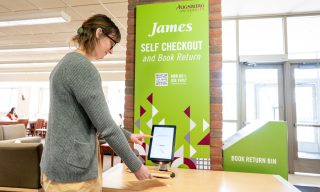
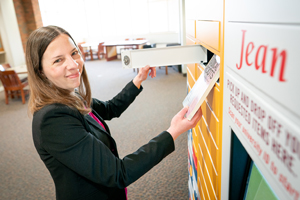
In 2024, Augsburg became one of the first academic libraries in the U.S. to go completely self-service for circulation. With James and Jean, a self-checkout station and smart locker named in honor of library benefactors James G. Lindell ’46 and Jean G. (Tigwell) Lindell, students check out and return books, retrieve holds, and pick up interlibrary loan materials with less staff support.
It’s been a seamless transition for a generation of students who are accustomed to self checkout at the grocery store and picking up packages at Amazon lockers. For the library, the benefits were immediate. Now that students don’t have to wait for someone to help them at the desk, circulation has actually increased, and staff time has been freed up for other priorities. Hogan says utilization of course reserves has also significantly increased by reducing friction for students.
The library also recently joined the MnPALS consortium, a network of 54 libraries in Minnesota whose scale makes it easier and more cost-effective for individual libraries to manage digital assets in an increasingly complex information environment. This involved a catalog migration—another major summer undertaking—but Fillbrandt says it was worth it, even as the staff continues to clean data following the migration. These changes are part of a broader shift, initiated by former Library Director Stewart Van Cleve, to leverage technology in order to free up staff time for more meaningful work with students and the Augsburg community in the aftermath of the pandemic.
Earth Day programming. Therapy dogs in the library. A student-curated Día de los Muertos ofrenda last fall. Vibrant mosaic artwork in the windows. “Instead of fixing broken links, our staff members are now spending time on things that matter more and are more visible to the community,” says Fillbrandt.
Fifth law: The library is a growing organism
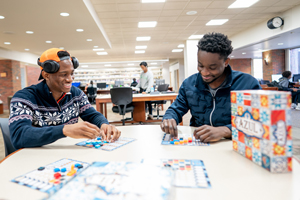
Gunkel often sees the library’s rolling whiteboards covered in chemistry notations when she arrives at work in the morning. Throughout the first floor, intentional changes have made the space more student-friendly in recent years. New tables and chairs on wheels make it easier for groups to gather in flexible arrangements around the whiteboards, whether to map out ideas or work out tricky equations. Where bare metal shelves used to display old yearbooks, students browse new collections on bright blue shelves—comics and graphic novels here, books by Auggie authors there. The tech help desk now shares space with the library front desk.
Next to racks of board games, students are working on the community jigsaw puzzle. In previous eras, one puzzle used to last the whole semester. But Fillbrandt says the refreshed community spaces in the library have made the puzzle a consistent draw for students, staff, and faculty alike. “We have three students who come in a couple times a week and sit for two hours. They’ve done three or four puzzles in the last two weeks!”
Students have had a hand in shaping the space. When Jerid McDonald ’28 initially reached out to the library staff, he was just trying to find a place for the Augsburg Board Game Club to meet. One thing led to another: the library offered space, the game club donated games, and Lindell’s game collection was born.
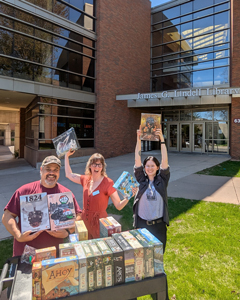
“I would say Azul and Root are the most popular games,” says McDonald, “along with Uno and chess. It helped that the library specifically surveyed people about what games they wanted to see in the collection.”
A sturdy, high-quality chess board was a common request. Munchkin and Slay the Spire get a lot of use. Students can play in the library, of course, or check out games to take back to their residence halls. It’s one of many ways the library is focusing on social belonging as well as academic success—by offering “brain breaks” when students need them. McDonald, a triple major in math, physics, and computer science, has had to step back from leading the board game club due to time constraints, but he’s proud and grateful that the permanent game collection in the library is now available to the whole Augsburg community.
This June, Fillbrandt will present as part of a panel at the American Library Association conference about the ways Augsburg has embraced change to make the library a more human-centered place. Hogan says doing so has required the courage and willingness to say “we’re not going to do that anymore” in order to make space for what students need today.
“I think this is the best iteration of the library so far,” she says.
At Lindell Library these days, that’s something you can say out loud.
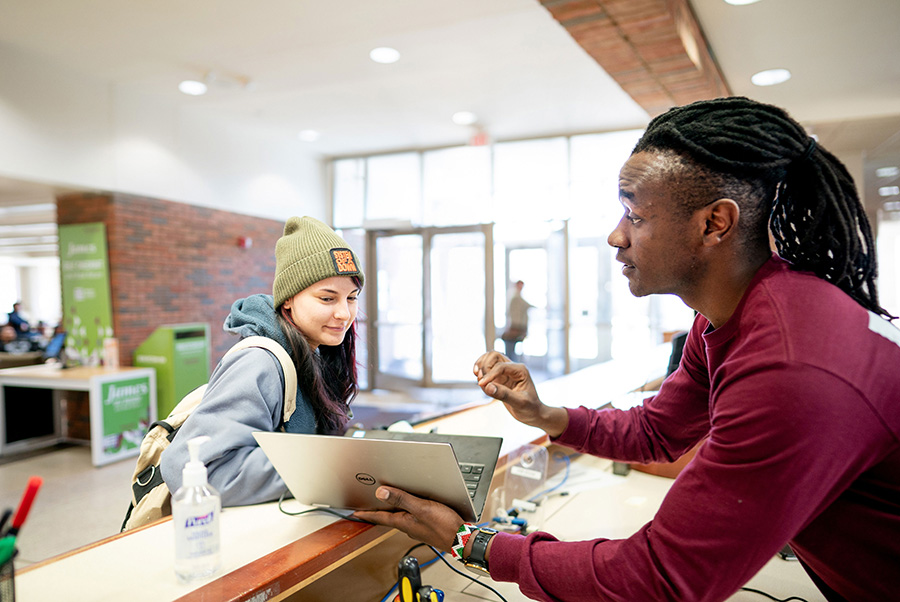
Top image: The Lindell Library service desk is a one-stop information hub for students, faculty, and staff.
You Might Also Like
Turning ideas into impact
- on April 23, 2026
Learning the world by living in it
- on March 26, 2026