
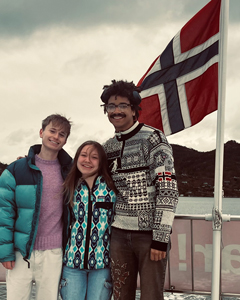
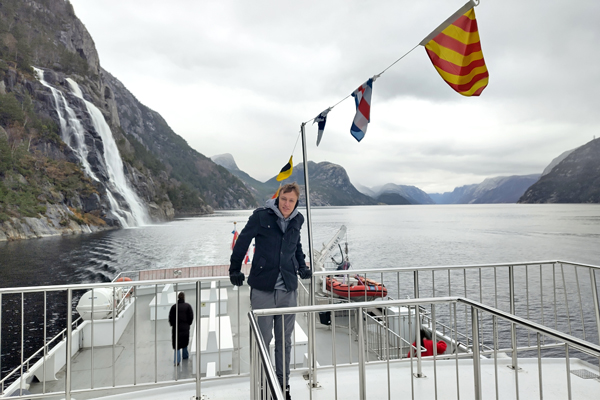
The ferry moves quietly through the fjord, the water dark and glassy beneath steep rock walls. Waterfalls cut silver lines down the cliffs, dropping hundreds of feet straight into the sea.
For students in the Center for Global Education and Experience (CGEE), this isn’t a postcard moment or a pause between lessons. It is the lesson.
Whether the view is in Norway, Guatemala, or South Africa, this is what learning looks like through CGEE: Students stand inside the geography, systems, histories, and questions that shape a place, rather than studying them from a distance.
For more than 45 years, CGEE has built semester-long, customized short-term, and summer programs supported by its long-standing study centers across Africa, Latin America, and Europe—including a new program in Norway and recently expanded offerings in Northern Ireland and Italy. Rooted in community-based learning, long-term relationships, and intentional reflection, CGEE’s model feels especially resonant, both globally and here in Minnesota.
“[CGEE] offers the opportunity to develop relationships with people across lines of difference, to truly engage,” says Ann Lutterman-Aguilar, who has worked with CGEE since the early 1990s and now leads its longest-standing program in Cuernavaca, Mexico, which started in 1979 and focuses on themes of religion and social change, migration and human rights, among others. “Not to just be a tourist somewhere, read about something in a book, but to hear people’s stories, get to know those people, and put human faces and voices to social issues.”
Learning through presence
CGEE programs are designed differently than many traditional study abroad experiences, with the program built on intercultural, experiential, holistic, analytical, and transformative pillars. Students move through their semesters as cohorts, take integrated courses, and live with host families. And they spend significant time outside the classroom, listening, observing, asking questions, and reflecting together.
“We are deeply in relationship with the places we serve,” says John Schwehn, one of Augsburg’s campus pastors, who participated in an Augsburg CGEE program in Central America as a St. Olaf student in 2006. “We’re challenging and inviting students to integrate what they’re learning with their own set of values, their own processes of discernment about who they want to be and the world they want to build.”
That discernment goes hand-in-hand with immersion—in community meetings, at kitchen tables, and in places where theory intersects with real life. Lutterman-Aguilar describes how quickly abstract ideas give way to empathy.
Once students have seen different realities up close, she says, indifference becomes harder to maintain and their engagement increases.
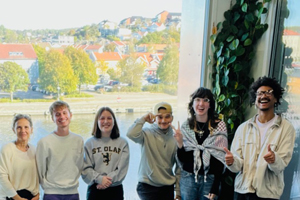
Northern Ireland: conflict, peace, and transition
One of CGEE’s newer program offerings takes students to Northern Ireland, where they study conflict, peace, and social transition in a region shaped by decades of division. The program builds on longstanding partnerships and focuses on how communities navigate reconciliation after violence.
From the late 1960s through the 1990s, Northern Ireland’s history was marked by The Troubles, a period of violent conflict rooted in political, national, and religious divisions that claimed thousands of lives. For Schwen, being physically present in a place shaped by that history deepens the learning.
“Being in places that are post-war, thinking about how religion and faith and identity play a role in the conflict and in building peace after the conflict, that’s a really unique and amazing opportunity,” says Schwehn, who visited Northern Ireland in 2025.
CGEE does not offer students easy answers. Instead, it asks them to sit with complexity, to listen to voices shaped by loss, resilience, and disagreement, and to reflect on what peace looks like in practice, not theory.
Norway: history, sustainability, and shared questions
If Northern Ireland invites students into conversations about reconciliation, Norway draws them into questions of sustainability, social systems, and equity. These themes connect directly to Augsburg’s history and Minnesota’s identity.
Launched in Fall 2025 after four years of planning, the Norway program is based in Fredrikstad, south of Oslo, and examines environmental sustainability, welfare systems, and contemporary social challenges.
For Ben Malovrh ’26, an Augsburg computer science major from Shakopee, the impact came as much from daily interactions as from coursework.
“It just boils down to the people,” he says. “I met friends and folks I never would have met, and was exposed to ideas I never would have been.”
For Liken Hefte ’26, an Augsburg urban studies major from south Minneapolis and part of the program’s first cohort, Norway offered a lived example of a society organized around different assumptions than those they grew up with in the U.S.
“So much of the political and societal infrastructure, including for things like transportation, are just more human-centered than we see in the U.S.,” they say. “It created a contrast for me to see and experience a society set up with a different type of community-building in mind.”
At the same time, the program resists romanticizing Norway. Bettine Hoff Hermanson, who helped build and currently leads the Norway program, pushes students to ask difficult questions about oil production, immigration, indigenous rights, and equity.
“While Norway is considered a utopia in many ways, my job is looking at the bigger questions of, ‘Who is Norway?’ to help students consider the notion that change needs to happen, even in a country like Norway,” she says.
Building on 200 years of connection
In 2025, Minnesota marked the 200th anniversary of Norwegian immigration, a milestone that resonates deeply at Augsburg University, founded by Norwegian Lutherans and shaped by generations of transatlantic ties. CGEE’s new semester program in Norway builds on that legacy while looking forward, inviting students to examine sustainability, equity, and social systems in a contemporary Nordic context. Rather than treating Norway as a symbol of the past, the program asks what ongoing relationships, shared challenges, and critical questions can emerge when history becomes a starting point, not an endpoint.
Reflection as curriculum
Across CGEE programs, reflection is not an add-on; it is core to the curriculum. Students write, talk, and revisit their assumptions throughout the semester.
“Part of my grading is their own reflections throughout the semester,” Hoff Hermanson says. “Their own experiences and growth: that’s important to me.”
Those moments often shape students’ sense of vocation. Lutterman-Aguilar recalls students who changed career paths after witnessing the effects of immigration policy firsthand or seeing community organizing in action.
“Whatever their major is, seeing they can make a difference and contribute to the common good is an important part of their experience,” she says.
Learning across difference, together
CGEE cohorts bring together students from Augsburg and partner institutions across the country. Many arrive with different backgrounds, beliefs, and levels of time traveling abroad. Learning to navigate those differences is part of the work.
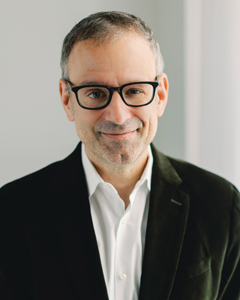
“The life and viewpoint diversity in our classrooms is really profound,” says Patrick Mulvihill, Augsburg’s assistant provost for global education and experience and head of the CGEE program since 2017. “Our model asks them to work on those issues together in good faith, even when they strongly disagree with each other.”
That practice feels increasingly relevant.
“Part of these programs is not just to learn about where they’re going,” Mulvihill says, “but about where they’re coming from.”
Students return home with sharper questions about the U.S., about community, democracy, sustainability, and responsibility, and with a clearer sense of how their own lives fit into a global context.
A global legacy, still unfolding
Standing in a fjord, debating social policy with Norwegian peers, or listening to stories shaped by conflict and reconciliation, students encounter something deeper than academic credit.
“One of the things that’s so transformative is these experiences provide a lot of students a sense of hope,” Lutterman-Aguilar says.
And that may be CGEE’s quiet through line: helping students step into the world with curiosity, return with clarity, and carry what they’ve learned—and hope to help change it for the better—into the communities they call home.
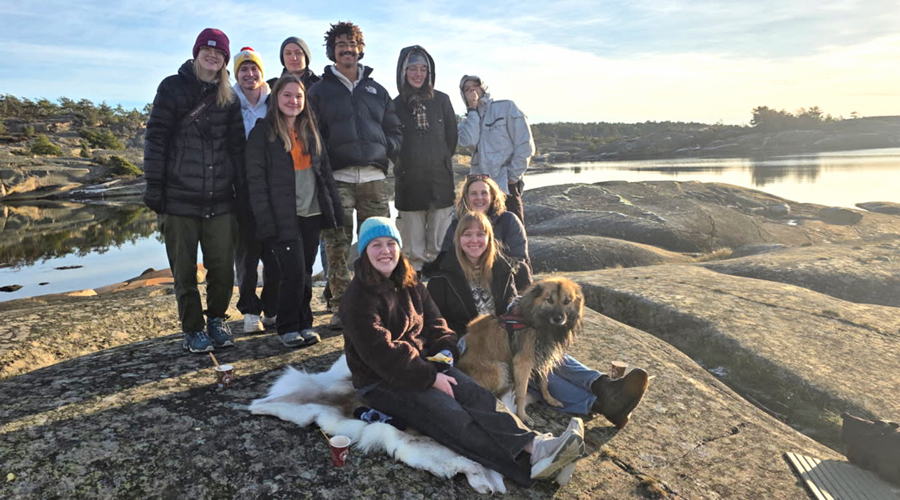
Top image: Students bundle up for a hike in Randholmen, a small peninsula located in the Fredrikstad municipality of Østfold, Norway. (Courtesy photo)
You Might Also Like
‘If you don’t know, go to the library’
- on May 29, 2026
Turning ideas into impact
- on April 23, 2026