
Dear friends,
What does a university president do?
This is a fairly common question I receive from students, so I always ask back, “What do you think my job is?”
The responses are familiar: You are the CEO of a good-sized organization. You are a fundraiser. You give lots of speeches. You spend time lobbying in St. Paul and Washington, D.C.
All of that is true, but what else? I am an educator-president, I tell them. I do all the rest of the job—and it is all important—so that I can come to campus every morning inspired by our students’ educational journeys.
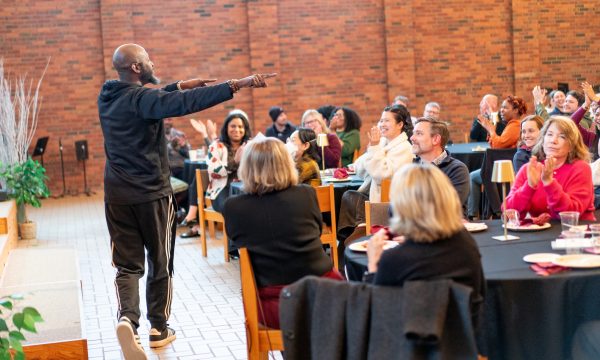
I have been privileged to co-teach courses throughout my 20-plus years as Augsburg’s president. Last spring, I co-taught my final course with Assistant Professor of Sociology Ashley Baber, and it was eye-opening for this educator-president.
Now, I will admit that I am an educator of a certain age who was formed by traditional pedagogical methods—but I experienced in the classroom last semester what it means to teach the students who are in front of us today.
Each week, when I came into the classroom, Ashley would have put on the sound system some piece of contemporary music that I didn’t recognize. One week, it was Chance the Rapper, whose Chicago-based experiences inform his (often profane!) lyrics, and tell a compelling story of life in the city for those marginalized and victimized. As the students explored the story behind those lyrics, they came forward with insights and nuances that stretched my understanding.
This is pedagogy that adapts to the learner and refuses to stifle creativity or the voices that matter: the voices of students. Our course showed me what our students deserve in their college experience, not as an entitlement, but as a gift that invites them into the wonder of learning for the moment we find ourselves in.
And that serves as a foundation for another aspect of teaching and learning for this generation: How do we honor what our students bring to the classroom from their own lived experiences that reflect perspectives beyond traditional Western values and attitudes? I believe our students are teaching me the value of what might be called “democratic excellences.”
In a discussion of climate justice, a Native student shares ways of caring for creation that don’t always pop up in the literature. In a discussion of architecture, a formerly unhoused student describes the brutalist features of urban architecture that are meant to exclude rather than offer sanctuary. In a session on immigration, a refugee student provides a compelling alternative narrative of our country’s broken immigration system.The challenge for those of us who teach this generation is to embrace these forms of wisdom, these democratic excellences, that make our teaching and learning richer and more authentic.
Adaptive pedagogy and democratic excellences—lessons even an educator-president of a certain age can learn. And lessons that we must embrace if we hope to meet the needs and aspirations of our students today.
Faithfully yours,
Paul C. Pribbenow
You Might Also Like
Auggie Days kicks off the 2026–27 school year
- on September 08, 2026
Summer Bridge builds success
- on July 22, 2026