
When Associate Professor Henry Yoon was a child, his mother asked him why humans had been so successful despite not being the biggest, strongest, or fastest animals. “Intelligence,” she said.
Her answer kickstarted her son’s lifelong interest in intelligence and individual differences. Today, Yoon specializes in individual differences and behavioral genetics as co-director of Augsburg’s biopsychology major. Since joining Augsburg in 2009, he has embraced the flexibility to pursue new, meaningful directions. So when generative artificial intelligence burst on the scene in recent years, he was interested both as a scientist and as a teacher.
“At first, I thought it might be a flash in the pan,” Yoon said. “But when I began to delve into it, I realized this might be a monumental moment not just for technology, but in the history of our species.”
Like any good researcher, he went to work, developing an annotated guide and toolkit of AI resources. Yoon divided them into categories that made sense to a psychologist: how AI works, potential impacts on instruction and teaching, implications for the science of learning and cognition, and ethics. In the last 18 months, he has published an essay on AI in EDUCAUSE Review, contributed to Lindell Library’s student-facing AI- and digital-literacy work, created and led multiple faculty workshops on AI through the Center for Teaching and Learning, and developed Augsburg’s AI-Informed Assignment Pilot. Now, he’s developing a focused operational-readiness discovery project with student-facing administrative offices.
In all of these arenas, Yoon starts with the end goal in mind. “The right question is: ‘What are my learning outcomes or work objectives, and would AI be appropriate to help?’” he said. “Not: ‘Here’s this AI tool, how should I use it?’”
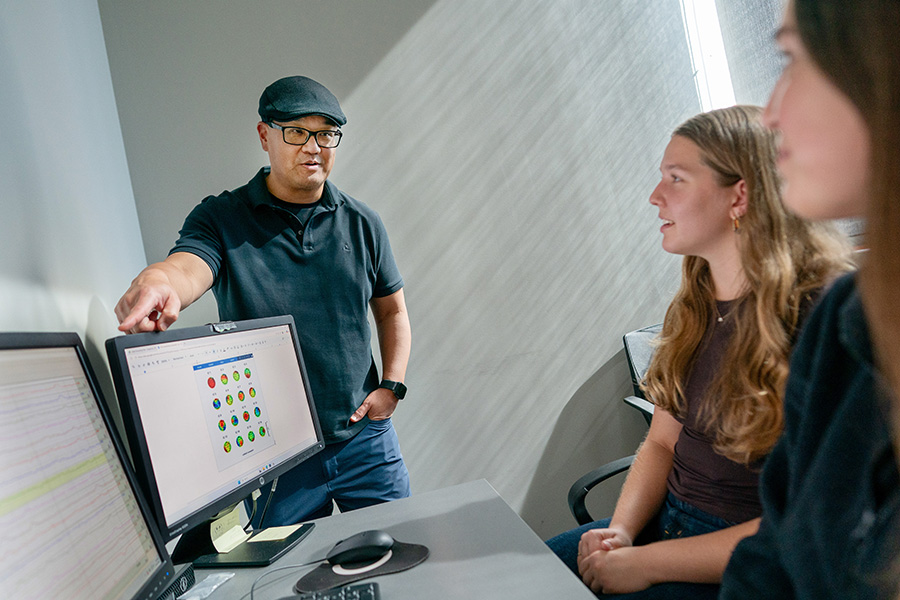
Reflecting his own curiosity, Yoon’s research interests intersect with multiple issue areas, from substance use risk to criminal justice reform. Across his Augsburg career, Yoon has mentored nearly 80 student researchers in scholarly activities. His students have gone on to pursue careers in medicine, clinical psychology and neuropsychology, addiction research, and other STEM fields. Many of his students have completed projects in Augsburg’s electroencephalogram (EEG) lab, where a major focus of Yoon’s research, in partnership with StepUP®, has been to examine whether certain measures of brain activity may serve as candidate markers associated with substance-use risk. Others are engaged in research into the scientific validity of polygraph interrogation or “lie detector” tests, which can contribute to false confessions and wrongful convictions. Augsburg students work on real cases of people who have been told they failed a polygraph test but were later exonerated. In related work, Yoon served as an expert consultant for an amicus brief submitted to the Texas Court of Appeals; in 2025, the court affirmed a lower court’s decision to suppress the post-polygraph statement as involuntary.
That kind of engagement, to Yoon, is what AI cannot replace in the college experience. “More than ever, I believe that students need hands-on experiences, like the ones they get in the lab: learning to formulate a research question, design an experiment, collect data, think critically, and communicate what they find. This is more important than ever in the shadow of AI.”
Working alongside Yoon, “a brilliant academic peer,” has been one of the highlights of his time at Augsburg, said Ben Denkinger, professor of psychology. After the COVID-19 pandemic, Yoon and Denkinger jointly developed a course called “Psychology in a Post-Pandemic World,” which sought to grapple with the deepening political polarization in the U.S. Students in the course explored misinformation and disinformation, how people come to hold conspiratorial beliefs, and moral psychology. They also practiced developing the skills to have conversations about challenging topics.
Since teaching the course, Yoon has become involved with Braver Angels, a nonpartisan organization that seeks to build bridges across political differences. In a world where science itself has become politicized, he sees his role as helping others understand how automatic and emotional processes can shape our reactions—often outside our awareness—and how understanding those processes can help all of us avoid contributing to increasingly polarized discourse.
“In this era of social media and news polarization, it’s difficult for all of us not to default to threat and fear responses,” he said. “But to me, a healthy democracy depends on our ability to keep having productive conversations across our differences. If we can develop a deeper understanding of where each of us is coming from, it can help us engage more constructively with one another.”
You Might Also Like
Caring for campus
- on August 18, 2026
An ecologist in the city
- on April 22, 2026