

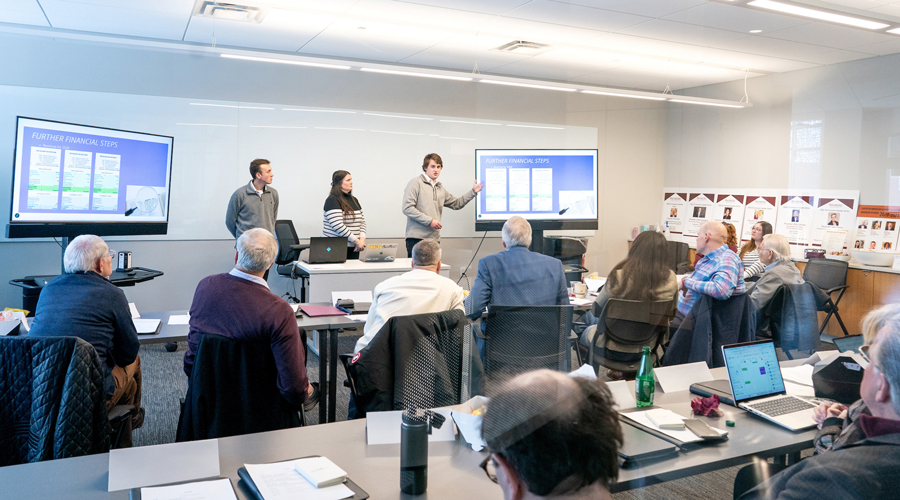
Last fall, Ryan Harvey ’26 arrived at Augsburg a week before classes began. Typically, he would have already been on campus—running plays as the Auggies’ quarterback—but injuries sacked the Minnesota native’s senior football season. Refusing to wallow, Harvey channeled his competitive spirit into a new opportunity to lead—this time, in the corporate arena.
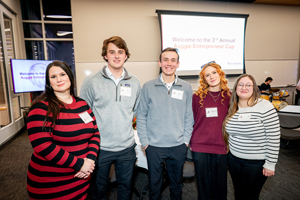
The double major in accounting and finance was invited to join one of three teams competing in the third annual Augsburg Entrepreneur Cup, better known as the Auggie Cup. Each team of one MBA student, two undergraduate business majors, and two graphic design majors assesses and supports a business venture that professionals and Augsburg faculty judge during a Shark Tank-style event in December.
Donors fund prize money of $3,000 per student for first place, $2,000 per student for second place, and $1,000 per student for third place.
“We partnered with Navatar Health, which offers AI-powered, culturally tailored ‘Navatars’ that walk people through the colon cancer screening process. Navatar doesn’t conduct screenings, but the platform works to reduce obstacles like confusion, fear, and language barriers to improve screening rates and, ultimately, save more lives,” Harvey said. “That reality makes the learning process more meaningful, and the experience gave us confidence and skills we can carry forward.”
During the fall, Harvey led a financial analysis of Navatar’s efforts to transform how patients are engaged, educated, and guided to act. Through interviews with health care professionals, Harvey and fellow business student, Jacob Henry ’26, learned that tens of thousands of Americans die from preventable cancers, even though screening is available, covered, and recommended. Navatar Health estimates that nearly one-third of eligible Americans remain unscreened, largely due to a lack of trust and understanding.
So, graphic design majors, Alanna Franklin ’25 and Bri Mccutchan ’25, helped the company execute its creative vision to offer user-friendly scheduling and custom Navatars who provide information in many languages. Jacqueline Zimmerman ’26 MBA led the team’s work, keeping the group organized and on track with research and marketing during the four-month project.
Harvey said the project became their passion: “We spent time outside of class on Zoom calls, worked through challenges together, and held one another accountable. Everyone on the team stepped up and did what was needed, and that commitment was present in our final presentation.”
The payoff
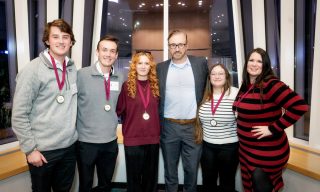
At an event in December, the Navatar Health team won first place in front of a crowd of nearly 150 students, faculty, staff, entrepreneurs, and donors. Dr. David Perdue, founder and principal of Navatar, was present to congratulate the students.
“They took this as seriously as if they were on my payroll,” said Perdue, who was a gastroenterologist for 16 years before starting Navatar in January 2024. “Our business students interviewed leaders at large health care organizations, including UnitedHealthcare and Blue Cross Blue Shield. They synthesized those interviews and thoughtfully integrated the insights into a business plan that reflects how decisions get made in health care. That level of initiative and real-world engagement is not easy, even for experienced professionals. The design students applied next-level design thinking, and Jacqueline managed the project with energy, insight, and expertise.”
The most valuable outcome, Perdue said, was the clarity students brought in, recognizing Navatar’s “friction points,” or where the company could pivot to enhance its reach and impact. Working with start-ups, he added, gives students a fresh perspective.
It was Perdue’s first partnership with Augsburg, and he would “absolutely do it again.”
“I was a little apprehensive at first, wondering how much of my time it would take,” Perdue admitted. “Those concerns were quickly belayed. I met with the team, gave them information about the market, helped make some business contacts, and talked to them about the business for about 30 minutes. They took it from there.”

Success builds momentum
Augsburg business professor George Dierberger, who started the Auggie Cup in 2023, said he is delighted but not surprised to hear these and other positive outcomes from the competition event.
“Students continue to impress with their professionalism, creativity, and work ethic. It’s more than a project for them. They come to care deeply about these partnerships and their very real-world outcomes,” said Dierberger, who is the inaugural Thomas ’72 and Karen Howe Endowed Professor for Entrepreneurship and chair of the Department of Business Administration and Economics. “It’s inspiring as we think about the importance and the impact of experiential learning on the trajectory of students’ careers and on the businesses we serve.”
In three years, the Auggie Cup has partnered 45 students with nine companies—awarding $90,000 in prize money to students. Its success led to the inaugural Augsburg Baby Shark entrepreneur contest in Spring 2025. The competition invites graduate and undergraduate students of any major to pitch a business venture that addresses a social problem. Submissions are due by April 1, and winners are announced during a celebration later that month.
“The final 10 teams present a 15-minute slide deck to a panel of ‘sharks’ (from the school’s Business Advisory Council) for the chance to win thousands in donor-funded prize money,” said Dierberger, who is also director of Augsburg’s MBA program. “Baby Shark has engaged more students in the entrepreneurial space, and students can use the prize money to start their business or pay for additional research.”
An innovative mindset
Dierberger has dedicated his life to the business sector. He led multi-million-dollar sales initiatives during his 25-year tenure at 3M before launching five companies. Teaching for the past 16 years at Augsburg has enabled him to inspire the next generation of business leaders through engaging, relevant experiences like the Auggie Cup.
Jeanne Boeh, director of the School of Business, said Dierberger is not unique among Augsburg business faculty in his professional experience: “Every one of our professors has worked in their field, and that influences their teaching and expands networks for our students.” Many universities offer entrepreneurial experiences, but it’s rare, she explained, for undergraduate students to partner with graduate students, alumni, and business leaders across industries.
“We don’t tell students how to apply their learning; we walk alongside them as they apply that learning through classes and extracurricular activities. And we are blessed with many donors, alumni, and friends who invest in our students with their time, gifts, and expertise.”
Boeh said the school’s Business Advisory Council is an active partner in fostering this synergy between campus and community connections. The group provides external perspective, reviews curricula, and advocates for the school’s programs and strategic direction.
“We constantly assess and reflect on how we can improve, and our Business Advisory Council and other partners are integral to that continued evolution,” she said. “We push entrepreneurial, hands-on learning because it prepares our students for practice and connects with Augsburg’s overall mission to apply learning to community needs.”
‘I want to provide that direction to others’
Kyle Wheaton ’99 joined the Business Advisory Council in October 2024 with a goal of helping students make connections and discover their path as early as possible.
“There’s a huge difference between passively listening to lectures about abstract business concepts and actually going through the process of building something,” he said. “It wasn’t until my junior-year internship that everything clicked, and I gained clarity about my direction. The guidance and preparation my boss provided had a profound, lasting impact on my career trajectory, and I want to help provide that direction for others.”
Wheaton said internships and experiences like the Auggie Cup “build real-world skills, confidence, and perspective that classroom learning alone can’t provide.”
He returned to campus in 2024 to offer guidance as part of Augsburg’s Center for Innovation and Entrepreneurship’s Innovator Series, which features six speakers each academic year. Wheaton’s talk stressed the importance of internships and networking.
“Do as many internships as you can and use them to figure out what you truly want to do. Then, build a clear plan to get there and work the plan relentlessly,” said Wheaton, who founded Victory Innovations, which pioneered a cordless electrostatic sprayer. “Reach out to professionals in fields that interest you—ask about what they love about their jobs, what they don’t like, and how they built their careers. Those conversations provide invaluable insight.”
Augsburg now requires an internship course to ensure each business major gains guided real-world experience before graduation. Students journal to reflect throughout the course, as they work alongside professionals in their chosen field.
A relevant, industry-driven education
Newer competitions and courses complement the school’s longstanding focus on applied learning and entrepreneurial partnerships. One such program is Innovation Scholars, in which scholars work in interdisciplinary teams, much like the Auggie Cup, to create business plans or specific deliverables requested by early-stage companies and the Mayo Clinic. Jacob Enger, assistant professor of business administration, is the Augsburg contact for this six-month program, which provides each student with a $1,500 stipend upon completion.
Jeff Clement, assistant professor of management information systems, teaches the department’s senior capstone, Information Systems Projects, which partners student teams to tackle the technology challenges of community organizations. Recent projects have included improvements to the cybersecurity and accounting software of the West Bank Business Association and the document management system at Luther Seminary.
“Students act as consultants—leading the project, defining the problem, and developing practical recommendations for solutions, vendors, or software that fit the organization’s goals and constraints,” he said. “A former student in her first job after graduation shared that one of her first work assignments was to develop a workflow diagram, which was something she did in her capstone project. She was able to confidently engage, ask good questions, and get started right away. She told me it helped her make a strong impression early on, and that’s exactly the kind of outcome these hands-on experiences are designed to create.”
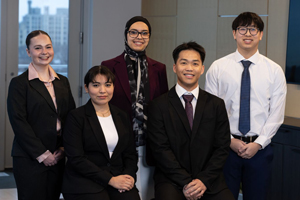
Clement was also involved with revision to the MBA Business Analytics course to incorporate hands-on experience using a range of AI and data-driven methods to solve real business problems. “Because our MBA students are all working professionals, many bring in problems from their own organizations,” said Clement, who previously worked as a scientific adviser for a digital health startup. “The goal is that the project isn’t just an academic exercise—it’s something they can take back to work, use immediately, and ideally leverage to make an impact and advance their careers at the same time.”
Lori Lohman, professor of marketing, has taught Marketing Research and Analysis since 1990. From the beginning, Lohman said, the course has focused on completion of an applied research project with a real client.
“I am a strong believer in learning by doing, as it’s the best way to experience what working in this field is really like. It’s easy to lecture about how to conduct marketing research and easy to take a test on the major concepts, but it’s a lot harder to apply those concepts in an actual workplace setting. Not even simulations can replicate the dynamics of what happens between a student group, a client, an instructor, and survey respondents.
“For example, students have to learn how to approach a client and ask to do a project for them, to initiate and maintain communication with them and with their instructor, to design and distribute a survey, to interpret the findings, and to make a formal presentation of the results.”
Students do this while handling the messiness that can happen in the real world, such as missed deadlines, poor communication, repeated survey edits, and slow response rates.
“It’s a win-win for everyone involved: The students gain experience, and the clients save at least $5,000 or more, which would be the cost of hiring a research firm to do a comparable study,” she added.
 One of the most memorable studies her entire class conducted was for a division of a $6-billion Japanese company that was interested in introducing a new product in the United States. The company flew its CEO in from Japan to meet the students and hear their final presentation: “It was an experience the students will never forget, and the company went ahead with the product introduction,” Lohman said.
The class has also conducted research for the NCAA, Metro Transit, many of Minnesota’s professional and non-professional sports teams, and a wide variety of local businesses and nonprofits. In addition to creating products and change in those sectors, the findings have been presented at academic conferences and published in academic journals.
Many students use the findings from the course to inform the marketing plans they develop in Marketing Management, an upper-level course that also engages a real-world client. The focus on practical application is woven into the curriculum across the school, Lohman said.
An embrace of the humanities
Many of the business school’s faculty share an appreciation for disciplines outside the school. Success in business, Lohman said, requires a broad understanding of economics, sociology, psychology, writing, communication, art, and history.
“I actively encourage my advisees to take courses in the humanities and social sciences because the best businesspeople are often those with a solid liberal arts education, as opposed to those students with only a narrow business focus,” she added.
Boeh said Augsburg’s transition in 2025 from two large divisions to five schools has fostered organic collaborations across the university, which has extended interdisciplinary innovations into the community. She meets weekly with the leaders of the arts, health, natural sciences, and the humanities and social sciences.
“We are just getting started,” Boeh said in an article about the new structure, “but it’s an exciting time to be an Auggie or to partner and dream with us.”
 Dierberger is also an advocate for cross-campus collaborations: “My wife is an artist, and I took a theater class in undergrad that brought theater to life for me. I still enjoy the stage and love to read and experience the arts to expand my world and perspective,” Dierberger said. “I push my students to embrace a holistic education and say ‘yes’ to new experiences. It enriches their lives and improves their ability to connect and adapt.”
Each semester, he introduces MBA students to Dave McClellan, who served as CEO, board chair, and executive chair of Cargill—America’s largest private company—from 2013 to 2023. McClellan, who earned an English degree before graduate studies in finance, stresses the importance of liberal arts to build critical thinking, sharpen persuasive communication, strengthen empathy, and deepen ethical judgement. Dierberger said it’s one of the students’ most powerful memories.
“He comes in all by himself and tells the students about his nontraditional path to the C-suite, and then he spends at least an hour answering their questions about leadership, service, and life,” Dierberger said. “He reminds us that the humanities make leaders, not just managers. [Humanities disciplines] don’t compete with a business education; they complete it.”
Harvey agrees. The Auggie Cup sharpened his transferable skills and applied his liberal arts education to evaluate evidence, make reasoned arguments, solve unfamiliar problems, and adapt to new expectations and environments.
“The experience showed me that I will not shy away from unique opportunities or challenges, even when they may seem difficult or outside my comfort zone. The competition reinforced the idea that saying ‘yes’ and being willing to try something new can lead to growth and unexpected opportunities that positively shape your career,” he said. “Communication, collaboration, and empathy are critical skills that have helped me secure multiple internships and a full-time role after graduation.”
Harvey came to Augsburg to play football, but he stayed “even after that chapter ended” because of the fulfilling, community-focused learning that has shaped him as a person and professional. After graduation in May, Harvey will move to Florida to work at Cherry Bekaert as a risk advisory associate.
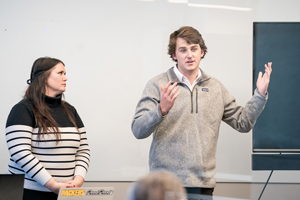
Top image: Gesturing to a slide on further financial steps, Augsburg students share their ideas with an engaged crowd. (Photo by Courtney Perry)
You Might Also Like

Learning the world by living in it
- on March 26, 2026
Community building in action
- on November 19, 2025