
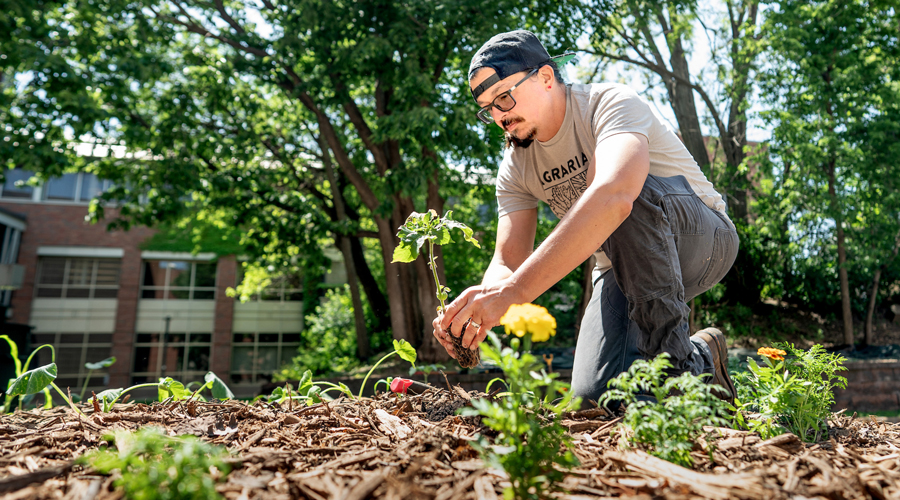
 When Augsburg University Groundskeeper Justin Wells talks about what it takes to care for the campus landscape, he mentions two things: people and plants. Together, a community of people and organizations support the grounds, and native plants bring a less-expensive, lower-maintenance beauty to campus.
With a background as a landscaper and urban farmer and training from the Permaculture Research Institute, Wells brings both traditional groundskeeping expertise and knowledge of native plants and soil health to Augsburg. He also came to campus with a network that has flourished during his time on the job, contributing resources that include labor, funding, and advice on sustainable landscapes.
Assistant Groundskeeper Blair Myers-Leehy is a key member of that network of contributors. He acts as a mechanic, manages the mowing, and collects the garbage on campus. Student workers are also vital to groundskeeping, but due to the extreme temperatures that can accompany Minnesota weather, they can be hard to find. Wells said that Associate Professor Joe Underhill “has been a huge support. He’s helped me find students who are interested in the outdoors.”
The support Wells receives goes far beyond his team. His mentor, Stefan Meyer, whom he met at the Permaculture Research Institute, came to campus to help design the garden beds and choose native plants. Several organizations have provided assistance through grants and other forms of financial assistance, including grant funding for native plants from the Mississippi Watershed Management Organization; significantly discounted trees from Tree Trust; and funding for an electric vehicle, electric mower, and other electric landscaping equipment from Augsburg’s Environmental Stewardship Committee. “Our electric vehicle has been a huge help,” Wells said. “If we didn’t have that, there’d be times when the students would just be walking around with tools.”
As a member of the Sabo Center Engagement Council, Wells also had the opportunity to work with the East Phillips Neighborhood Institute, which offered several workshops, many on native plants. “I learned a lot from them,” he said. “A lot of students showed up, and staff and faculty.”
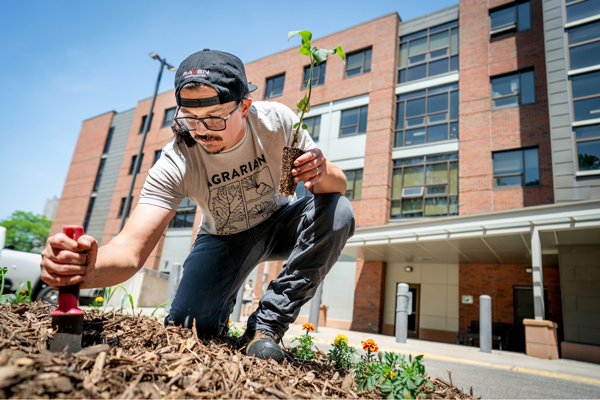
Since he joined Augsburg, Wells has overseen the installation of many native plants in beds that were once devoted to annuals, saving the university money and, once the annuals were established, reducing reliance on watering. They’re also more resistant to rabbits.
“I heard a lot from students that they wanted more fruit trees, edible landscapes, as far as plants go,” Wells said. “I think about rabbits a lot when I’m planting. My first year, I didn’t think rabbits would be that big of a deal, but they took out a lot of plants and even the bark around trees. That was a big problem.” Besides planting natives, he finds that including marigolds in the landscaping and spraying plants with Neem oil and hot pepper also help.
Despite the challenges he faces, from finding resources to protecting plants from rabbits, Wells finds the work well worth it. Not only does he get to be outside, but he gets to share his love of the outdoors with students. “I like training them, showing them, teaching them about plants,” he said. “I’ll teach them whatever they want, and that’s fun.”
You Might Also Like

A curious mind
- on September 21, 2026
An ecologist in the city
- on April 22, 2026