
To help his students better understand some of the dense philosophical texts they study, Assistant Professor of Philosophy Bernardo Andrade divides his class into three or four groups to translate paragraphs into Gen Z or Gen Alpha lingo. If one were to walk by his classroom on any given day, they could hear an animated discussion incorporating words like “delulu,” “no cap,” and “bet.” In this way, Andrade learns just as much from his students as they do from him. These “silly” conversations fit his goal of helping his students fall in love with learning, he says.
Andrade himself fell in love with learning when he was growing up in Rio de Janeiro, Brazil. He was always interested in philosophy but didn’t know how to incorporate it into his dream of pursuing an education abroad. He explains that many Brazilians typically leave to study something like economics or political science and then come back to make a difference in their home country. Thanks to everything he learned from a middle and high school teacher who happened to have a PhD in philosophy, Andrade bravely followed his passion first to Vermont, where he completed his undergraduate degree at Middlebury College. He then pursued his PhD at Emory University in Atlanta, with some time spent at Tilburg University in the Netherlands.
Andrade’s global educational journey eventually brought him to Augsburg. He was drawn to the university’s vision, “Small to our students and big for the world,” and he admires the way the Center for Global Education and Experience (CGEE) can create a global impact for the Augsburg community. “You have this small tight-knit community with interdisciplinary connections as a liberal arts college, and yet a global outlook,” Andrade says. “I am so impressed by the CGEE sites abroad in so many locations. For a school of this size to have so many international connections is really surprising.”
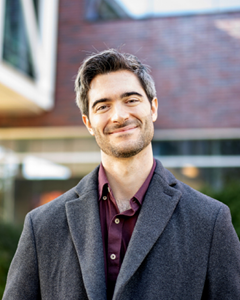 Andrade also appreciates Augsburg’s tight-knit community—especially in the Department of Religion and Philosophy, whose faculty members warmly welcomed him to campus. Part of his initial task was to help rebuild the philosophy program after a number of philosophy faculty member retirements. When he started in Fall 2024, two students were majoring in philosophy. Now two years later, Andrade says he’s building deeper relationships with the 16 students who are currently pursuing a philosophy major or minor.
Seeking to bring a global perspective, Andrade and Visiting Professor of Religion David Hall established a new program requirement: Historical and Global Philosophies. Designed to reflect both Augsburg’s diverse student body and the philosophy field itself, the curriculum currently includes Andrade’s course in Latin American philosophy and Hall’s in Buddhist philosophy, with plans to introduce Africana philosophy in the future.
The best part? Students are taking a greater interest in the program.
“To see that happen is perhaps the most rewarding experience of my educational career so far. I’ve taught courses before as a PhD student, and I’ve had great relationships with students before, but the level of engagement we’re getting now is so inspiring,” Andrade says. “I wasn’t expecting that philosophy would generate this level of engagement with students.”
Engaging students has taken multiple forms—including expanding the philosophical canon, translating text into Gen Z and Gen Alpha lingo, and incorporating films or other visual media. These approaches help make the material real to the students, so they aren’t just discussing abstract theoretical beliefs or ideas from a different era. Through his experience teaching first-years, Andrade realized many students didn’t have an engaging educational experience before coming to Augsburg. In many cases, helping students find that “source of curiosity” is what makes a difference.
“This is really our first opportunity to show the joys of learning,” he says. “Here, we have the opportunity to be really transformative.”
You Might Also Like
A second home in Mexico
- on October 29, 2026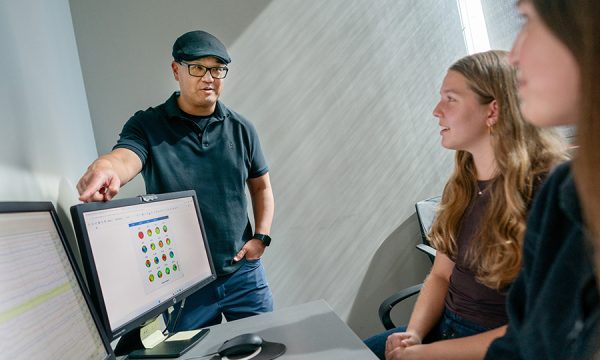
A curious mind
- on September 21, 2026