
Medieval Studies
- Course Descriptions
ART 386 Medieval ArtEarly Christian through late Gothic and proto-Renaissance painting, sculpture, and architecture in Europe. (Prereq.: ENG 111)
ART 387 Renaissance and Baroque Art
European painting, sculpture, and architecture, from the 14th through the 18th centuries. (Prereq.: ENG 111)
ENG 330 Shakespeare
Study of the bard’s major plays—comedies, histories, tragedies, and romances —for their literary, dramatic, and cultural significance. (Prereq.: ENL 220 or 221, or a 200-level literature course or THR 250, or consent of instructor.)
ENG 332 Renaissance and Reformation
A survey of 14th- to 17th-century British literature, with attention to its European contexts. Begins with the Reformation of the 14th century and Canterbury Tales and ends with the Puritan Revolution and Paradise Lost. Themes include “the enchantment of evil”; the hero as lover and courtier; utopian dreams and the literature of conquest; the writer as politician; and the challenges to religious certainty in a post-Ptolemaic universe. Major writers include Marlowe, Spenser, Shakespeare, More, and Donne. (Prereq.: ENL 220 or 221, or a 200-level literature course, or consent of instructor.)
ENG 360 The Classical Tradition
A study of the major works of Greek and Roman literature, including Homer, Virgil, Aeschylus, Sophocles, through Dante. Works are studied with reference to their mythological foundations, their cultural background, their influence on later literature, and their enduring relevance. (Prereq.: ENL 220 or 221, or a 200-level literature course, or consent of instructor.)
ENG 361 The Medieval World
A survey of medieval literature from the collapse of the Roman Empire to the 14th century, this course emphasizes themes of cultural collision and synthesis: pagans—both classical and “barbarian”—and Christians; Islam and Christendom. Attention is paid to heroic traditions (myth, epic, saga, romance, hagiography); the literature of courtly and profane love; and visions of heaven and hell. (Prereq.: ENL 220 or 221, or a 200-level literature course, or consent of instructor.)
HUM 120 Medieval Life in 12th-century Europe (Medieval Connections)
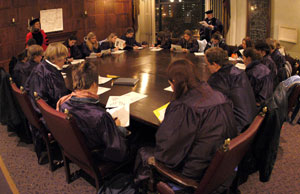
This is the introductory course for Medieval Studies. It uses an interdisciplinary approach to study European culture during a period known as the High Middle Ages, roughly AD 1100 to 1300. It attempts to examine medieval culture as a complex system of thought and feeling, which includes history, religion, philosophy, literature, art, theatre, music, and food. It also takes an experiential approach to this material, for example, by having students and faculty attend class in academic regalia, just as they did in medieval universities. (Fulfills the Humanities LAF, Spring)
HUM 499 Senior Project in Medieval Studies
This is the required capstone/keystone of the Medieval Studies major. The project must reflect significant interdisciplinary work, and should be conducted under the guidance of three professors from different participating departments. The project may be completed as part of a seminar or as independent study, depending upon enrollment, and at the discretion of the advisor. Enrollment is normally restricted to students who have nearly finished their coursework.
HIS 369 Early and High Middle Ages
Examines the history of Europe and the Mediterranean from the so-called "fall" of the Roman Empire to the High Middle Ages (c.300 to c.1350 AD). In addition to the "traditional" political narrative, examination of social, economic, and cultural aspects of medieval life.
HIS 370 Late Middle Ages to 1648
Examines the roles of Church and State in the late Middle Ages, the impact of the Black Death and the Hundred Years War, and the societal effects of the Italian Renaissance and the Protestant Reformation.
HIS 372 Medieval Church
Examines the history of the medieval church from Constantine the Great to Martin Luther (c. 300 to c. 1517 AD), using a variety of written and visual sources in an attempt to understand the medieval church and its influence, not only in religious matters, but also in the social and political spheres.
HIS 374 Medieval Crusades
Examines Western Europe's crusading era (1095-1291 AD), a time when warriors from the Christian West attempted to “take back” the Holy Land from its Muslim occupiers. Includes such issues as Pilgrimage, Holy War, the complex relationships between East and West, between Muslims and Christians.
HIS 440 Medieval Monks and Heretics
Framed around a reading of Umberto Eco's novel, The Name of the Rose, a murder mystery set in a monastery in 14th-century Italy, this course examines the volatile religious life of the late Middle Ages.
MUS 231 History and Literature of Music I
A study of the evolution of music from antiquity to 1750. (Prereq.: MUS 101, 102, 201)
PHI 242 History of Philosophy II: Medieval and Renaissance Philosophy
Students will read writings by various medieval and Renaissance philosophers in order to understand the process of philosophical assimilation involved in constructing a Christian philosophy. Topics include: the nature of being, human understanding in relation to faith, and the place of the image of God in the human condition. (Suggested prior course: PHI 241. Spring)
POL 380 Western Political Thought
A study of influential political philosophers, emphasizing the values, goals, and assumptions that continue to inform and to rationalize human governance. (Prereq.: one course in political science or consent of instructor)
REL 361 Christian Church in the First Four Centuries
An introduction to the theological thought of the early church, from the time of Christ to AD 400, with special attention to the writings of Paul, Augustine, Ambrose, Jerome, and the heretical controversies of the early church. (Prereq,: REL 100)
REL 362 Theology of the Reformers
An introduction to the theological thought of the Protestant reformers of the 16th century. Special attention to the writings of Martin Luther and other representative figures. . (Prereq,: REL 100)
THR 361 Theatre History and Criticism I
An overview of theatre history, dramatic literature, and criticism from the classical Greek through the Medieval period. Reading of several plays and attendance at local theatre productions are required. Need not be taken sequentially with THR 362. (Prereq.: ENG 111. Fall: alternate years)
