
Note: This reflection originated from Najeeba Syeed’s independent platform A Daily Peace via Substack.
I work for the best President, Paul Pribbenow.
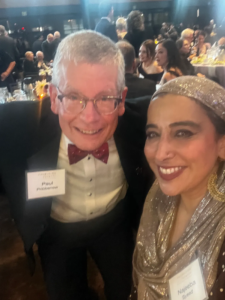
He is retiring this year, and so we took our last selfie together at a work event.
I’ve been working on his selfie game.
Today a student came to my office, a Somali Muslim student who chose our college because she said she heard Paul testify as a state hearing about standing with immigrant students and communities. She turned down prestigious offers from other schools because she trusted him after hearing his testimony.
I am the first Muslim women who has earned tenure at this historically Lutheran university. Paul’s unflagging support is a key to my own success.
Why are interfaith professional friendships important?
Power is relational, and at its best transformational
We build connections in institutions and structures based on our ability to connect with others.
It’s easy to think of power as merely accumulating advancements in our status. One of the things we learn from conflict resolution is that the power of convening is one of the most vital forms of power.
Can you gather people?
And how diverse are the folks you can gather? In the workplace, the wider the range, the greater the diversity, not only can we solve more problems but we also transform in our friendships.
We grow when challenged, and when supported, interfaith friendships make us question our core beliefs and we grow, together with others.
Paul and I share our scholarship from time to time. I write often about the lived theologies of neighborliness and he engaged that work for one of his own pieces.
Simply put, we push each other further into exploring our own traditions and enhance each others’ intellectual trajectory when interfaith friendships abound in workplace. Encountering differences builds a dynamic, open minded intellectual stance which is far better suited to problem solving.
Public interfaith scholarship and engagement matter
The student in my office today chose Augsburg because of Paul’s public engagement.
How we project our values as leaders, the empathy we show people of other faiths and communities
matters
A Christian President, or if in a company a CEO who can be trusted by people of other faiths, is a fountainhead for that workplace to welcome others.
They become a symbol of inclusive leadership that by extension is the ethos of that organization.
Silence does not achieve this.
A vocal, continuous, courageous and also strategic communication of values of interfaith engagement, grounded in the history (in our case at Augsburg, Lutheran) of that particular institution is important.
As Peter Drucker helped us see, workplaces have theologies.
Even non religious workplaces have embedded values that govern the culture and ethos of those spaces.
What is your workplace feel like?
Are friendships across all forms of differences encouraged?
How do you hold and build intentional interfaith spaces?
Does leadership and all levels of your workplace model interfaith friendliness?
This may be my last selfie with President Pribbenow. But his lasting impact in my life and the lives of others will be felt for a very long, long time.