bing pixel

2026 Interfaith America Summit

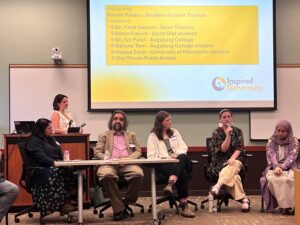
The Interfaith Institute team attended the recent Interfaith America Leadership Summit in Chicago! August 6-9, thousands of educators, higher education staff, students, and donors from across the country attended the summit to connect, share inspiration, and strengthen bridge-building skills. This year’s theme, A Road Forward, invited attendees to reflect on America’s 250th year and our shared commitment to cooperation across difference.

Augsburg’s Interfaith team attended plenary sessions from engaging speakers like the Inheritance Theater Project and activist Loretta Ross. One recurring theme was practicing getting comfortable with discomfort, recognizing there will still be unanswered questions and opposing opinions when people team up to make good things happen together. The Interfaith team also participated in training sessions on how to increase pluralism on campus. Professor Syeed co-led a series of sessions for professionals entitled “Campus Culture Starts with Me.” It was also a great opportunity for networking with colleagues from other schools!

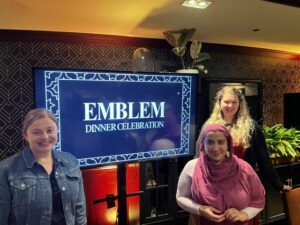
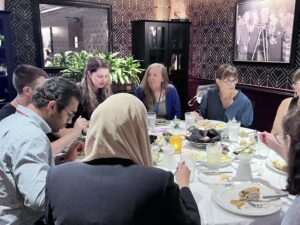
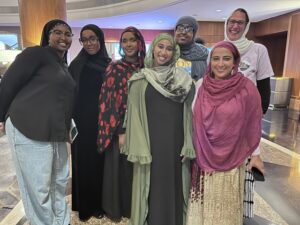
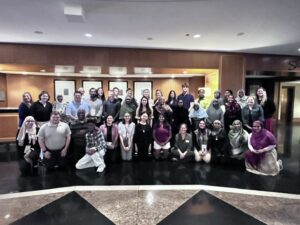
Thanks to funding from the Arthur Vining Davis Foundations, we were able to bring 8 EMBLEM (Emerging Muslim Leaders Engaging the Midwest) grantee campuses from across the midwest to the summit! Students and advisors from Augsburg, Augustana College (IL), Carleton College (MN), Concordia College – Moorhead (MN), Gustavus Adolphus College (MN), University of St. Catherine (MN), University of Michigan, and Lewis University (IL) attended a special gathering to make connections and celebrate their EMBLEM projects. It also provided an opportunity to reflect on the impact of the summit.

Ian Avers of the University of Michigan reflected; “The main thing I will be taking back from the summit is the stories I heard from others. I can say with confidence that I am more comfortable having ‘uncomfortable’ conversations after everyone’s vulnerability and honesty.” Farah Abdalla, of Concordia College, highlighted the importance of listening, with the reminder that “Interfaith conversations don’t always need to be an argument.” Students and advisors expressed gratitude for the chance to connect with interfaith leaders from different campuses. It was an energizing gathering and we look forward to sharing more about EMBLEM in the weeks to come!

Chautauqua Lecture

Najeeba Syeed speaks ‘from the broken heart of democracy’ on interfaith peace


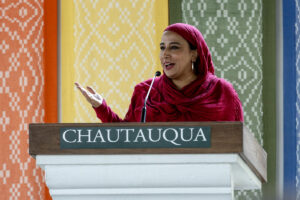
Professor Najeeba Syeed participated in the Chautauqua Institution’s Interfaith Lecture Series: Faith in the Public Square.


“Democracy is not a religious act; it is a spiritual struggle.”

Professor Syeed structured her lecture on the teachings of Christian ethicist Glen Stassen and U.S. religion sociologist Robert Bellah.

Read about her lecture in the Chautauquan Daily and watch the video online.

Inspired Generosity Minnesota

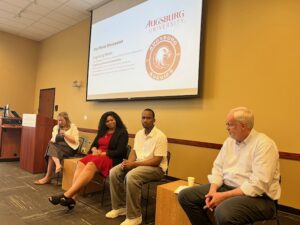
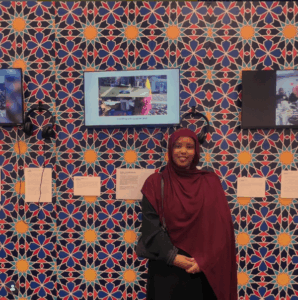
Inspired Generosity (IG), a national showcase of powerful stories of generosity from the Muslim American community, was featured at UROC Gallery in Minneapolis March – May. Augsburg students presented at several showcase related events, including the opening reception panel on religious traditions of generosity, and a panel on Earth Day. In April, Augsburg staff and student presented to a group of local DEI leaders on Augsburg’s response to Operation Metro Surge.

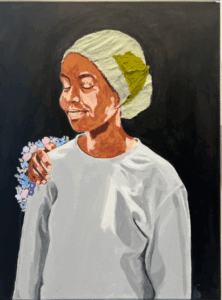
In addition to student panelists at IG MN events, Augsburg graduates Ayan Mohamed ’25 and Rahma Mohamed ’26 contributed a self-portrait painting and a video poem to the showcase. View Rahma’s poem here.

Ayan notes, “In this self portrait, flowers are emerging out of my mothers hand as I face away from the audience. These flowers stand out as a contrast to the darker background and gray sweatshirt as an embodiment of light in my life. This symbolizes my mother’s generous support and love as I struggle with wearing my hijab.”

Pieces of Ayan’s hijab in the painting further represent her view of Muslim American generosity.

Article: Neighborliness is a lived theology in Minnesota


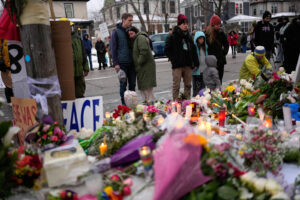
Interfaith Institute Executive Director Najeeba Syeed recently wrote an article on Religion News Service about how Minnesotans are caring for each other after the fatal shooting of Renee Good.


People gather around a makeshift memorial honoring Renee Good, near the site of the shooting in Minneapolis, Thursday, Jan. 8, 2026. (AP Photo/John Locher)


Interfaith Scholars Visit Brian Coyle Center

Our November 20th Interfaith Scholars class took place at the Brian Coyle Center in the Minneapolis Cedar-Riverside community where Augsburg is located. During their visit students:

  • Learned about community youth programs focused on sports, job readiness, tech education, and others that help neighborhood kids thrive from Auggie alum Coach Jennifer Weber  and  Abdirahman Mukhtar of Daryeel Youth Outreach.
  • Attended an interfaith dialogue between Trinity Lutheran church and Dar Ul Hijrah mosque members, led by Pastor Jane Bucklee Farley and Imam Sharif Mohamed .Table conversations focused on how faith communities can support bridgebuilding and interfaith cooperation on community based challenges and dire issues of our time including mental health support.
  • Reflected on what they learned with community leaders during dinner and connected with volunteer opportunities to serve our unhoused neighbors, work with youth, support food shelf projects and further Augsburg’s engagement in building a better world for all.

After the visit, Imam Sharif noted, “The interfaith exchange we experienced together reflects the very best of what community engagement and education can be—rooted in care, dignity, and mutual respect.”


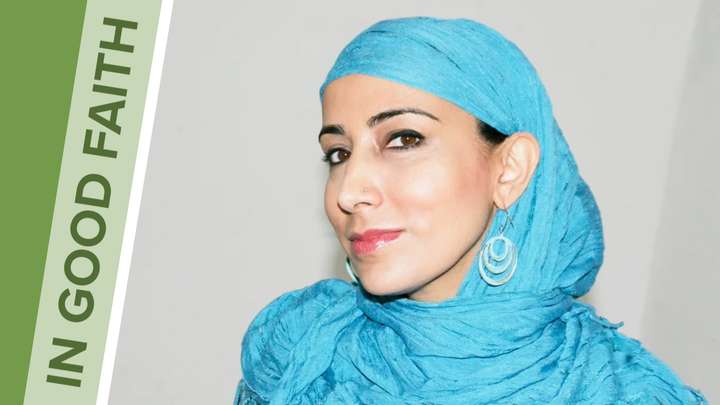
In Good Faith Podcast features Najeeba Syeed: Lived Religion & Peacebuilding


Ep. 311: Lived Religion & Peacebuilding | Najeeba Syeed


In Good Faith Podcast

EP 311: Lived Religion & Peacebuilding: Najeeba Syeed 29 min

Dr. Najeeba Syeed discusses how peacebuilding and lived religion unify us and how they’re crucial to a democratic society. Najeeba Syeed is the inaugural El-Hibri endowed chair and executive director of Interfaith at Augsburg University in Minneapolis MN. She co-edited the book “Critical Approaches to Interreligious Education,” and she’s been feature in the Los Angeles Times, or NPR, PBS, and other television shows, and she lectures at major universities across the US.

Welcome to our 2024-25 Advancing Religious Pluralism Faculty Fellows


Please welcome our distinguished Augsburg University 2024-25

Interfaith Institute Advancing Religious Pluralism Faculty Fellows! 


Augsburg University 2024-25 Interfaith Institute Advancing Religious Pluralism Faculty Fellows


Margit Berman, Department of Clinical Psychology 

Kathleen Clark, Department of Nursing (Chair) 

Sarah Degner Riveros, Department of Languages and Cross-Cultural Studies

Daniel Hickox-Young, Department of Physics

Brooklyn Loxtercamp, Department of Nursing 

Sergio Madrid-Aranda, Department of Education

Vanessa Marr, Department of Social Work 

Kao Nou Moua, Department of Social Work 


We are so pleased to welcome this cohort from across academic disciplines , the cohort is led by El-Hibri Endowed Chair Najeeba Syeed and Matthew Maruggi, Chair of Religion and Philosophy Department. In addition to working on curricula in their own fields related to religious pluralism they will be supported for further training and travel of their own choice in religious pluralism. We look forward to their campus wide impact! 

Chaplaincy for Everyday Democracy

Written by: Najeeba Syeed, El-Hibri Endowed Chair and Executive Director, Interfaith Institute


I recently sat across a room of 500 students and faculty from around the country, gathered for the annual Interfaith America summit. My own student was in the audience. I have looked at thousands of students, across hundreds of rooms in the last 15 years of my career as a professor.

I have also had the honor of serving as a staffer to an elected official, and have mediated dozens of conflicts in many contexts. Imbued in all of these spaces, and in the most recent times, I have begun to understand how much we must think about democracy with an everyday lens. How do people express their opinions on policy, how do they organize to have their voices heard, and why is decision making often left to those who have formal power?

Where have the voices of everyday people gone? Maybe it is time to think about a model of:

Everyday democracy, coupled with the skills of care, and built on an ethic of hope.

What does it mean to be a chaplain for everyday democracy?


Listening, Humble Listening
One of the students in my interfaith scholars class last semester, Vernis Campbell, talked about learning to listen in her own words: humble listening. To set aside the ego and hear the pain of another. She captured a foundation of engagement that is often missed.

When we try to build spaces for exercising civic engagement, we should also pay attention to the barriers that people face. Some are resource driven, and some are trauma induced. Engagement in systems takes vulnerability. We open ourselves and communities to the gaze and eyes of power that may be connected not just to decisions we disagree with, but decisions that hurt us or our communities.

A chaplain for democracy listens, does not bully someone into engagement. They are curious, they walk with the person, they hear the pain and it becomes a part of the process of how one relates to everyday democracy. Humble listening, if practiced by more with access to power, does not dismiss the connection between people and policies. It opens the door to understanding how past policies injured others and also to building new ones that are inclusive, durable, effective and efficient.

I often ask people in conflict, “Who is human?”

We must open our own hearts to understand how we dehumanize others and how we are dehumanized. Policies built on dehumanization are the enemy to democracies. Let us learn to listen in a manner that humanizes everyone and builds societies predicated on common humanity. We may never reach common ground, but let us start with common humanity.


Multiply Power, not Subtract
We live in a time and space where the notion of power is a zero sum game. How can we spiritualize this discourse on power? Engage with people in ways that multiply a notion of power that is co-created?

Interdependence as the core of a chaplaincy for democracy is built on getting to our underlying interests and not just positions. We build processes and convenings not just focused on expressing the transactional, extractive modality of building power but also the collective care that people and communities seek. We build connections between communities across differences who are able to hear, see, feel and hold the other for a moment. It is often called ‘perspective-taking’, understanding a situation from the point of view of another.

I am hopeful that we can build an approach to dialogic engagement that is beyond the accumulation of power for one group, one community, and one candidate, and begin to think about chaplaincy as a model for power. An open ended conversation that seeks to empower everyone, a non judgmental open stance in the posture of the convenor and facilitator. A coaching of leaders to understand that values can be shared, but that it takes vulnerability to trust one another over time. Trusting another is not a weakness, but actually a mutual strength.


Beyond the polls
Understandably, we focus on the ballot box as the generator for democracy. It is often the case that once someone is elected the fervor for them dies down. From campaigning to governance, one loses that connection to communities and individuals slow down in their engagement with democratic processes.

One of the roles we envision for higher education is a center for exercising democratic processes and principles. How do we build institutional capacity for diverging viewpoints and long term disagreements? I’ve been very curious to see that many institutions who have an affiliation with religious communities or bodies have been spaces for conversations on ethics and values in the past year. Perhaps our chaplaincy of care and commitment to mutual flourishing means the university becomes a space to protect all students. When values related to the big questions in life are embedded in how an institution runs, in how teachers educate, in how administrators make decisions, the bottom line is a human line. Are we building curricula that ask these moral and ethical questions in ways that are inclusive of students with different religious, spiritual and non religious commitments? A concern for the humanity of our students as the guiding principle.

As we begin to think about the day after the next election, perhaps we spend less time gloating for whatever side wins, and begin to think more about how we create communities of care, resilience and everyday democracy, together.

I often ask parties in conflict, “are you in each other’s future?” When we are in conflict, it is the painful present and past we are most focused on and the future eludes us.

I am in this for the long game, a future that includes you and me. Between elections, let’s listen, build, disagree, and co-create. Many spiritual traditions draw on the notion of making decisions with the next generations at the table. Engage with your body, your community and the many who will come next, as if they are all on the line. Sometimes the way through is to open your line of vision to a future you cannot see yet; find uncommon allies and use hope as your fuel to get there.

Our futures depend on it.