bing pixel

In Defense of Awkward Spaces

Prof. Najeeba Syeed has written a reflection “In Defense of Awkward Spaces”:

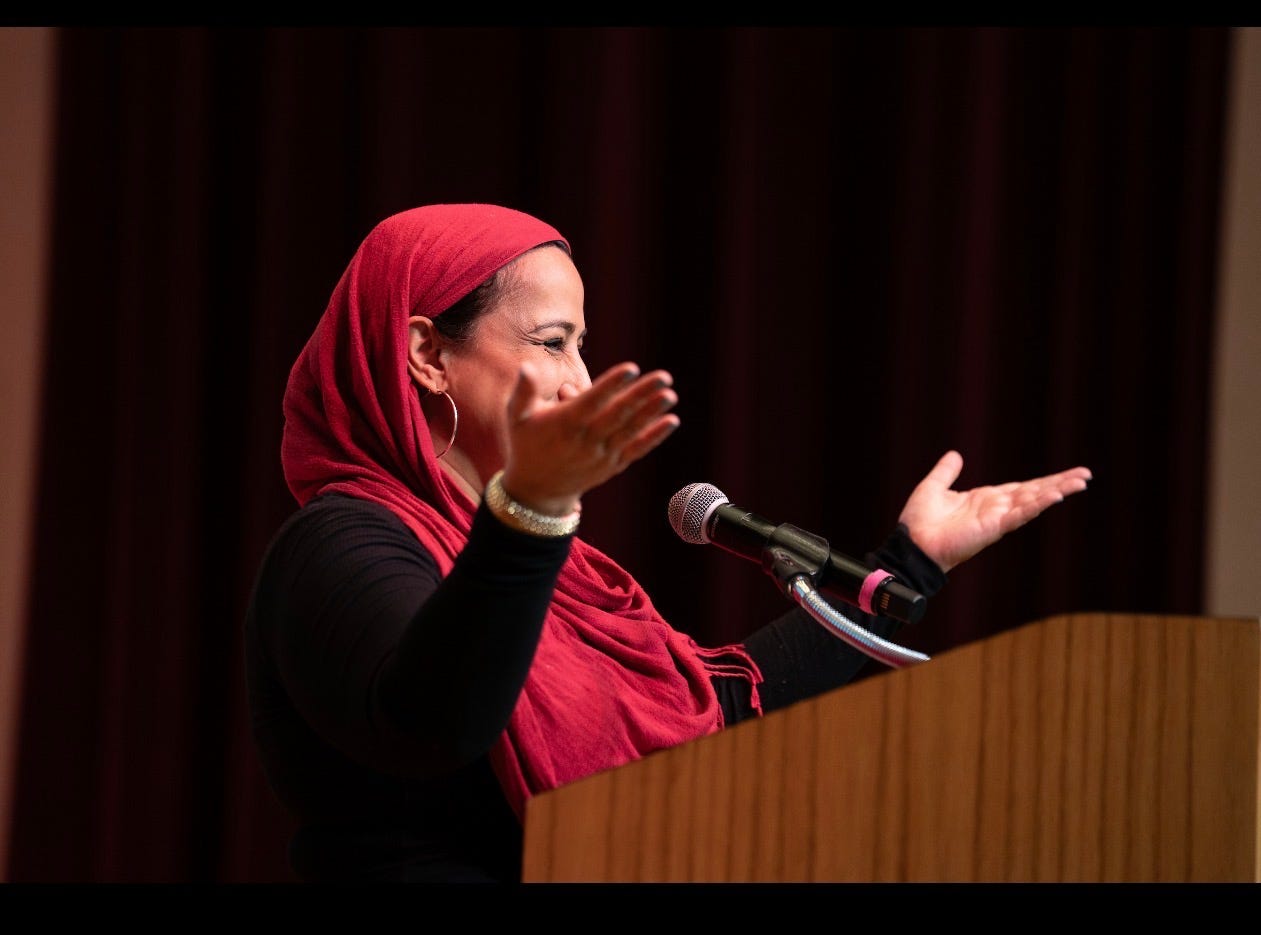
Najeeba Syeed, wearing a red hijab and hoop earrings, smiles at a microphone and gestures to the audience

I am back home after another set of travels, a summer of teaching and learning and growing in the work of Peacebuilding.
I’ve written before about safe spaces and brave spaces and now I am writing in defense of awkward spaces.

The spark that ignites understanding, before the magic of humanizing one for another comes through the space that feels hard, feels unnavigable, it pulls on our imagination.

I spent much of my summer as a steward of awkward space. Teaching mediators, leaders, students, university administrators, community organizers and others to *hold* that space.

The flourishing silences, the unpredictable exchanges, the fumbling moments, the times when we pray our tongue is untied for others to understand us (that is a prayer of Musa (Moses) that I shared this summer with others from the Muslim tradition.

Leadership needs us to to be vulnerable and awkward. Maybe we need to hold our selves as examples of works in progress not just paragons of perfection, and to hold others when they fall apart, maybe just a little maybe sometimes a lot.

I am here for your awkwardness I embrace it and you. I hope you will do the same for me.

Together I believe it’s the only way we will all flourish.

It can be helpful to model awkwardness as a facilitator. I know this is counter intuitive when you want to seem the expert, I’ve learned people respond much more to authenticity. Share a story of what didn’t work in the past, be honest about a time you were nervous about a conversation.

Facilitators who’ve had to navigate awkwardness together and came out of the tunnel as closer colleagues and friends are often a great team to lead these kinds of spaces.

And remember every space is awkward for someone in the room.

Maybe it’s time we all embrace, and even celebrate those awkward moments.


Podcast Interview

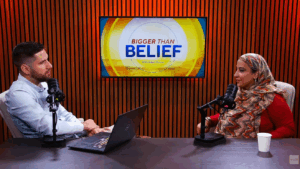
Adam Duxter and Najeeba Syeed smile, facing each other at a table with microphonesProf. Najeeba Syeed was interviewed on the podcast Bigger Than Belief with Adam Duxter, produced by WCCO, the local Minnesota CBS affiliate television station. The episode covers a range of topics: “Facing a Cancer Diagnosis: Najeeba Syeed on Faith Across Differences & Finding Peace in Uncertainty.”

As WCCO writes, Prof. Najeeba Syeed “challenges the idea that religious differences must divide us. Instead, she argues that authentic faith should expand our capacity to love our neighbors, engage conflict with courage, and build meaningful relationships with people who see the world differently. The conversation takes an unexpected and deeply personal turn when Najeeba reveals she is awaiting results from a biopsy and facing the possibility of a cancer diagnosis. In that vulnerable moment, she reflects on prayer, uncertainty, and the surprising people who have shown up for her—including friends and colleagues from different faith traditions. Her story becomes a powerful reminder that our deepest connections often emerge not from shared beliefs, but from shared humanity.”

Timestamps

  • 0:00 What Faith Does With Life’s Curveballs
  • 4:39 Meet Najeeba Syeed: Peacebuilder, Professor & Interfaith Leader
  • 6:38 From Kashmir to Indiana: Growing Up Muslim in the Heartland
  • 13:23 How to Stay Rooted in Your Faith While Building Bridges Across Religions
  • 25:24 “I’m Awaiting a Cancer Diagnosis” — Who Shows Up in a Crisis of Faith?
  • 36:06 Finding Common Humanity in a Divided World

Sahan Journal Spotlight

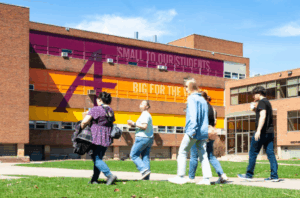
Students cross the quad at Augsburg University in the Cedar-Riverside neighborhood of Minneapolis
Students walk across campus
Credit: Aaron Nesheim | Sahan Journal

Interfaith Institute Executive Director Najeeba Syeed was featured in an Augsburg spotlight in the Sahan Journal.

Founded in August of 2019, the Sahan Journal is a nonprofit digital newsroom dedicated to reporting for immigrants and communities of color in Minnesota. Education reporter Becky Z. Dernbach provided a window into community care on campus: “Caught in the crosshairs: How Augsburg University mobilized to protect students during the ICE surge.”

Read more in the article ➜


Interfaith Symposium 2026

Healing the Earth, Healing Ourselves – Tending to the Soil We Share

By: Jerilyn Miller, Sr. Benefactor Relations Specialist

There was a moment during the Interfaith Symposium—Healing the Earth, Healing Ourselves—when the room grew still.
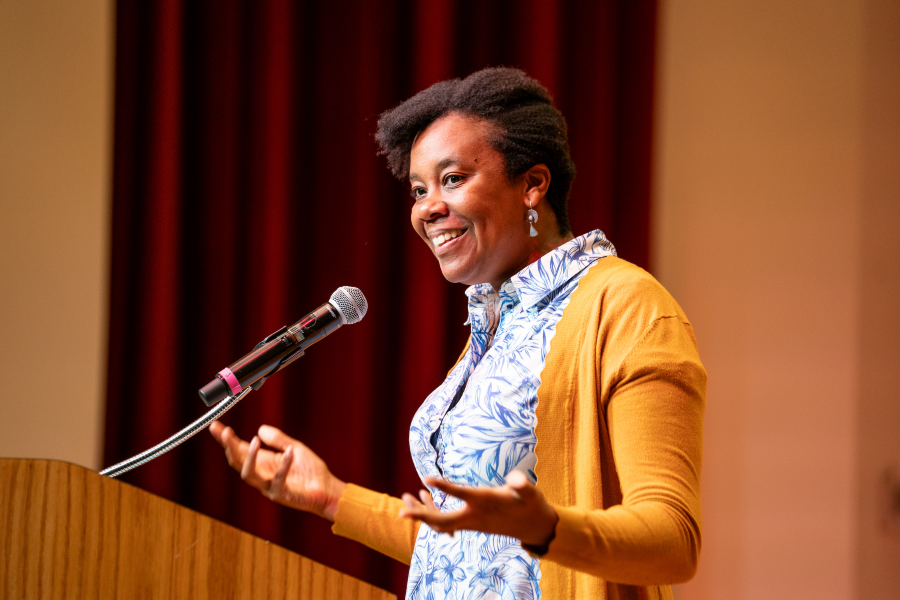
Rev. Jen Bailey is speaking and wearing bright yellowRev. Jen Bailey, the keynote speaker, began with a story. She spoke about her grandmother, who worked the sugarcane fields of the American South in the 1930s and 40s, in the shadow of Jim Crow. Despite the violence and inequity around her, she cultivated dignity, community, and life from the land.

In that story was something deeper—the connection between soil and survival, between land and liberation.

Bailey named what many are already feeling. We are living, she said, in a time of “toxic soil.” Not only environmentally, but relationally and spiritually. The fractures we see—climate crisis, political division, loneliness, mistrust—are not isolated problems. They point to a deeper disconnection: from one another, from the earth, and from our shared humanity.
“This is not just a political crisis,” she said. “It is a relational crisis… a spiritual crisis.”

And yet, she did not leave the room in despair.

Instead, she offered another image: sunflowers.

Drawing on the concept of phytoremediation—plants that draw toxins out of the soil—Bailey described the slow, patient work of healing. Even damaged soil can be restored. Not quickly. Not easily. But through sustained care.

Healing, in this vision, is not a grand solution. It is a practice.

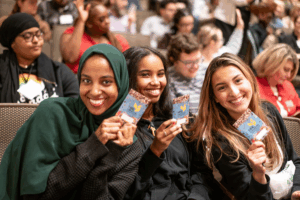
With native flower seed packets in hand, participants turned to one another—sharing ideas, hopes, and the ways they are already tending their communities. For Augsburg senior Zuko Buechler ‘26 an urban studies major, the conversation felt both personal and practical.

“I’m learning a lot about practices with the land and healing,” Buechler said. “It’s making me think about how I can plant these seeds at my grandmother’s [home] and share in her love of gardening —a connection that has shaped me.”

Bailey closed with a simple invitation: a daily discipline of choosing to plant something life-giving, even when there is no guarantee of what will grow.

Over lunch, the conversation continued—grounded in honesty about life experiences and resilience. Bex Klafter of Lutheran Social Services reflected on what stayed with her most:

“All land is good,” she said. “There is value—even when the soil needs to be amended.”

It is a simple idea, but one that shifts the frame. Healing does not begin with perfection. It begins with what is already here.

At Augsburg, that kind of work takes shape in real time—in conversations like these, in shared practices, and in a community willing to stay with what is difficult and choosing to tend to what is possible.

Marty Center

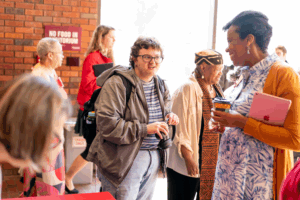
We’re delighted that Augsburg University President Paul Pribbenow utilized our Executive Director, Prof. Najeeba Syeed’s writing on a lived theology of neighborliness in his recent piece for the Martin Marty Center at University of Chicago Divinity School.

If there is a blessing to be wrestled from the wreckage of Operation Metro Surge, it’s that our students have received an indelible education in what my colleague Najeeba Syeed calls a “lived theology of neighborliness,” one that is likely to shape their lives forever.

Read his full piece here:
https://martycenter.org/sightings/who-is-my-neighbor-religion-and-the-metro-surge

Interfaith Cooperation in Minnesota

March 5, 2026 — Our Executive Director, Prof. Najeeba Syeed offered testimony on interfaith cooperation in the state of Minnesota in response to current crises. She addressed members of the ELCA Lutheran community along with Augsburg Univerisity alumna Kristen Opalinski. Kristen and Najeeba offered theological and practical ways to improve the conditions of communities in this moment. These contributions were grounded in ELCA and multifaith sources and practices. We love collaborating with Lutheran and interfaith partners, especially when they are Auggie alumni!


Zoom call with Najeeba & Kristen

Article: ICE Raids Reignite Rituals of Resistance in Minneapolis

Najeeba Syeed has been featured in an Interfaith America article by Rachel Crowe, “ICE Raids Reignite Rituals of Resistance in Minneapolis”:

While ICE’s presence in Minneapolis has propelled the city onto the national stage in recent weeks, Minnesotans have been “grappling with a changed reality on the ground for more than six weeks,” executive director of Interfaith at Augsburg University Najeeba Syeed says. “The reality is people are not okay; it’s not business as usual.”

Read More

a protestor holds up a guitar in a march protesting ICE actions in MN

Najeeba Syeed featured on Interfaith America podcast

Interfaith in America podcast with special guest Najeeb Syeed


Listen to Professor Najeeba Syeed’s conversation with Interfaith America’s Founder and President, Eboo Patel. Najeeba Syeed is the El-Hibri Endowed Chair and Executive Director of Augsburg University’s Interfaith Institute.

In their conversation, Najeeba and Eboo explore the ethics and future of interfaith work amid deep divides across religious communities. They focus on the impact of global wars and crises on religious communities and discuss the role of institutions in promoting interfaith understanding through open-mindedness and deep listening. Najeeba also details how she has engaged in “scared witness” during a period of heightened religious and political tensions.

T’isnt the Season

“T’isnt the Season: What I Learned from Not Having a Holiday Season”

A reflection from Dr. Syeed on being a Muslim in the United States during the Christian holiday season.

Read more ➜


Interfaith at Augsburg Welcomes Najeeba Syeed

Najeeba Syeed

Interfaith at Augsburg is pleased to welcome Najeeba Syeed as the inaugural El-Hibri endowed chair and executive director of Interfaith at Augsburg. In this role, she will serve as a national ambassador for the interfaith movement and will partner with campus leaders as a change agent for interreligious learning and living. She also will serve as the faculty advisor for Augsburg’s Interfaith Scholars.

“Professor Syeed is an experienced mediator, a publicly-engaged scholar, a passionate educator, and a seasoned organizational leader,” said Augsburg President Paul C. Pribbenow. “This appointment represents a crucial and exciting step forward in our commitment to enhancing interfaith leadership on campus and nationally.”

For more than two decades, Syeed has been a professor and expert practitioner in the fields of conflict resolution, mediation, and interfaith studies. An award-winning educator, she has taught extensively on interreligious education and published articles on faith and community-based conflict resolution, restorative justice, and interfaith just peacemaking. She previously served for 10 years as an associate professor at the Claremont School of Theology. She also held faculty positions at Starr King School for the Ministry and Chicago Theological Seminary, where she was most recently associate professor of Muslim and interreligious studies. She has served as the co-chair of the American Academy of Religion’s Religion and Politics Section and was a member of the Academy’s Religion, Social Conflict, and Peace Section.

Syeed also brings significant executive experience in organizations focused on conflict resolution in community, higher education, and government settings, including the Western Justice Center Foundation and the Asian Pacific American Dispute Resolution Center. In 2021, she served as chief of staff to Nithya Raman, the first Asian American woman elected to the Los Angeles city council. She holds a law degree from the Indiana University School of Law and a bachelor of science degree from Guilford College.

“I am honored to serve as the inaugural El-Hibri Chair and Executive Director of Interfaith at Augsburg. This is a unique opportunity to extend and amplify Augsburg’s remarkable interfaith work and to honor the generous and visionary commitment of the El-Hibri family, “ said Syeed.

“My life’s work combines a commitment to scholarship, teaching, and community organizing,” she added.  “Listen, learn, partner, and co-create is the process I utilize to lead and build with fellow faculty, administrators, students, community leaders, and stakeholders from around the globe.”

Interfaith engagement is a core aspect of Augsburg’s academic mission and reflects the religious and secular diversity of the campus and surrounding community. Interfaith at Augsburg: An Institute to Promote Interfaith Learning and Leadership was established in 2019 to further the belief that religious diversity can be a constructive force serving the common good. In 2021, a significant gift from Fuad and Nancy El-Hibri allowed for the creation of the El-Hibri endowed chair and executive directorship for the institute.

Syeed’s appointment helps to fulfill one of the goals of Augsburg150, the university’s sesquicentennial strategic plan, to advance the public purposes of an Augsburg education by enhancing interfaith leadership on campus and throughout the nation. Building on the strong foundation established by Bishop Mark S. Hanson, founding director, she will lead a strategic planning process that strengthens, integrates, and extends the Interfaith Institute’s work on campus and beyond.