bing pixel

Interfaith Symposium 2026

Healing the Earth, Healing Ourselves – Tending to the Soil We Share

By: Jerilyn Miller, Sr. Benefactor Relations Specialist

There was a moment during the Interfaith Symposium—Healing the Earth, Healing Ourselves—when the room grew still.
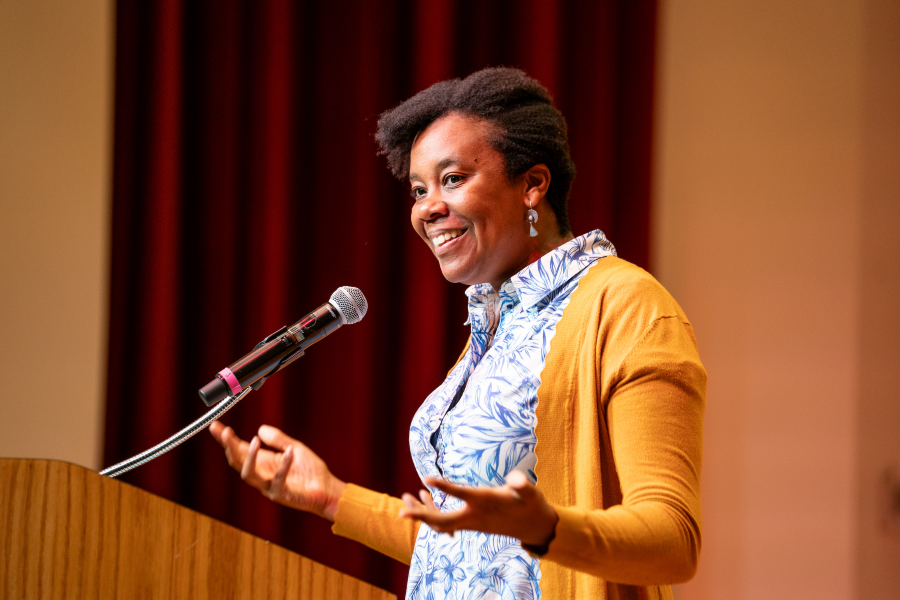
Rev. Jen Bailey is speaking and wearing bright yellowRev. Jen Bailey, the keynote speaker, began with a story. She spoke about her grandmother, who worked the sugarcane fields of the American South in the 1930s and 40s, in the shadow of Jim Crow. Despite the violence and inequity around her, she cultivated dignity, community, and life from the land.

In that story was something deeper—the connection between soil and survival, between land and liberation.

Bailey named what many are already feeling. We are living, she said, in a time of “toxic soil.” Not only environmentally, but relationally and spiritually. The fractures we see—climate crisis, political division, loneliness, mistrust—are not isolated problems. They point to a deeper disconnection: from one another, from the earth, and from our shared humanity.
“This is not just a political crisis,” she said. “It is a relational crisis… a spiritual crisis.”

And yet, she did not leave the room in despair.

Instead, she offered another image: sunflowers.

Drawing on the concept of phytoremediation—plants that draw toxins out of the soil—Bailey described the slow, patient work of healing. Even damaged soil can be restored. Not quickly. Not easily. But through sustained care.

Healing, in this vision, is not a grand solution. It is a practice.

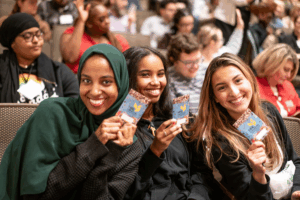
With native flower seed packets in hand, participants turned to one another—sharing ideas, hopes, and the ways they are already tending their communities. For Augsburg senior Zuko Buechler ‘26 an urban studies major, the conversation felt both personal and practical.

“I’m learning a lot about practices with the land and healing,” Buechler said. “It’s making me think about how I can plant these seeds at my grandmother’s [home] and share in her love of gardening —a connection that has shaped me.”

Bailey closed with a simple invitation: a daily discipline of choosing to plant something life-giving, even when there is no guarantee of what will grow.

Over lunch, the conversation continued—grounded in honesty about life experiences and resilience. Bex Klafter of Lutheran Social Services reflected on what stayed with her most:

“All land is good,” she said. “There is value—even when the soil needs to be amended.”

It is a simple idea, but one that shifts the frame. Healing does not begin with perfection. It begins with what is already here.

At Augsburg, that kind of work takes shape in real time—in conversations like these, in shared practices, and in a community willing to stay with what is difficult and choosing to tend to what is possible.

Marty Center

We’re delighted that Augsburg University President Paul Pribbenow utilized our Executive Director, Prof. Najeeba Syeed’s writing on a lived theology of neighborliness in his recent piece for the Martin Marty Center at University of Chicago Divinity School.

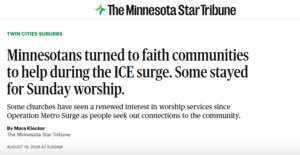
If there is a blessing to be wrestled from the wreckage of Operation Metro Surge, it’s that our students have received an indelible education in what my colleague Najeeba Syeed calls a “lived theology of neighborliness,” one that is likely to shape their lives forever.

Read his full piece here:
https://martycenter.org/sightings/who-is-my-neighbor-religion-and-the-metro-surge

Interfaith Cooperation in Minnesota

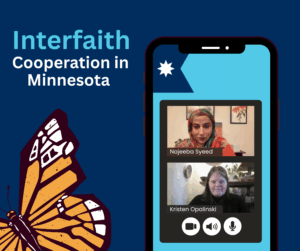
March 5, 2026 — Our Executive Director, Prof. Najeeba Syeed offered testimony on interfaith cooperation in the state of Minnesota in response to current crises. She addressed members of the ELCA Lutheran community along with Augsburg Univerisity alumna Kristen Opalinski. Kristen and Najeeba offered theological and practical ways to improve the conditions of communities in this moment. These contributions were grounded in ELCA and multifaith sources and practices. We love collaborating with Lutheran and interfaith partners, especially when they are Auggie alumni!


Zoom call with Najeeba & Kristen

Article: ICE Raids Reignite Rituals of Resistance in Minneapolis

Najeeba Syeed has been featured in an Interfaith America article by Rachel Crowe, “ICE Raids Reignite Rituals of Resistance in Minneapolis”:

While ICE’s presence in Minneapolis has propelled the city onto the national stage in recent weeks, Minnesotans have been “grappling with a changed reality on the ground for more than six weeks,” executive director of Interfaith at Augsburg University Najeeba Syeed says. “The reality is people are not okay; it’s not business as usual.”

Read More

a protestor holds up a guitar in a march protesting ICE actions in MN

Article: Neighborliness is a lived theology in Minnesota


Interfaith Institute Executive Director Najeeba Syeed recently wrote an article on Religion News Service about how Minnesotans are caring for each other after the fatal shooting of Renee Good.


People gather around a makeshift memorial honoring Renee Good, near the site of the shooting in Minneapolis, Thursday, Jan. 8, 2026. (AP Photo/John Locher)


Interfaith Scholars Visit Brian Coyle Center

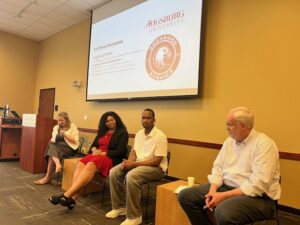
Our November 20th Interfaith Scholars class took place at the Brian Coyle Center in the Minneapolis Cedar-Riverside community where Augsburg is located. During their visit students:

  • Learned about community youth programs focused on sports, job readiness, tech education, and others that help neighborhood kids thrive from Auggie alum Coach Jennifer Weber  and  Abdirahman Mukhtar of Daryeel Youth Outreach.
  • Attended an interfaith dialogue between Trinity Lutheran church and Dar Ul Hijrah mosque members, led by Pastor Jane Bucklee Farley and Imam Sharif Mohamed .Table conversations focused on how faith communities can support bridgebuilding and interfaith cooperation on community based challenges and dire issues of our time including mental health support.
  • Reflected on what they learned with community leaders during dinner and connected with volunteer opportunities to serve our unhoused neighbors, work with youth, support food shelf projects and further Augsburg’s engagement in building a better world for all.

After the visit, Imam Sharif noted, “The interfaith exchange we experienced together reflects the very best of what community engagement and education can be—rooted in care, dignity, and mutual respect.”


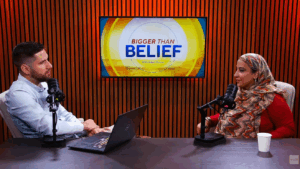
In Good Faith Podcast features Najeeba Syeed: Lived Religion & Peacebuilding


Ep. 311: Lived Religion & Peacebuilding | Najeeba Syeed


In Good Faith Podcast

EP 311: Lived Religion & Peacebuilding: Najeeba Syeed 29 min

Dr. Najeeba Syeed discusses how peacebuilding and lived religion unify us and how they’re crucial to a democratic society. Najeeba Syeed is the inaugural El-Hibri endowed chair and executive director of Interfaith at Augsburg University in Minneapolis MN. She co-edited the book “Critical Approaches to Interreligious Education,” and she’s been feature in the Los Angeles Times, or NPR, PBS, and other television shows, and she lectures at major universities across the US.

Welcome to our 2024-25 Advancing Religious Pluralism Faculty Fellows


Please welcome our distinguished Augsburg University 2024-25

Interfaith Institute Advancing Religious Pluralism Faculty Fellows! 


Augsburg University 2024-25 Interfaith Institute Advancing Religious Pluralism Faculty Fellows


Margit Berman, Department of Clinical Psychology 

Kathleen Clark, Department of Nursing (Chair) 

Sarah Degner Riveros, Department of Languages and Cross-Cultural Studies

Daniel Hickox-Young, Department of Physics

Brooklyn Loxtercamp, Department of Nursing 

Sergio Madrid-Aranda, Department of Education

Vanessa Marr, Department of Social Work 

Kao Nou Moua, Department of Social Work 


We are so pleased to welcome this cohort from across academic disciplines , the cohort is led by El-Hibri Endowed Chair Najeeba Syeed and Matthew Maruggi, Chair of Religion and Philosophy Department. In addition to working on curricula in their own fields related to religious pluralism they will be supported for further training and travel of their own choice in religious pluralism. We look forward to their campus wide impact!