Every year at Commencement, one graduating senior receives the Marina Christensen Justice Award for demonstrated dedication to community and working in solidarity with under resourced communities. This award recognizes work that is in keeping with the personal and professional life of Marina Christensen Justice.
Nominations are submitted in the spring with nominations for other Augsburg Leadership Awards, and are judged on the following criteria:
The depth and breadth of community involvement
A strong commitment to addressing the systemic roots of the issues
A personal and professional commitment to work with under resourced communities
Bold and courageous leadership
Authentic and sustained engagement with community and issues.
Each year Minnesota Campus Compact presents awards at their annual statewide summit. At this year’s summit, an Augsburg student, staff member, and community partner were recognized for their leadership and collaborative work. The 2018 award recipients were:
Student Leadership Award: Janet Nguyen
As the student food shelf coordinator this year, Janet built a base of committed volunteers, increased participation and donations, and even navigated a successful recovery from a small fire. Janet brought a bold, equity-focused lens to the food shelf by diversifying offerings and working to destigmatize food insecurity.
Civic Engagement Steward Award: Jane Becker
Jane Becker, Augsburg’s Head Volleyball Coach, organizes more than 500 athletes and their coaches each year to engage with youth in the Cedar Riverside neighborhood and beyond. She has created new summer sports clinics, an on-campus homework help program, and an alternative spring break program for young people.
Community Partner Award: Cedar Riverside Community School
Cedar Riverside Community School is the only school in the Cedar Riverside constantly adapts to best serve the educational needs of an ever-changing population. School leaders and teaching staff are committed to deep, reciprocal partnership with Augsburg, so that CRCS and Augsburg students are prepared successful futures.
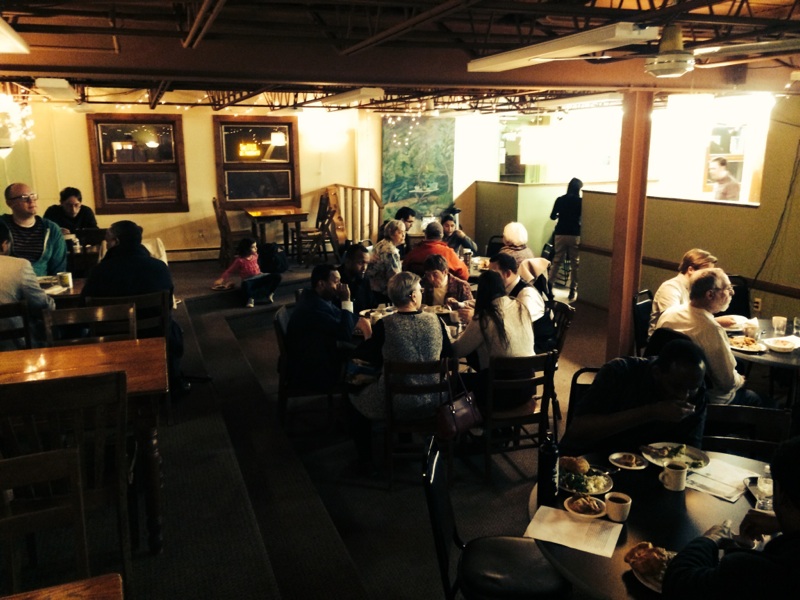
Attendees at an Interfaith at Cedar Commons event share a meal and conversation.
Twice a month, students and community members gather in the Cedar Commons space adjacent to Augsburg’s campus, intentionally coming together to build relationships across faith and non-faith traditions and learn from each other’s experiences, stories, and convictions. Coordinated through the Sabo Center for Democracy & Citizenship, Interfaith at Cedar Commons is one of many initiatives based at the Sabo Center that connect the Augsburg campus and the wider community. Gathering around a topic and often a meal, participants discuss subjects ranging from Islamophobia to religious holidays, human rights, political activism, and creation stories. The inter-generational group involves faith communities from the Augsburg campus and the Cedar-Riverside neighborhood, and integrates the Interfaith Scholars program, cultivating student and community-based leadership.
Shoshana Freund and Bethany Keyl are two Augsburg students who have been involved with Interfaith at Cedar Commons as current or past interns with the core team of students and community members that plans the gatherings. They described the interfaith events as open, welcoming spaces where topics and faith and non-faith perspectives are understood to be complex. For Shoshana, an atheist, the complexity of these discussions were refreshing. Speaking from her experience on the planning team, Shoshana described how the topics chosen for the events are designed to help people from all paths–including those who do not practice a religion–to find common ground through storytelling and experience sharing. Often this leads to new, profound understandings of people and communities who might otherwise have remained “Other.” Interfaith is an opportunity for students and others to see that “people of other belief systems are not antagonists,” Shoshana said. “Their beliefs don’t exist to contradict yours.” Bethany noted that the gatherings are an opportunity to find “common ground” and to “foster understanding” through the experiences and stories of people who come from different traditions.
Beyond story-sharing and relationship-building, Interfaith at Cedar Commons is also focused on building skills for inter-faith organizing. Activities such as power-mapping, one-to-one trainings, and other aspects of community organizing have been regular additions to the 2016-17 school year interfaith meetings. These skill-based sessions, along with the practice of having nuanced and complex conversations about meaning, core commitments, and the role of different faith traditions in the world with community members from campus and beyond, makes Interfaith at Cedar Commons a program that embodies the Sabo Center’s commitment to “create a culture of civic agency and engagement among students, faculty, staff, and our broader community so that graduates are architects of change and pioneers in work of public significance.”
After twenty years of democratic education and practice, the Jane Addams School for Democracy met for the last time earlier this month. From the beginning, its founders sought to free and cultivate the talents, cultures, and interests of people from diverse backgrounds and traditions and engage in a minimally structured, non-hierarchical way that allows participants to shape the agenda. The Jane Addams School for Democracy brought immigrant families, college students and other community members together to do public work and learning. It was inspired by the vision of democracy, productive citizenship, and popular education held by settlement house pioneers like Jane Addams, who created Hull House in Chicago in 1889.
As we consider the current state of our democracy, the principles and practices of Jane Addams School are a much needed antidote to the polarization and division that colors public discourse. We have faith that the lessons of Jane Addams School can continue to support a more just and democratic world. In 2007, the Kettering Foundation published a book called Voices of Hope: The Story of the Jane Addams School for Democracy which features 22 essays by 12 Jane Addams School participants, including non-native English speakers, and more than 75 photos.