bing pixel

Building a Hate-Free Minnesota 

This was such a busy #Interfaith summer Augsburg University, at the Interfaith Institute. A peek at some of our work!

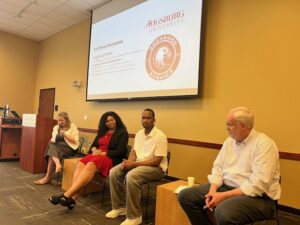
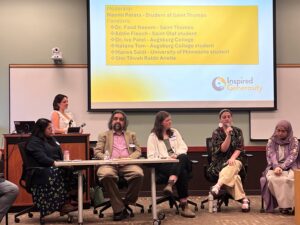
In July, we co-hosted Interfaith Institute Augsburg University, a statewide summit on hate crimes prevention with our state wide partner Minnesota Multifaith Network and our national partner Shoulder to Shoulder. We were delighted that over 50 faith, community, philanthropy, academic, and government leaders joined us. The First Lady of Minnesota Gwen Waltz opened the summit (you can see from the pics she stayed and listened to the discussion), followed by Dr. Anantanand Rambachan who set the tone, we heard from Rev Jim Bear Jacobs who invoked storytelling and reminded us interfaith spaces need a deep understanding of Native communities and histories. We were blessed to have Rev Cassandra Lawrence of Shoulder to Shoulder lead us through a mapping exercise and asset analysis of hate prevention resources. 

Our director Najeeba Syeed led the group through a discussion of action steps and we were blessed to hear from Dr. Jen Kilps of  Minnesota Multi-Faith Network who shared the history of recent hate crimes activities.

Out of this convening on our campus grew a renewal of ties for Augsburg to Islamic Resource Group. Imam Tamim Saidi, who gave a closing blessing, is now joining us in Augsburg classes to help increase our students’ literacy on Islam. Rabbi Adam Spilker will be enriching our students’ understanding of Judaism in our classes. 

We are so thankful for all who joined us and for the new friends and allies that were made. 

Our director wrote about the rural implications for rural Minnesota here based on her own research as well:  https://www.augsburg.edu/interfaith/2023/07/24/reflections-on-statewide-summit-on-hate-prevention/

Our director Professor Syeed will be presenting on the issue of rural interfaith work with Dr. Jen Kilps next week for a statewide network of rural Minnesota communities. There is a hunger for this type of research across the nation. 

We are excited to be enriching our classrooms with the resources we’ve discovered and will continue to build these partnerships!


Muslim Women and Interfaith Spaces: Pluralism as a Daily Practice

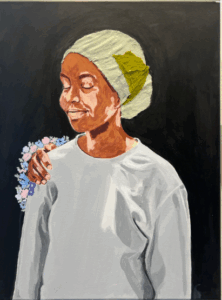
Line drawing of a woman wearing a hijab.Last week I attended Interfaith America’s Leadership Summit. One of the elements that struck me as I walked into the hall of hundreds of undergraduate students was the number of Muslim women who were in attendance, and I had the pleasure of speaking with them throughout the weekend. 

Embodied religious pluralism 

My own story in interfaith engagement started at 18 when I left for college in 1991. I was the only Muslim woman in my incoming class at my Quaker college and my story made it into the annals of American history, told by Diana Ek in her book, “A New Religious America.” She describes how my classmates fasted with me for my first Ramadan away from my family. Later on in 2000, I was the first Muslim professor hired by a particular Methodist  seminary, and now I am the first Muslim woman who was granted tenure and full professorship at another university, Lutheran in origin. My life has been one of firsts entering into spaces, what I have called in my writing elsewhere being “an embodied interruption.” 

I’ve written about what it means to be the first encounter with Islam many Christian students had, my body the first text they read of my tradition. I continued this trend of being one of a few,  later in a secular government space as an executive, the only Muslim woman who held a position of that particular rank. So it was a beautiful thing to see so many young Muslim women at this interfaith conference last week, so much changed since my own college years! And I am thankful to many Muslim women who broke barriers before I did, across the country so that I could occupy the spaces I have in my own life. 

Muslim women like myself are walking fonts of experience and expertise, in the very lived sense of that word of pluralism. I often talk about it as “embodied religious pluralism,” linked very much to Muslim women and our experiences of constantly being in spaces of difference. What is often seen as irreconcilable by others is inherently contained in our own bodies, and we learn how to create the capacity to exist with others, internally coalesce these identities and make them functional as whole. 

This type of experiential learning is powerful, we can all benefit from hearing the stories of how different Muslim women embody the very real challenges of religious identity and practice with complex social, political and educational contexts. It is not a one size fits all type of pluralism, nor is it dogmatic. It is pragmatic, lived out everyday and material in a very real sense. It is pluralism as a daily practice.

Storytelling and hearing more from a variety of Muslim women helps us see how pluralisms can be nuanced, deeply embedded in context, and how communities can learn from each other.

Interfaith leadership opportunities 

For many women, interfaith spaces are vital for their leadership and development. If one comes from a tradition without formal clergy, or where women are not ordained as clergy, then interfaith spaces allow for informal leadership opportunities that strengthen capacities to lead communities, collaborate across faith communities and solve dire problems of our time. 

Interfaith spaces can encourage women to lead and learn across religious lines. One of my favorite scholarly dialogues was between Orthodox Jewish women and Muslim women over a decade ago. We discussed topics ranging from our texts but also from our experiences figuring out how to be both within our own communities, preserve religious identities with the challenges of modernity and how scholarship on mutual concerns could benefit both our communities. 

In the context of higher education, it was a beautiful thing to see institutions play a hospitable role to Muslim women. I spoke with one young Muslim woman at the Interfaith America conference who went to a Catholic university and felt so supported by the institution and went on to lead on her campus. She is now on the road to being an interfaith professional, and I was really touched by the fact that this interfaith experience of being at a Catholic university strengthened her commitment to her own faith, and also her deep desire to continue to do interfaith service work to benefit all communities. 

Sometimes the issues may be specific to one’s perspective as a woman, and it is also powerful when in fact the concern is more universal. All of these young women at this conference were exercising their skills as interfaith leaders, and they just happened to be women. This excites me greatly because it means that they feel safe, are thriving and participating in building both their own communities and a joint reality that is kinder for all. 

Thankful to see how we move towards more just, equitable and inclusive futures and so  happy to see this happen in my own lifetime! 

Najeeba Syeed

El-Hibri Endowed Chair and Executive Director of Interfaith Institute


Reflections on Statewide Summit on Hate Prevention

Map of Minnesota with organizations throughout the stateMulti-Faith Relations in Rural Settings

This past week the Interfaith Institute collaborated with the Minnesota Multi-Faith Network and Shoulder to Shoulder campaign to organize and host a statewide summit on hate prevention and I wanted to share a few reflections based on my years of engagement on multi-faith relations around the country. We will continue to offer our learnings as we do our work, this is just a taste of what we have been thinking about at the Institute this week. 

Centering the National Discourse 

I’ve written about “casserole” hospitality, an ethic of care demonstrated in the Heartland of the country found in communities of various traditions who welcome new members into their midst. It may be in church, the casserole may be an Eid baklava dish offered by a Muslim neighbor to a new friend. It may have many iterations depending on the cultural context and religious practice of a community. What I mean to emphasize is that regions of the country have their own unique modalities and methods of welcoming, and opening doors. The center of this country has many rich examples to draw upon. 

Small towns and sparsely populated regions of the country can be and are home to some of the most innovative multi-faith programs and organic sets of relationships. Smaller communities  create interdependence of resources of all types. Very often, when I am at the national tables I am invited to, the norm that is being discussed is an assumption of a diversity of communities that are present in large urban settings. 

I’ve been struck by the relationships that exist between religious communities of vast difference in what is often called fly-over country. My experience has been that these are not regions to fly over, but to learn from. 

When I first came to the US, in the 1970s my father landed in Bloomington, Indiana for his doctorate program. In those years, as immigrants we had little to no access to zabiha markets where we could find meat that was permissible to eat. My father heard that my school bus driver, Mrs. Anderson, had a farm and he proceeded to speak to her about going  out to her farm and we found her open to our form of Muslim ritual slaughter of animals on her farm.  

It is a small example, let me share another from the same region I learned about when I went to a Quaker college. The headquarters of the Islamic Society of America was in Plainfield, Indiana. The campus minister at my college in North Carolina recalled how his extended family in Indiana would reach out to support Muslims when the sign for the organization had been shot at in the 80s. These are a few of the many stories of the central part of this country in which solidarity and just  pure necessity created deep and lasting multi-faith relations. What I mean to say is this is not new. 

Scholars like Edward Curtis have documented the multi-racial, multi-religious histories of communities in Indiana and beyond. We can celebrate the work of recent organizations and efforts, while recognizing it is often built on the contributions of many communities and leaders who preceded us and that multi-faith relations are not new to this region and date back even  hundreds of years. A national picture of interfaith should and must include these examples. 

Diversity and its Multi Dimensional  Presence 

If you look at the map above, we find that there are groups of people doing multi-faith work across the state of Minnesota. It may not always be by faith based actors or congregations who lead these efforts. In one conversation I had at the summit last week, I was struck by how community development organizations are harnessing opportunities to do multi-faith engagement  without utilizing the terminology or traditional venues often associated with interfaith work. 

Civic engagement opportunities for religious pluralism are and can be created by non faith actors. Universities like ours, local and municipal government, Rotary clubs and other types of service organizations can be sites for conversations on religious literacy and education about local interfaith histories. I love the example of the Abdel Kader project (https://abdelkaderproject.org/) which among other things has used the fact that Iowa has a city named Elkader after a major Muslim historical figure  to develop materials on religious pluralism and practices. The very name of a city has inspired a deep connection of a small town in Iowa with a global view and vision for interfaith peace and solidarity. 

In our summit last week we discussed the idea of invisible diversity. When one walks into a room, religious diversity may not be apparent if one judges it by their own experiences and standards. We live in a moment when many Americans also join new communities besides their religious communities of origin through conversion, marriage or other means. You cannot assume the  religious identity of someone based on  how they present to you in person without learning more about someone’s stories. 

I also noted that in many communities there are  religious identities that span a wide spectrum of different communities beyond the Abrahamic. Shamanism, Buddhism, Hinduism all find homes in rural and small towns across the state in addition to the Abrahamic religions. It important to recognize the complex definition of religion and the presence of a wide array of religions and spiritual practices across the Heartland. 

Many faith communities may not have the symmetry of a congregational home or bricks and mortar space that some of us are used to. For example, in some communities which are newer or in a minority status, religious instruction may happen in someone’s home, not in a large building downtown.  People may congregate at a coffee house that serves the local community and engage in spiritual formation. 

We cannot assume our city or town is not diverse just because communities may not look like what is viewed as a common calculus of a religious entity. It takes work to know one another, time, patience and understanding that religion and spirituality look different and we can learn so much just by listening and hearing how people construct their own communities before assuming they will look like our own. 

We will continue to share more about what we are learning from our work across the state and we are so honored to have you join us on this journey!

Najeeba Syeed, El-Hibri Endowed Chair and Executive Director

Dr. Thea Gomelauri joining Interfaith Institute as a Senior Fellow

Thea GomelauriThe Augsburg University Interfaith Institute is delighted to announce that Dr. Thea Gomelauri will be joining the Institute as a Senior Fellow. The fellowship is a key anchor in the partnership between Oxford Interfaith Forum  and the Institute. Our Executive  Director, Najeeba Syeed has also been appointed to a senior fellowship at the Oxford Interfaith  Forum. We look forward to a joint collaboration across the globe on issues of peace, justice, intercultural and interfaith education and furthering interreligious learning. 

Dr Thea Gomelauri is a Member of the Faculty of Asian and Middle Eastern Studies at the University of Oxford, and Director of the Oxford Interfaith Forum. She has a vast experience in research, teaching, and consultancy in different international, and intercultural contexts. Thea held Academic Fellowships with the Central European University, Open Society Institute, World Bank Institute, and the University of Oxford. She is a recipient of multiple research and teaching grants, including HM King Abdullah II of Jordan World Interfaith Harmony Award for Religious Education, Curriculum Development Grant at Interfaith Youth Core, USA,  Robert S. McNamara Research Fellowship at the World Bank Institute in Washington DC, USA, International OSI Policy Fellowship at the Open Society Institute in Budapest, Hungary, Curriculum Development Fellowship at Central European University in Budapest, Hungary, and European Commission Tempus Program in Berlin, Germany. At different times, she worked on research and consultancy assignments with the EBRD, UNDP, and UNHCR in troubled and war-torn regions of the world.

Thea is a member of the Jewish-Muslim Research Network, the Bible and Religions of the Ancient Near East Collective, and the British and Irish Association of Jewish Studies. She has presented papers at the International Conference of Patristic Studies, and the Ian Ramsey Centre for Science and Religion at the University of Oxford, and the British and Irish Association of Jewish Studies. Her research interests include: Comparative Religious Studies; Biblical Exegesis; Reception History of the Bible; Manuscripts and Material Culture. She has contributed chapters on David’s Children in Art in the Oxford Handbook on King David (OUP, 2024), Reimagining Abishag: Retelling her Story in the Routledge Handbook of the Hebrew Bible in contemporary Fiction and Poetry (Routledge, 2024), and Paul of Thebes in Georgian Manuscript and Ecclesiastical Culture in The Lives of St Paul the First Hermit (Brill, 2024). Currently, she is working on The Lailashi Codex: The Crown of the Georgian Jewry.

For more information and a publication list, please, visit: https://www.oxfordinterfaithforum.org/dr-thea-gomelauri/

As another academic year comes to a successful close our work continues to grow.

Here is a letter from Executive Director and El-Hibri Chair, Najeeba, highlighting the Institute’s ongoing commitment to Interfaith at Augsburg.

Dear Friends of the Interfaith Institute, We are excited to be in touch with you as we close out our academic year in 2023! It has been a very full year. We have built collaborations with campus partners, offered programming that has touched the lives of Augsburg students, and helped our faculty and staff respond effectively to concerns related to religious diversity. We have been at the table to help convene solutions to concerns on the opioid crisis, participated in national gatherings on how spirituality can heal our nation and helped to spread the model of interfaith engagement we are building at Augsburg. We have a full year of programming planned for next year! We’re happy to share with you what we have been doing for the past two months. Please enjoy our latest updates!

Goodbye to our 2023 Interfaith Scholars!

2023 Interfaith Scholars

Interfaith Scholars is a specialized course dedicated to teaching students about religious diversity, interfaith peace-building, and leadership skills. The course concludes with the Sending to celebrate Augsburg’s commitment to shaping interfaith leaders and the accomplishments of graduating Interfaith Scholars.

This year’s Interfaith Sending was a success. The evening featured a world map that marked the many places across the globe connected to Augsburg’s community and readings selected by students from Buddhist, Christian, Muslim, and Secular traditions. Link to readings. Next year we are excited to host the Interfaith Scholars course again. Executive Director and El-Hibri Chair, Najeeba Syeed, will be the instructor for the course. Select class sessions will be opened to the whole campus so students and staff can benefit from interfaith panels and programs connected to the course throughout the year.  We expect it will be a fantastic year of interfaith learning and growth!

Ceremony attendees light the world map with candles

A Campus Visit with Regent Karim El-Hibri ’06

Karim El-Hibri, Najeeba Syeed & President Pribbenow

We were honored to host Karim El-Hibri ’06, he met with Najeeba Syeed, El-Hibri Endowed Chair and executive director of the Institute. We are so grateful to Karim and his family for making our work possible on interfaith peacebuilding and healing on campus, in communities, and across our country.

Spiritual and Mental Health

Our interfaith scholars hosted a discussion on spirituality and mental health with fellow students and a local counselor. This semester we have been finding an increased interest in interfaith activities and mental health. The staff of the Center for Wellness and Counseling and the Interfaith Institute met this semester to plan programming for next year. We will be focusing on recovery and interfaith concerns and look forward to collaborating with Campus Ministries on addressing these topics as well.

Interfaith scholars hosting a discussion on Spirituality and Mental Health


On October 12, we will be hosting an event open to the public on Busshō Lahn’s new book on the intersection of spirituality and mental health, Singing and Dancing are the Voice of the Law: A Commentary on Hakuin’s “Song of Zazen.”

Singing and Dancing are the Voice of the Law: A Commentary on Hakuin's “Song of Zazen.”
Singing and Dancing are the Voice of the Law: A Commentary on Hakuin’s “Song of Zazen.”

Our executive director has authored an article on religiously competent models of community-based intervention in recovery. This publication will be available for healthcare practitioners as a resource. Najeeba is working with the Institute Coordinating Committee members, nursing faculty Katie Clark, and social work faculty Ankita Deka on research related to opioid use and intervention in Muslim communities. This groundbreaking research led by Dr. Deka is some of the first that has been published on this topic.

Community Health and Healing Dialogue

Event Presenters: Multi-Faith Workshop banner featuring presenters, Michael Le Buhn Jr., Najeeba Syeed, Simran Jeet Singh, Jen Kilps, and Jane Ulring

We are pleased to announce that we have received a grant from Interfaith America that will expand our Interfaith Scholars programming to give students the opportunity to serve in the Healthcare Commons, a program led by Dr. Katie Clark. Our executive director will be teaching students in the Interfaith Scholars course, next year we have students from Muslim, Christian, Jewish, and other backgrounds who will be working on issues our unhoused neighbors face in the Twin Cities under the guidance of Dr. Clark and Professor Syeed.

On May 10, our executive director lectured on forgiveness and multifaith engagement for the Minnesota Multi-faith network.

National Engagement

We are excited to be poised to have a seat at the table at a number of new national initiatives addressing interfaith issues and collaborations.

Our executive director will be presenting two sessions at Interfaith America’s 2023 Interfaith Leadership Summit, the largest gathering of higher education professionals and students in the country in August. We look forward to sharing our Augsburg interfaith model with campuses around the nation!

See https://www.interfaithamerica.org/summit-2023/

Our executive director will be joining the Powering Pluralism Summitt 2023 held by the Aspen Institute in DC, she is a member of the Powering Pluralism network and was selected as a member of their cohort of interfaith leaders in 2020.

Link: https://www.aspeninstitute.org/programs/powering-pluralism-summit/

Our executive director will be joining colleagues from Notre Dame Law School and the Emory University School of Law, Center for the Study of Religion and Democracy to present on democracy and faith at the 2023 Parliament of World Religions, the largest interfaith conference on the globe, held in August.

Read more here about the program https://parliamentofreligions.org/

Celebrating Another Year of Interfaith at Augsburg


Every Spring Augsburg holds a ceremony called the Interfaith Sending to honor graduating Interfaith Scholars. 


Interfaith Scholars is a specialized course dedicated to teaching students about religious diversity, interfaith peacebuilding, and leadership skills. The course concludes with the Sending to celebrate Augsburg’s commitment to shaping interfaith leaders and the accomplishments of graduating Interfaith Scholars 

This year’s Interfaith Sending was a success. The evening featured a world map that marked the many places across the globe connected to Augsburg’s community and readings selected by students from Buddhist, Christian, Muslim and Secular traditions. ( Download Ceremony Readings)

Interfaith and Campus Ministry Team
Ceremony attendees light the world map with candles
Interfaith Scholars read sacred texts and wisdom passages from their traditions

It was a meaningful gathering; a reminder that we are each rooted in cultural and spiritual identities and that our identities are gifts to one another and the communities we participate in.

Thank you to this group of Interfaith Scholars and leaders who will go forth from Augsburg rooted in who they are to share their perspectives, convictions, and gifts with others and create a more caring world.

Congratulations to all the graduating Interfaith Scholars! 

Each senior was gifted a Blessing Blanket at the ceremony by Augsburg Campus Ministry
Graduating Interfaith Scholars with course instructors

Next year we are excited to host the Interfaith Scholars course again. Executive Director and El-Hibri Chair, Najeeba Syeed, will be the instructor for the course. Select class sessions will be opened to the whole campus so students and staff can benefit from interfaith panels and programs connected to the course throughout the year.  We expect it will be a fantastic year of interfaith learning and growth!

Celebrating Black History Month

It’s February: Black History Month.  In recognition of this month commemorating Black culture, identity, pride, and contributions to America, the Interfaith Institute will be featuring scholarship, writing, and art showcasing Black religious/spiritual/worldview diversity.

February 1st:

Teaching African American Religious Pluralism – Monica Coleman

Download the article


February 9th:

Meditations of the Heart – Howard Thurman

Howard Thurman (1899-1979), was a theologian and pioneer of the nonviolent civil rights movement of the 20th century. His vocation was inspired by the stories of the religious faith maintained and grown amongst the slaves in the United States. He was a Baptist pastor, but he found wisdom in Quaker mysticism from Rufus Jones and in the teachings of Gandhi. Thurman’s focus on interfaith was most influential when it came to unifying people of diverse backgrounds to fight for a common cause. He approached it in a behind-the-scenes way, inspiring others to use their gifts to pursue justice and celebrate marginalized identities. He was a mentor to civil rights leaders such as Martin Luther King, Jr., Pauli Murray,Vernon Jordan, James Farmer, Whitney Young, and Bayard Rustin.

Meditations of the Heart is a collection of fifty-four of Thurman’s most well-known meditations, featuring his thoughts on prayer, community, and the joys and rituals of life. Within its pages are words that sustain, elevate, and inspire. From “A Man Becomes His Dream” to “I Need Courage” to “The Season of Remembrance,” Thurman addresses life’s moments of trial and uncertainty and offers a message of hope and endurance for people of all faiths.


February 13th:

Check out these resources on the experiences and contributions of African American Muslims in history from Islamic Network Group. (Islamic Networks Group (ING) is a peace-building organization providing face-to-face education and engagement opportunities that foster understanding of Muslims and other misunderstood groups to promote harmony among all people.)


Enslaved African Muslims in the United States –  Sylviane Diouf

Play video


Experiences and Contributions of African American Muslims in History –  Imam Faheem Shuaibe

Play video


January Newsletter: Interfaith Spring Symposium and more…

Dear Friends of the Interfaith Institute,

I am so pleased to be starting off our new year with you! We are excited to bring programming to you that continues to co-create a more caring world, build community, and foster collaboration. Our theme for this year and much of our programming is “Interfaith Leadership and Healing in Times of Crises.” We believe that this year presents challenges for us all and also promises the ability to work together to solve issues we face.

Augsburg, deeply rooted in the Lutheran faith to serve and practice hospitality, continues to offer the world a beautiful example of how to build connections across diversity. It is in fact, our differences that animate our collective strength. Coming together in fellowship to learn about each other’s worldviews and traditions allows us to dull sources of fear, open threads of conversation, and build a relational ethic of care.

We are also planning programs on timely issues involving recovery and faith communities and leaders. Our Institute staff is working closely with campus partners to offer programming to faculty, staff, and students in various sessions across campus in 2023.

Campus-wide highlights include:

Interfaith Scholars course, January 19th, 2023.
  • Interfaith Lunch and Learns geared toward students, faculty, and staff learning about each other’s traditions (January – April).
  • Presenting to a retired group of Augsburg faculty and staff on Interfaith topics (January 11th).
  • Participating in Augsburg’s annual Leadership Institute, a campus-wide training day for Augsburg student leaders, by teaching a workshop on Interfaith Advocacy Skills (January 21st).
  • Focus Campus-wide Conversation topics of Interfaith (Feb 9th).
  • Interfaith Sending is student-led worship showcasing Interfaith Scholars coursework and leadership skills and celebrating Augsburg’s religious diversity (April 25th).
  • Collaboration with Augsburg’s Sabo Center, to host a dinner bringing neighborhood faith communities and Augsburg staff together for a meal. This will be a chance to deepen relationships with the broader Cedar-Riverside community, as well as an opportunity for neighbors of different faiths to learn more about each other.
  • Interfaith in the Workplace. We trained over 300 employees in one of the largest construction companies in the country on how to navigate religious diversity. We look forward to continuing to offer these highly impactful sessions with other workplace sites across the country.

Interfaith Scholars Course Topics for the spring: Sacred Texts, Interfaith Leadership, Interfaith Peacebuilding Skills, Faith and Intersectional Identities, Interfaith Activism, Interfaith on College Campuses, Interfaith Leadership in Non-religious settings (ongoing).


Upcoming 2023 Events

Najeeba speaks at Interfaith Fall Dinner, Dec 8, 2023.

I am delighted to share the Inaugural Interfaith Symposium – March 2, 11:00 am CT

We are so excited to announce our first Annual Interfaith Symposium. This signature event will be hosted each March. The goal is to bring the best minds and practitioners from around the globe to our campus. Najeeba Syed will be sharing a lecture on our 2023 theme, interfaith leadership, and healing in times of crisis.

We look forward to making this an annual tradition and hope you will be a part of it!


With warmest personal greetings in this new year,

Najeeba Syeed

El-Hibri Endowed Chair and Executive Director

Augsburg’s Interfaith Institute


Reflection on Winter Solstice

Gratitude for the Darkness

Reflection by Jane Ulring, Managing Director of the Interfaith Institute.

In November of my second year in seminary, my health began to gradually deteriorate. The doctors couldn’t decipher my symptoms, and I was left to muddle through three years of fear and discomfort. There’s one evening from the worst Winter of my illness that stands out in my memory. Searching for comfort, I attended a candlelight Advent vespers service. As worship concluded, the pastor prompted us to share what we were grateful for as we anticipated Christmas. My spirit was not in a space of gratitude that night. I was hurting and weary and didn’t want to give thanks. But as I sat there in the dim candlelight some thoughts flickered forth: I was grateful for the gentle, intimate privacy the darkness of vespers provided while I was so raw and unwell. And I was grateful the service was at 6:00 pm, before I was too tired to go out. And then I realized, for the first time in my life, I was grateful for winter’s early nightfall.

I kept pondering these small gratitudes long after worship finished. Growing up, I always found Winter’s short days to be a nuisance. But now, I began to wonder if there was a wisdom dwelling within Winter’s long nights, and if I had, until now, failed to understand Winter’s role in the balance of things. These thoughts returned the next day when, feeling worse than the previous day, I woke from a late afternoon nap relieved to see the sun was setting; inviting me to curl up and go back to sleep.

So, I began learning about seasons and creation, curious about what I had failed to understand about the natural world. I sought out eco-theologies that celebrated Earth’s gifts and learned more about local ecosystems and environmental movements. Two books, in particular, helped me grow: Earth-Honoring Faith by Larry Rasmussen and Braiding Sweetgrass by Robin Wall Kimmerer. These authors taught me the Earth is a complex sacred being, with wisdom to share if I learned the languages of trees, plants, waters, and seasons. This animated way of interacting with the world was different from the Christian example I grew up with. I was taught to think about nature as something passive I had dominion over, not a living being to learn from, grow with, and mutually care for.

I now relate to Winter as a sacred teacher of rest; her long nights hospitably offer me the gift of respite essential to life’s flourishing. I’ve often made negative associations with the darkness accompanying Winter’s short days. I connect darkness with endings and death and lack. But reframing Winter’s darkness as a holy invitation to rest, has helped me see new attributes. Winter’s teachings have helped me discover darkness is a source of beginnings, revitalization, and life. For instance, in scripture creation begins in darkness, a formless void. And the darkness of sacred text, home to the first act of creation, is echoed in our ecosystems today. Life begins in wombs and beneath the soil where there is no light.

Reframing the meaning of Winter’s long, dark nights inspired me to incorporate Winter Solstice into my faith practice. It is a holy day that reminds me of the fundamental relationship darkness has with rest, and with acts of creation and new beginnings. The Solstice occurs on the longest night of the year and marks the transition from night growing longer to night growing shorter. It is the apex of a natural cycle of contraction, when days shorten and lengthening evenings invite me and all living beings into a season of rejuvenating rest. It’s a time to conserve our energy, a time to reflect, a time to heal. Solstice also marks the moment this natural cycle of contraction transitions into expansion again. The days stretch gradually longer on the other side of Solstice and invite me to gather the lessons I’ve learned from a period of reflection, anticipate how the energy I’ve stored will inspire me to grow, and imagine what I’m called to create now that I am restored by darkness.

It is a holy day that reminds me of the fundamental relationship darkness has with rest, and with acts of creation and new beginnings.

I rarely get to experience the fullness of Winter’s gifts because the patterns of my lifestyle, society really, rarely slow down the way Winter would advise. My workday remains on a 9 to 5 schedule, and I often fill my evenings with additional activities, like going to the gym, or gathering with friends. And as Winter’s nights grow longer, I still generally gripe about the shortening days. However, there is an invitation I now know I’m ignoring when I whine about winter’s supposed gloom; a sacred call from the darkness to slow down, to shed responsibilities, reflect, and restore.

Regardless, when Winter Solstice rolls around I remember the holy shadows of that evening vespers service. I remember how exhausted and vulnerable and lonely I was, and how Winter’s shroud felt so stabilizing and relaxing. As I anticipate Solstice this year, I remain thankful for Winter’s wise and resounding invitation to the sacred practice of rest as part of creation.


The Northern Hemisphere Winter Solstice is December 21.
This article was originally published in December 2021.

Give to the Max: A Message from Executive Director Najeeba Syeed

Dear Friends of the Interfaith Institute,

Since my first day on August 1st, I have already hit the ground running and I would like to share a glimpse of the Institute’s exciting work with you.

Augsburg's Muslim Student Association leaders with Karim El-Hibri, Nancy El-Hibri and Najeeba Syeed.
Augsburg’s Muslim Student Association leaders with Karim El-Hibri, Nancy El-Hibri and Najeeba Syeed

This October, by vote of the full faculty and then Board of Regents, I was incredibly honored to be appointed to the rank of Full Professor, with tenure and a university wide appointment which means I can work with all departments across campus. This demonstrates Augsburg’s commitment to the success of the Institute at all levels. We were so blessed to have Nancy and Karim E-Hibri visit us on campus this semester and inspire our students in so many ways. We are thankful for their involvement and support.

As our team works to build the Institute, we are focused on three elements of interfaith transformational work: Care, Community, and Collaboration.

Our goal is to build on spiritual ethics of care within and across traditions of community to expand our collective capacity for compassion. We know we can only do this by creating intentional communities that bring us together, closer, and connected with a purpose for solving dire issues of our time. Ultimately, we want to collaborate in innovative ways to be the peacebuilders who are celebrated in so many holy scriptures and sacred teachings.

Najeeba and presenters at the National Spirituality in Education event.
Najeeba and presenters at the National Spirituality in Education event at Columbia University in New York on October 22.

This semester, we have already participated in seven public events. Some examples include:

Giving a keynote on how to educate children K-12 in peace and environmental ethics  for the National Conference on Spirituality in Education at Columbia University.
Lecturing on care and community which will reach tens of thousands at the Annual Festival of Faiths, one of the largest annual interfaith events in the country.
Presenting research on addressing mass incarceration from an interfaith perspective, using a restorative justice lens at a conference in Pasadena sponsored by Fuller Seminary and Interfaith America.

We have also been deeply involved with campus based programming, offering a well attended chapel session on interfaith vocation, guest lecturing in religion and communications courses on Augsburg’s campus, and continuing the Interfaith Scholars course which 12 campus leaders from diverse communities attend. We look forward to expanding campus based programming in collaboration with academic departments, campus ministries, student organizations, and off campus community partners.

This year, we have prioritized the current opioid crisis as a programmatic issue building on the programming done by our Institute and campus partners last year, led by Fardosa Hassan on our staff. This is the focus of our academic research and intervention. We have been convening campus partners to address the issue and to build an interfaith framing to expand faith leaders’ capacity to help stem a crisis which has cost more than 100,000 lives across the country and especially concentrated in communities who face other barriers. Our Institute will be publishing best practices and offering public educational programming  that can be utilized nationally for communities who are experiencing parallel addiction crises impacting youth and young people.

We can only be successful if we partner with you, to see a world where people care more, build stronger communities and collaborate to end conditions of despair and violence.

We hope you will consider supporting our work for Give to the Max Day going through Thursday, November 17.

Blessed are the peace makers!

With love and peace,
Najeeba Syeed