bing pixel

Solidarity and Supports for Our Somali Neighbors

In the Sabo Center, we work closely with many different communities in the Cedar-Riverside, Seward and East Phillips neighborhoods. A core part of our work is to connect our campus community with those living and working in the neighborhoods adjacent to campus. This provides learning opportunities for our students, staff and faculty, and lends support to our neighbors in meaningful ways. 

As long as Cedar-Riverside has been a neighborhood it has been a neighborhood of immigrants. Today, those immigrants come from many places, mainly East Africa and many from Somalia. The warmth and welcome, the spirit of joy that permeates Cedar-Riverside has been amplified by the Somali community. We at the Sabo Center likewise extend that warmth and welcome to our Somali neighbors and all immigrant communities near and far. We stand in solidarity with our neighbors and will do all that we can to support and keep safe as many people as possible. We invite you, allies, collaborators or wherever else you stand, to join us.

The following are ways to support Cedar-Riverside:

  • Share the care and respect you have for the Somali community widely using social media and any other outlets available to you. Augsburg’s community is rich with examples of the contributions that our Somali students, colleagues, and friends have made and will continue to make. 
  • Join Trinity Lutheran and friends in providing some care and welcome to our Muslim neighbors. We’ll be serving tea and coffee at Dar Al-Hijrah Mosque this Friday, December 5th at 1:15 pm. If you would like to walk from campus together, please meet at the Sabo Center in Oren Gateway Center at 1:00 pm. 
  • Support the Brian Coyle Community Center in feeding our neighbors. Their food shelf is open Monday, Wednesday, Thursday and Friday from 11:00 am to 3:00 pm. With many residents afraid to leave their homes, they need help making deliveries. Stop by during open hours to lend a hand.
  • Give money. The Brian Coyle Community Center is part of Pillsbury United Communities, there are multiple ways for you to support their work. Make sure to note that you would like any funds you contribute go to Brian Coyle by making a note when you donate. 
  • You can also support those working to protect immigrant communities by giving to the Council on American-Islamic Relations (CAIR) and the Minnesota Immigrant Rights Action Committee (MIRAC).
  • Find resources, learn about trainings, and find Know Your Rights materials in English, Spanish and Somali at Monarca.
  • Join Sabo Center Staff next Wednesday, December 10th at 12:30 pm to learn more about the neighborhood and have lunch at Sagal. We’ll meet at the Sabo Center, please fill out this short Google Form to let us know you’re interested.
  • Spend time in the neighborhood. Cedar-Riverside is rich in wonderful restaurants and entertainment. Grab dinner at the West Bank Diner or Nader before catching a show at the Mixed Blood Theater or the Cedar Cultural Center–if you haven’t had the great pleasure of seeing Black Market Brass make your way there this Friday!
  • The Sahan Journal and Minnesota Reformer are good local media sources for keeping apprised of what’s happening.

We will continue to post opportunities to engage here on the Sabo Blog and in A-Mail. Please reach out to Jenean Gilmer, Community Engaged Learning Community Manager in the Sabo Center (gilmerje@augsburg.edu) with any questions or concerns.

Community Changemakers Accepting Proposals for Collaborative Projects with the East Phillips Neighborhood Institute

Over the last two months, the Sabo Center has hosted our inaugural Community Changemakers collaborators, the East Phillips Neighborhood Institute, for six talks and three workshops with EPNI staff. We’re now inviting proposals from our campus community, including students, staff, and faculty, for projects to be completed in collaboration with EPNI in the spring semester. 

These projects work to build relationships with EPNI staff and community members and bring their knowledge and experience to campus while providing experiential and community engaged learning experiences for our campus communities. Proposals may be organized around an event, course development, lesson plan, campus project or whatever else you might imagine. 

Some examples for potential projects might include:

  • connecting a student group or class to work with Forest Hunt to revitalize the Indigenous Student Plot in the Community Garden
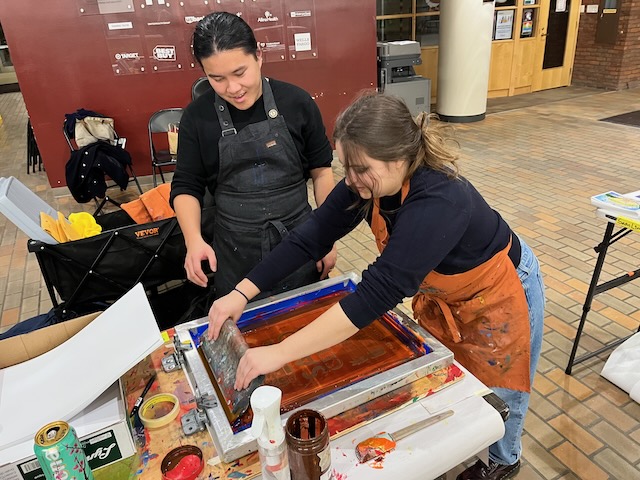
  • bringing Sean Lim to your class or student organization to collaboratively plan and complete an art project (banner, screen prints, stickers, buttons) around an issue or event
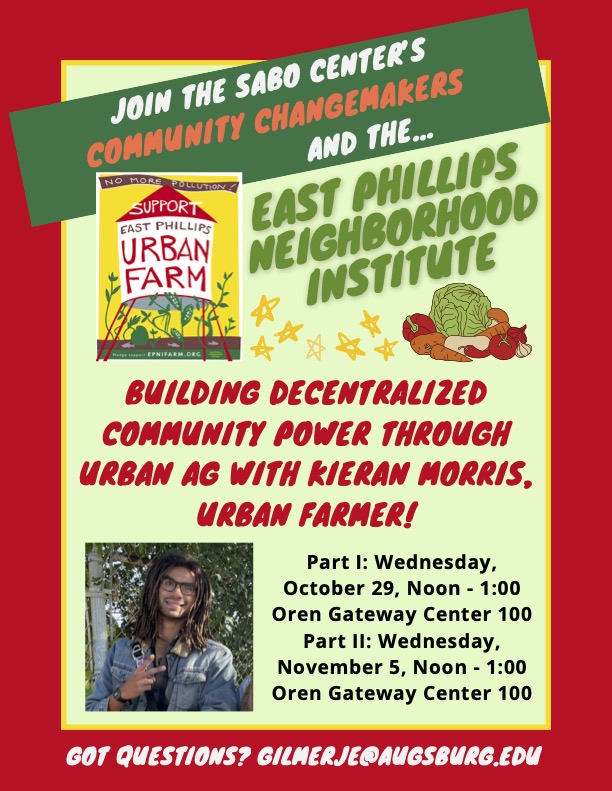
  • invite Kieran Morris to class to talk about the uses and importance of community gardens and urban farms for building and sustaining communities

Applications will be accepted until Friday, December 12th. Applicants will receive responses on Friday, December 19th. Please submit your proposal using this short Google Form or email Jenean Gilmer to discuss your ideas. You can find additional details in the form to submit proposals. Please reach out to Jenean with any questions or concerns at gilmerje@augsburg.edu.

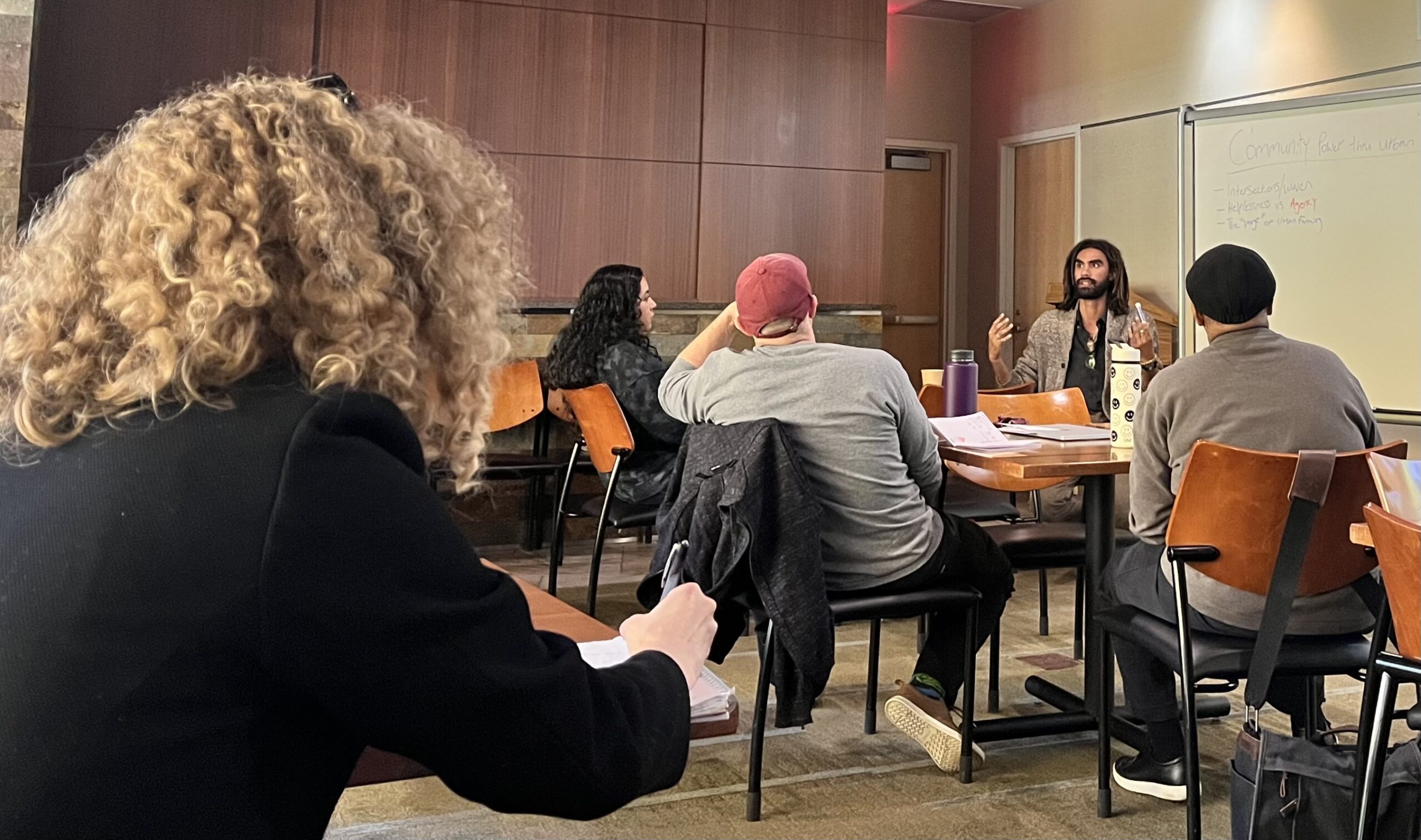
Kieran Morris talks Building Community Power with Urban Agriculture.
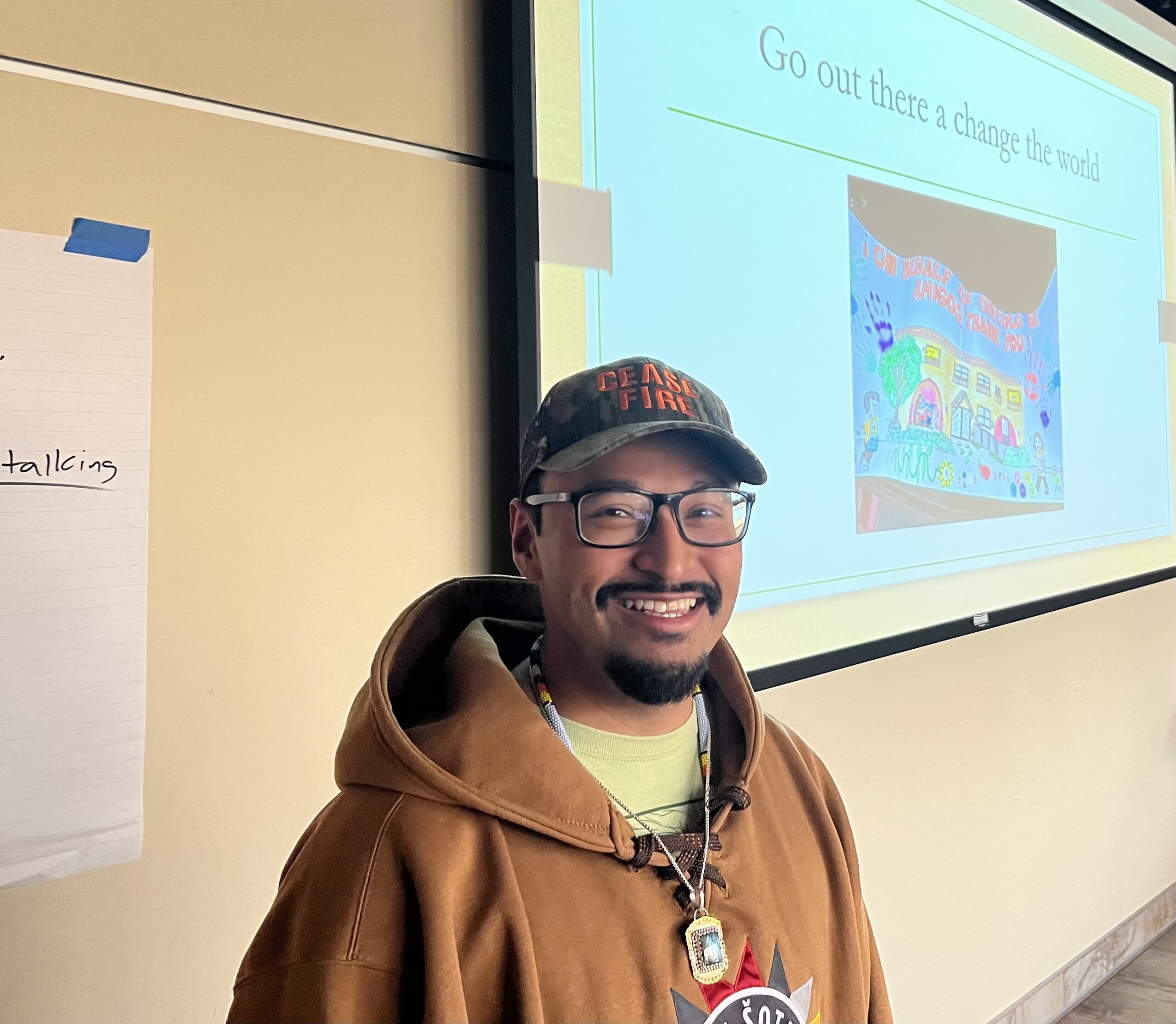
Augsburg Alum, Joe Vital, talks Political and Community Organizing and encourages students to “Go out there and change the world!”
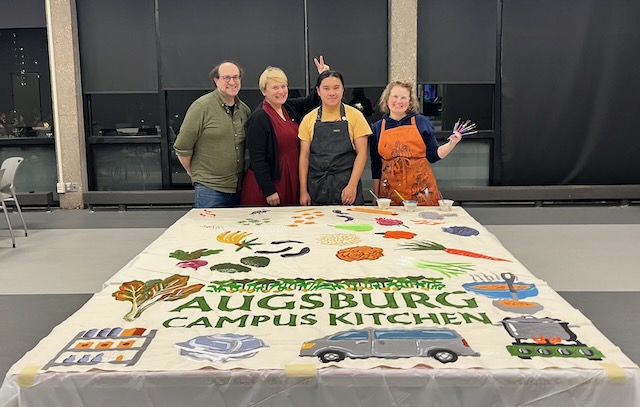
Dan Ibarra, Jenean Gilmer, Sean Lim and Gretchen Roeck finished up this collaboratively designed banner for the Sabo Center’s Campus Kitchen.
Sean Lim teaches Day Student Government Environmental Action Committee Coordinator, Lillee Buechler, how to make a screen print.
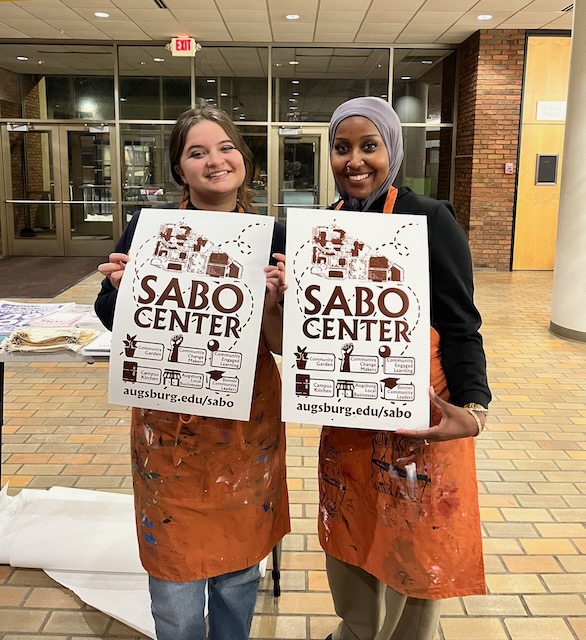
Students Lillee Buechler and Sheyma Abase show off their freshly printed posters.

Bonner Congress (BonCon) 2025

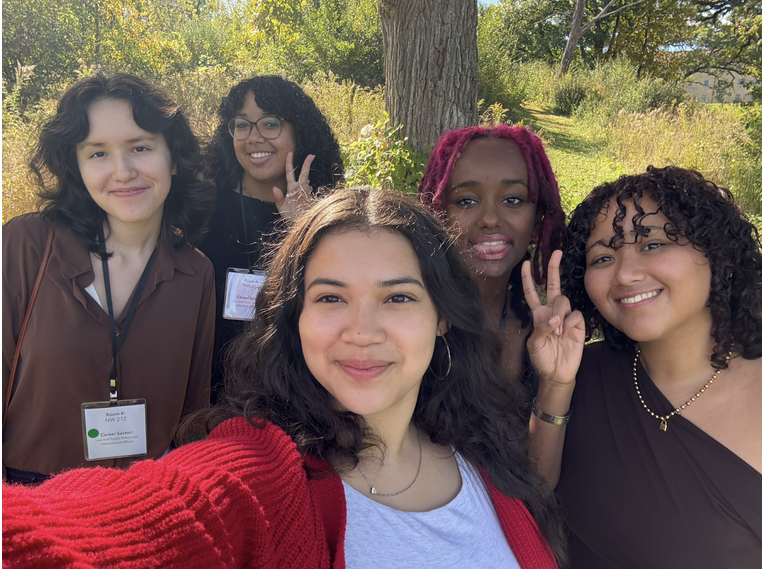
Authored by Bonner Community Leaders, Beti Milashu and Génesis Loza

Bonner Congress was a wonderful experience that left me with a lot of new information. It was eye opening to hear about the various Bonner programs and the uniqueness of each placement. It feels very inspiring to know there are so many different ways this program helps communities all over the United States. I learned about new placements I never expected. For example, I met a student who works at a phone line to help women report their abuse within our program. Bonner provides numerous essential resources for our society that many may not realize.

During our time at Bonner Congress, we had the opportunity to meet with Bonner alumni. Meeting the alumni demonstrated that Bonner is more than a 4-year college commitment, if not a community you are a part of for life. Being able to connect with Alumni and other Bonner students alike was such an incredible opportunity. During the breakout career sections for the Law, Public Policy, and International Affairs sector, it was very enlightening to hear about Dominique Cressler’s journey to working with immigrants in Chicago who ICE has targeted. Civil Rights is an area of law I would love to focus on studying the most. It was inspiring to hear from someone who wants to help people in the same way I do and is succeeding in doing so. Although given how vastly different we Bonners all are, it can sometimes be challenging to find specific advice on certain career paths. In the end, it was still great to absorb a lot of general information that helps any Bonner student on their way to the workforce and continuing to be an impactful source in the community.  I wouldn’t change this experience for anything in the world.

Photo of Bonners at BonCon

We got to learn multiple skills with the alumni, and learn more about their undergrad experience and how it can resonate with us. The Bonner alumni that we spoke to, their words made an impact in how we can progress. All of them are doing great things and accomplishing what most cannot; nonetheless, most share a common trait when describing their experiences and how they got to where they are today. However, after all their hard work, they still felt like they did not belong in their respective fields. Once they continued to describe their goals they said that there was always that feeling of imposter syndrome, even when doing the impossible. Before that I thought that I could never accomplish or fulfill any of the goals of that magnitude, but hearing how they felt whilst doing so made me resonate with them a lot. Imposter syndrome does not go away even if you are the founder of your own company, or going to graduate school in another country, however your achievements and abilities you gain along the way will not leave either. However we are doing in our individual fields, does not define the future impact we will have on others.

Thanks to the Bonner Foundation we were able to not only connect with our community but also learn about others in the process of getting out of our comfort zones. Learning from alumni and that their hard work did make a positive impact on others made us comprehend that we are also capable of making an impact. The tools that the Bonner Leaders at Augsburg University have given us, and the experiences we have faced, have allowed us to make change in our community.


Give to Campus Cupboard for Max Impact!

It’s Give to the Max season! And it’s coming at just the right time.
This year, the Sabo Center is hoping you’ll join us in providing critical support to Augsburg’s Campus Cupboard.
The Campus Cupboard team made an amazing video taking you on a tour of our work:

The Campus Cupboard isn’t just a food shelf. It is a student-led and mostly student-operated organization staffed by students passionate about food security, supporting their peers and community, and being leaders in making change in the world.
A few more things you should know:
  1. About 12% of our students are on SNAP, and the number is growing with new state enrollment eligibility changes – and their benefits are uncertain and unstable during the federal government shutdown.
  2. The Cupboard serves hundreds of Augsburg students per day (and growing year over year) with household staples, culturally appropriate and relevant foods, and hygiene products.
  3. A study in 2022 found that 69% of students at Augsburg, Hamline, and St. Kate’s experience food insecurity.
  4. While we receive state food dollars in support of our work, those dollars are waning in the wake of the pandemic and federal policy changes.
In short, demand for food is up and resources to provide it are declining. This is why we need your support.
Join our Campus Cupboard – Give to the Max campaign – and pass the word on. Thank you!

Community Changemakers: East Phillips Neighborhood Institute on Campus This Week!


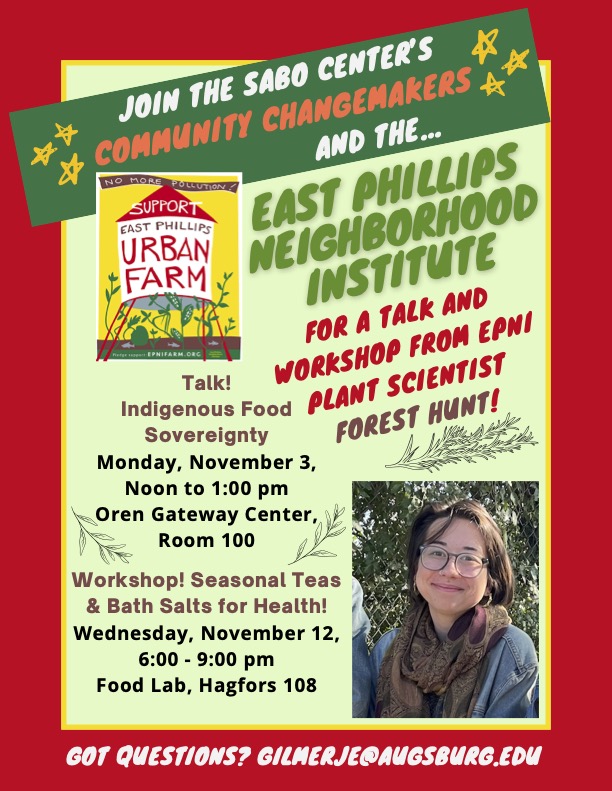
Join the Sabo Center Community Engagement Council’s Community Changemakers this week for a talk and workshop with Forest Hunt and part two of Kieran Morris’ talk on community power and urgan agriculture! Stay tuned to A-Mail and the Community Changemakers page for more information about upcoming events for Fall 2025! If you’re interested in learning more please email gilmerje@augsburg.edu.

Growing Through Practice: My Internship Journey at the Sabo Center

by Ethel Zidenga

When I first began my internship at the Sabo Center for Democracy and Citizenship, I wasn’t entirely sure what to expect. I knew I’d be challenged. I hoped I’d be changed. What I didn’t anticipate was how deeply this experience would shape not only my understanding of community engagement, but also my place within it.

One of the most transformative parts of this internship was the opportunity to explore the meaning of community engagement. I spent time researching how it is defined and practiced, and I quickly realized that true community engagement must be intentional. Whether it’s a partnership between an institution and a community, or among individuals, both sides need to be fully invested and both must receive equitable benefit. Just as importantly, both parties must have an equal voice in setting the goals and defining what success looks like.

Too often, institutions hold the upper hand in these relationships, directing the terms and outcomes. But if we are serious about creating anti-oppressive and anti-racist models of engagement, we must center the voices of marginalized communities. Their leadership, knowledge, and lived experiences must guide the work, not be tokenized or added on as an afterthought. This shift in power is not optional; it is essential.

During my time at the Sabo Center, I also had the opportunity to dive into powerful readings that pushed me further in my thinking. One that left a lasting impact was Hospicing Modernity by Vanessa Machado de Oliveira. I truly believe everyone should read this book. I only wish I had encountered it at the beginning of my MSW journey, but perhaps it wouldn’t have impacted me the way it just did. Sometimes the right book finds you when you’re ready.

In Hospicing Modernity, Vanessa challenges us to unlearn everything we’ve been taught by oppressive systems. She calls on us to recognize the harms embedded in modernity, systems that reward domination, extraction, and control, and instead be part of birthing something new. Her words awakened something in me: a deeper responsibility not just to question oppressive systems, but to actively participate in creating liberatory ones. She reminded me that being uncomfortable is necessary and that unlearning is a lifelong process.

I am also incredibly thankful for the mentorship and support I received from my field supervisor, Dr. Alex Fink, and my task supervisor, Ms. Jenean Gilmer. They created a brave and safe space where I could make mistakes, ask hard questions, cry when I needed to, and grow into a more critical and reflective practitioner. Their encouragement helped me find my voice and stay grounded, even when I was struggling to extend grace to myself. I will forever be grateful for the compassion, honesty, and guidance they offered throughout my internship.

Reflecting on this journey, I truly believe that the MSW program and the Sabo Center are a perfect partnership at Augsburg University. I may be biased, but the way both programs embrace holistic approaches to learning, justice, and community makes them a powerful team. The MSW program gave me the theoretical foundation, while the Sabo Center gave me a living, breathing classroom in the real world. Together, they shaped an experience that was not just educational but transformative.

As I close this chapter, I carry with me more than new skills. I carry a renewed sense of purpose and commitment. I will continue to unlearn, to listen, to act with intention, and to walk alongside others as we collectively build a more just and compassionate world.


Ethel Zidenga completed a Master of Social Work in Spring of 2025. She spent a year as an intern in the Sabo Center with Jenean Gilmer and Alex Fink, developing an extensive Community Partner Database, researching definitions and practices of community engagement, participating in relationship building and community development in the Cedar-Riverside Neighborhood. Her contributions are deeply appreciated and continue to provide meaningful support.

Fall Cooking Class in the Augsburg Community Garden with co-hosts Edible Boulevards and Ifrah Hashi

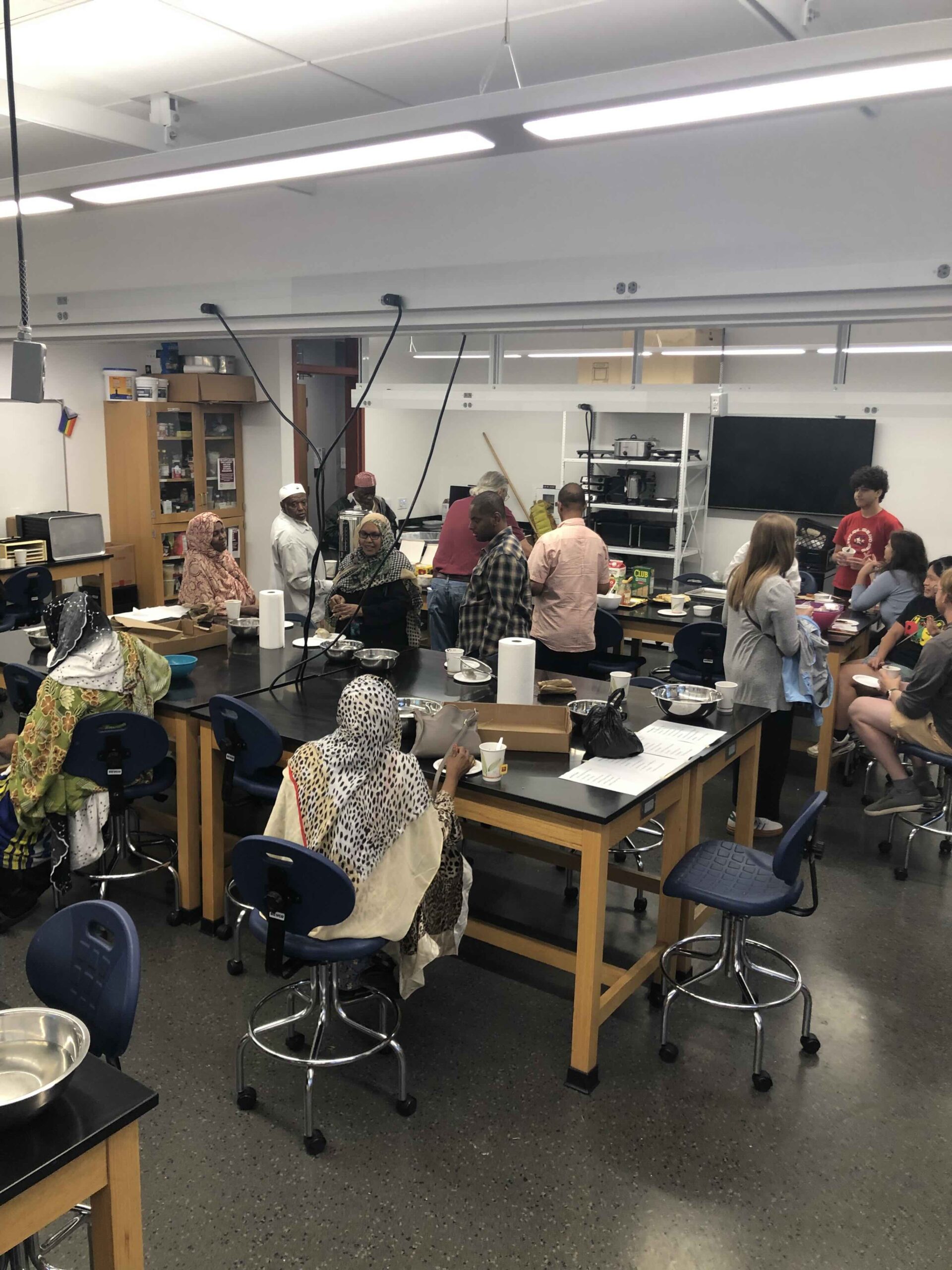
A group of gardeners in the Hagfors Food Lab roomAuthor: Greta Klawiter-Lein, Community Garden Coordinator

Fall is the perfect time to harvest veggies. And as the weather cools, stews and soups are a wholesome way to utilize these garden goodies! This fall, the Augsburg Community garden got to play host for a super special plant-based cooking class. In collaboration with Edible Boulevards; a food initiative focusing on supporting Green Zone residents, and the amazing Ifrah Hashi, we saw how to turn a bountiful fall harvest into a warm, delicious meal. It was such a warm, cozy early afternoon full of good food, good people, and beautiful stories.

Ifrah walked us through how to make a vegan lentil stew that hit all the right fall notes—hearty, flavorful, and perfect for chilly evenings. While she chopped garden kale and peppers, she shared about growing up cooking and peeling potatoes with her Somali mom in London. Her stories were personal and heartfelt, and made the food feel even more meaningful and filling.

The class brought together a really lovely mix of people—gardeners, students, neighbors, and community members, all learning together. The room was relaxed and welcoming, and of course, there were door prizes of dried lentils and culinary spices!

Big shoutout to Edible Boulevards for the work they do helping people grow food right in their boulevard spaces, and for hosting monthly plant-based cooking classes that bring folks together around healthy, accessible meals. Every month is a different cooking class, in a different community garden with rotating hosts. While the location and chef might change, the meal prepared is always vegan and focuses on elements of the chef’s cultural heritage.

Events like this remind us why the Augsburg community garden exists in the first place—to connect, to learn, and to grow (literally and figuratively).


September 17th is Constitution Day!

HAPPY CONSTITUTION DAY!

Constitution Day is an American federal observance that recognizes the adoption of the United States Constitution and those who have become U.S. citizens. It is celebrated on September 17, the day the U.S. Constitutional Convention signed the Constitution in 1787 in Philadelphia.

September 17th Celebrate the Birthday of Our Government Constitution Day


Make a plan to vote on November 4.

This year local elections will be held on November 4 and Augsburg has made election day a holiday during which classes are canceled so that all eligible voters have time to vote. The office of the Minnesota Secretary of State has sample ballots and information about voting. If you have questions feel free to reach out to the Sabo Center staff, we’d love to help.

Environmental Stewardship Team Celebrates & Reflects

Today past and current Environmental Stewardship team (ESC) members gathered in the Community Garden to celebrate this year’s accomplishments, reminisce about fun times we’ve had together, eat local food, and reflect on what the work and team has meant to each of us.


In a tradition started this year, graduates from 2022 and 2023 ESC teams planted Arikara Yellows Beans. This planting acts as a symbol of the gifts each of our graduates, Alexa, Alyssa, Elan, Gigi, Grace, Mercy, and Zoe, have given to the work of advancing environmental sustainability at Augsburg and in our neighborhood. Although most may not see the results of the work they have started and propelled along, their legacies will be felt in small and profound ways by future Auggies, ESC members, and neighbors. These seeds, as their past work, will be stewarded by current and new ESC members. The dry beans will be cared for this summer, harvested in the fall, dried, and used to feed the community. Some seeds will be saved for the 2024 ESC graduates to plant anew. The cycle will continue and with each planting the soil will continue to be nourished as will the work of environmental sustainability be advanced. This is how changes happens – with joy, community, and the sharing of gifts.


Thank you Alexa Carrera, Alyssa Parkhurst, Annabella Castillo, Elan Quezada Hoffman, Elijah Abdullah, Gigi Huerta Herrera, Grace Muchahary, Malachi Owens, Mercy Zou Taithul, Summer Bordon, Wren Doyle, Yousra Tinsley, and Zoe Barany. Your collective leadership, equity-mindedness, authentic teamwork, wisdom, and organizing power has moved environmental sustainability work forward in profound and meaningful ways. The garden is continuing to be more connected to campus and advancing food sovereignty for its gardeners. The ShareShop has become a welcoming resource for many Auggies, a way to rethink waste diversion, and a catalyst for mutual aid on campus. Although renewable energy is still on the horizon, the steps to get there have become clearer and excitement is building. Thank you to each of you for your leadership, stewardship, and collective action.


Campus Cupboard keeps our community well-fed and thriving

Written by Imogen Page, MSW Intern with Campus Kitchen

On the ground floor of the Anderson residence hall, the Augsburg Campus Cupboard is buzzing with activity. A student worker reminds fellow Auggies to grab a box or a bag for their free groceries, and around 15 students are shopping in AugFour campus cupboard workers smiling.sburg’s free food cupboard.

Today, there is plenty of fresh produce – salad greens, apples and pears, onions and potatoes in addition to fresh herbs and berries. A refrigerator stands full of milk, yogurt, cheese, and dairy alternatives, and a freezer contains frozen chicken, ready-to-eat meals, and tortillas. The week before, the cupboard distributed a shipment of halal beef, goat meat, and salmon. Students browse canned goods, fresh bread, dried beans, pasta, and rice in addition to coconut milk, oil, vinegar, ketchup, fish sauce, Tabasco, and salad dressings. 

“These condiments literally kill, dude” one student says to his friend as they choose from the shelves.

This is all part of the daily routine at the Campus Kitchen, where a team of student workers, interns, and staff operate the Campus Cupboard six days a week. We’re always busy – whether unloading boxes of produce from our trusty old van, stocking shelves, distributing hot meals and groceries to our neighbors, or cooking together in the food lab. 

Abi Hilden at the Augsburg Echo recently covered Campus Kitchen’s work, interviewing student worker Heldon Centellas about the cooking workshops, grocery distribution, SNAP application help and other work we do in our community.

“During the summer and fall months on Saturdays, we glean leftover produce from local farmers at the Mill City Farmers Market and redistribute it to our neighbors at Riverside Plaza! On Fridays during the majority of the year, we help distribute free produce to our neighbors there!” shares Centellas. In addition to these seasonal efforts, Campus Kitchen “[has] a community garden for people to grow their own food behind the Hagfors building, meal deliveries to Ebenezer Towers and Bethany Church, serving warm food at the Brian Coyle Center, provide assistance in SNAP applications, host giveaways, have open Food Lab hours, offer Cupboard online orders, and more!”

Our work at Campus Kitchen is possible because of support from Augsburg’s community. With growing food insecurity in our communities and the rising price of basic essentials, we need your help to keep providing nutritious food in our community. Your donation today helps to keep our community well-fed, healthy, and thriving. You can give here, and designate your gift to “Campus Cupboard.”