
 What does it truly mean to welcome someone into an organization? That question drove a recent Reell Insights conversation led by Dr. Stacy Frost, Adjunct Professor in Augsburg University’s Master of Leadership Program. Drawing on doctoral research and three decades across hospitality, ministry, and higher education, Dr. Frost invited participants to reflect on their onboarding experiences — as newcomers and as insiders — and to consider how leaders at every level can do better.
Orientation vs. Onboarding
Orientation is about compliance and clarification — paperwork, policies, and directives. Onboarding is something deeper: culture, connection, and relationship. Onboarding never truly ends — it’s an ongoing process of understanding an organization’s values and the networks that actually get things done.
Dr. Frost drew on researcher Talya Bauer’s framework — the 4 C’s (Compliance, Clarification, Culture, and Connection) — to map the full welcoming experience. Most organizations handle the first two reasonably well. The last two — the ones that determine whether a newcomer truly flourishes — are where investment most often falls short.
Connections and Peak Moments
Dr. Frost offered a guiding idea from Dr. Arthur Aufderheide of the University of Minnesota: “All knowledge is connected to other knowledge. The fun is in making the connections.” Newcomers aren’t just absorbing information — they’re building a web of meaning, and the richness of that web depends on the quality of relationships they’re invited into early.
Drawing on the Heath brothers’ work on peak moments, Dr. Frost also noted that the most memorable experiences — good or bad — shape the story a person carries about an organization for years. Intentional early moments are an investment with lasting returns.
Onboarding Is Everyone’s Responsibility
The most important takeaway: onboarding belongs to everyone in the organization. The newcomer experience is shaped not by a single program, but by hundreds of small interactions — how a question gets answered, whether someone goes out of their way to make an introduction.
Frontline employees are often the most pivotal. The administrative assistant who offers supplies, the peer who explains how things really work — these informal culture-carriers matter as much as any formal mentor or manager. Managers play a key role too, but only when they move beyond clarification into genuine connection.
As Dr. Frost put it: we can do better. Most of what matters costs nothing. It requires only attention, intention, and the willingness to see the whole person in front of you. It’s bringing our own humanity into the workplace that makes the difference.
Watch the Full Conversation Here:
The Reell Insights Series is hosted by Augsburg University’s Reell Office of Seeing Things Whole and explores practices that foster curiosity, dignity, humility, and trust in leaders and organizations.
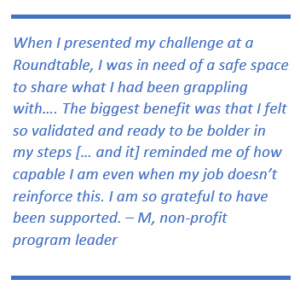 Are you a leader facing a big challenge at your workplace? The STW Roundtable Dialogue offers a unique process designed to assist leaders and organizations in gaining valuable perspectives on critical decisions.
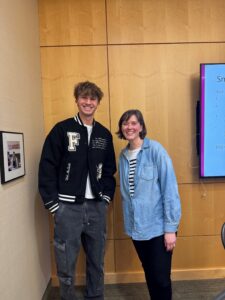 The Reell Office of Seeing Things Whole is partnering with the Strommen Center for Meaningful Work to launch a new Internship Preparation Program to equip students with the skills and experiences necessary to succeed in the 21st-century workforce. The program focuses on students developing their NACE (National Association of Colleges and Employers) career competencies: career and self-development, communication, critical thinking, equity and inclusion, leadership, professionalism, teamwork, and technology. By combining a skill-building approach with tangible, real-world internships they will learn to see the whole of themselves and their potential in the workforce.
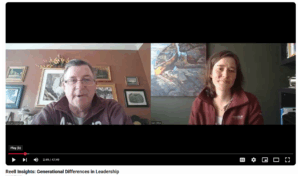 In the eighth episode of the Reell Insights Series in April 2025, Dr. George Dierberger shared some helpful ideas on how leaders can take a thoughtful approach, what we call “Seeing Things Whole,” to lead across the five generations and many differences that exist in today’s workplace.