
 Augsburg is proud to announce that Jessica Spanswick and Katia Iverson have been chosen as the 2009 Peace Scholars representing Augsburg College.
Spanswick [pictured left], a sophomore from Perham, Minn., is majoring in international relations with a minor in peace and global studies. Spanswick enjoys playing the alto saxophone in the Augsburg Concert Band and the Gospel Praise Jazz Ensemble, but her favorite activity is tutoring East African adults and children in the Cedar Riverside community. She is also actively involved in the Seward Montessori School, helping with a 4th and 5th grade class. The most meaningful college experience for Spanswick was studying abroad in Namibia and South Africa in the fall semester of 2008. Studying “Nation Building, Globalization, and Decolonizing the Mind” in Namibia inspired a passion in her for cross-cultural communication. She is planning to work abroad after graduating in Spring 2010, and hopes to return to Africa. Her goal is to one day work for the United Nations in a peacekeeping mission. Continue reading “Meet the 2009 Peace Scholars”
 Food drives generally mean the return of big, bulky barrels to Christensen Center. Donors pull some canned goods out of the back of their pantry. Or they pick up a few things on their next trip to the grocery store.
 Do you constantly worry about the weight, shape, and size of your body? Do you weigh yourself often and feel obsessed with the number on the scale? Do you ever feel out of control when you are eating? Do you feel like your identity and value is based on how you look or how much you weigh?
 Steve Peacock’s education about the connections between colleges and communities started early. When he was a young man, Peacock’s father, who was a campus minister at the University of Illinois, would talk with his family around the dinner table about what the church and the university could do to improve lives of people in the Champaign-Urbana community.
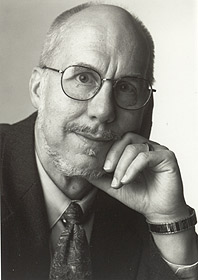 Massive changes to the planet at human hands require that we think anew about who we are and how we are to live. Cosmological, psychological, political-economic, and spiritual elements will all come into play. How might Christianity, in its newfound ecological phase, help us rethink who we are (talking the walk) and how we are to live (walking the talk)?
 Bruce J. Nicholson, president and CEO of Thrivent Financial for Lutherans, comes to Augsburg to speak about what it means to be an authentic person in today’s vulnerable financial world. Nicholson will speak at 10:20 a.m. on Monday, Feb. 16 in the Hoversten Chapel, Foss Center.
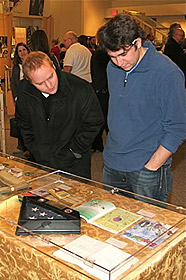 The multimedia exhibit, “Warrior To Citizen: Stories of Minnesota’s Most Recent Veterans,” will be on Augsburg’s campus through Friday, Feb. 13. The exhibit is on display in the glass room next to the Student Art Gallery in the Christensen Center. This exhibit was designed by Kristin Farrell of the Center for Service, Work, and Learning at Augsburg.
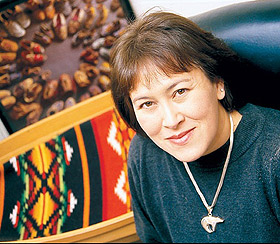 Dr. Lori Arviso Alvord, the first Navajo female surgeon, returns to Augsburg College Feb. 13 and 14 to share the story of her journey from the reservation to become a surgeon and her work to combine Navajo philosophies of healing with western medicine, to create models of healing environments. This convocation is sponsored by the Center for Counseling and Health Promotion, American Indian Student Support Services, and Augsburg for Adults.
 Today the world is a small place. The population continues to grow while perceptions of distances and differences are minimized by faster and smarter ways for the world’s citizens to connect. That reality means we are confronted daily with the effects our actions can have on people not just across the table but also across the globe.
 Augsburg College was recently selected by the Carnegie Foundation to receive the classification for Community Engagement. This classification affirms that a university or college has institutionalized community engagement in its identity, culture, and commitments. It also affirms that the practices of community engagement are aligned with the institution’s identity and form an integral component of the institutional culture.