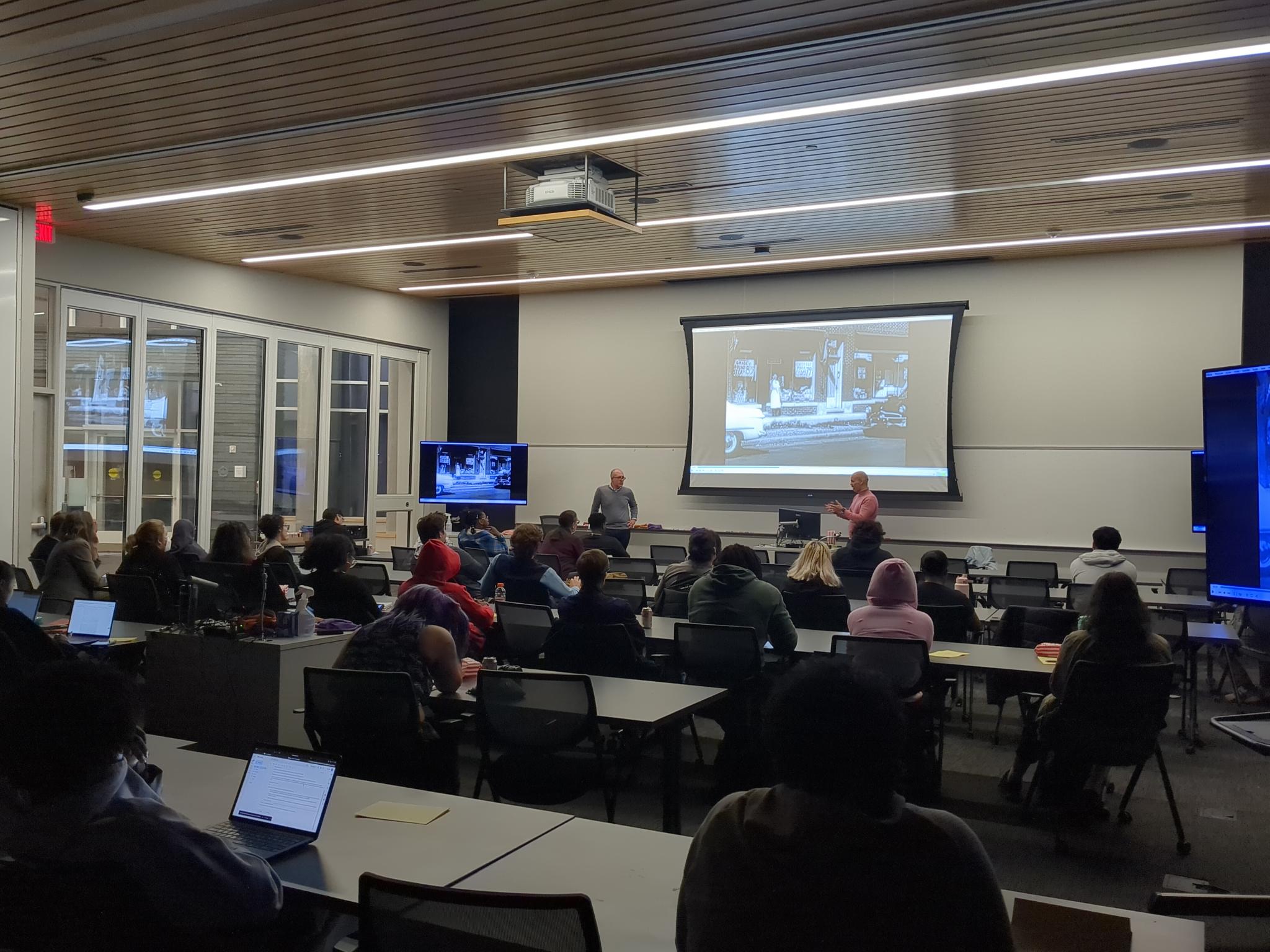
We recently screened the new Twin Cities Public Television documentary Paradox: Echoes of Reform & the Minneapolis Police (https://www.tpt.org/paradox-echoes-reform-minneapolis-police/), with Augsburg Professor Michael Lansing and Daniel Bergin the filmmaker (and Twin Cities Public Television executive producer and historian).
The film – a compelling blend of deep research, candid interviews, and rare archival footage- explores the history of police reform in Minneapolis. It illustrates how mayoral politics, community activism, and police union pushback shaped the city’s trajectory as well as what is at stake for the future of public safety. Over the course of a 2 hour event, Lansing and Bergin showed a number of clips from the documentary, providing introductory framing and commentary throughout. The audience asked many wonderful questions that gave these two space to elaborate about the film and the careful historical work that went into developing it.
As a resident of Minneapolis, it was refreshing to hear the detailed historical, local reconstruction that these two, as well as Professor Yohuru Williams of the University of St. Thomas, did to assemble this film. They dug up archival material, captured interviews with many of those involved, and gave coherence to the unfolding of policing in Minneapolis. Understanding this narrative helped us to understand why policing today has taken shape in these specific ways.
The entire 3 part series is available to watch freely on TPTs website.
The event was hosted by the Augsburg Center for Teaching and Learning, Sabo Center for Democracy and Citizenship, Office of Faculty Development, and the History Department.
The Coalition of Urban and Metropolitan Universities (CUMU) awarded Professor Katie Clark (Chair, Nursing Department and Executive Director, Health Commons) with the prestigious 2025 Barbara A. Holland Scholar-Administrator Award. CUMU writes that “This award honors mid-career scholar-administrators who ground their leadership in research, shape ideas and actions within and beyond their institutions, and help universities serve as engines of social mobility and community well-being.” Katie could not be a better choice for this award! As an administrator of the Health Commons, Katie leads a a program embedded in multiple communities with the aim of creating community connections and advance health for all. Across 5 sites in the Twin Cities, the Health Commons has had over 150,000 visits and collaborated with more than 3,000 students. It is now a national model for experiential education in nursing, health professions, and more broadly.
At CUMU, Augsburg President Paul Pribbenow noted “Barbara Holland championed a vision of higher education leadership that was intellectually rigorous, publicly engaged, and community-accountable. Dr. Katie Clark lives out that vision every day.” He adds, “Katie exemplifies Augsburg’s commitment to the intersections of scholarship, service, and systems reform – and she does it all with the heart of a healer, building relationships and community wherever she shows up.”
The Sabo Center, through our Community Garden, Campus Kitchen, and Campus Cupboard, works in close collaboration with the Health Commons. We are inspired by, and learn from, Katie Clark’s work and vision. We are very excited to see her recognized nationally for her work and leadership.
Author: Steve Peacock, Augsburg Director of Community Relations
I look forward to the Cedar Riverside Multicultural Dinner that is held annually at the Brian Coyle Center. It is an amazing gathering of people from all corners of the neighborhood who come together to share a meal, enjoy cultural performances, and build community. The Multicultural Dinner combines so many things that I love about the Cedar Riverside neighborhood – hospitality, kindness, generosity and diversity all combined together with a dose of controlled chaos!
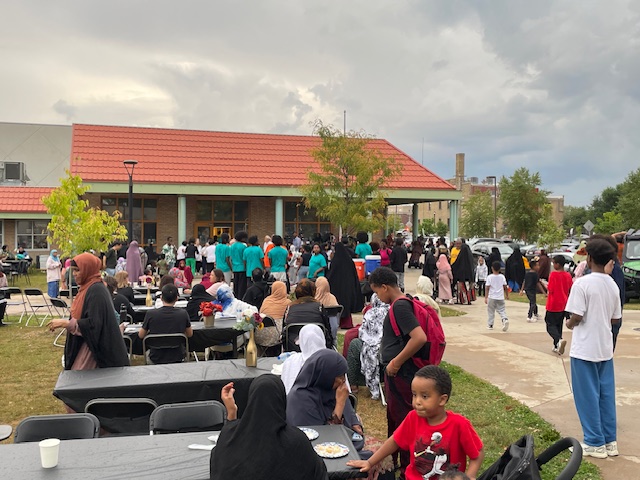
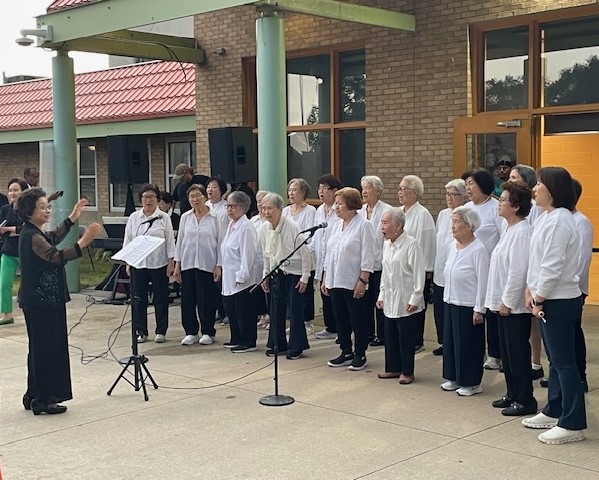
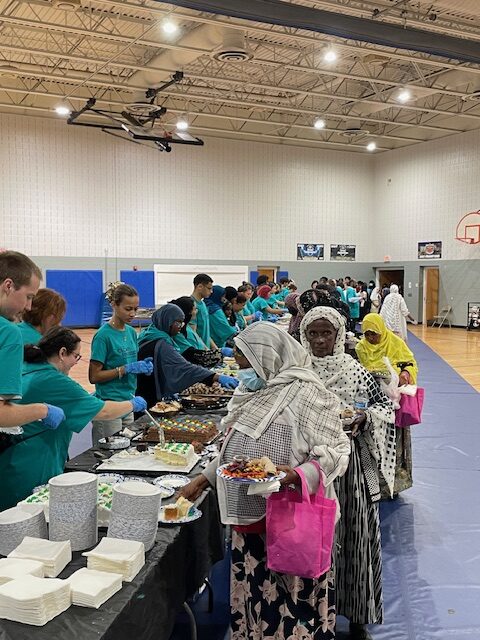
This year’s event, held on September 18th , was no exception. Despite intermittent rain that disrupted plans to hold the dinner outside in Currie Park, over 400 people attended. They were greeted in the gym of the Brian Coyle Center by a long line of tables filled with food provided by local restaurants. Wonderful aromas and voices in many different languages filled the air. Volunteers, including Augsburg staff and students, stood ready to greet guests and dish out generous portions. People shuttled inside and out as the weather changed. As the rain came, volunteers hurriedly set up chairs in the gym and then dried off tables and chairs outside when the rain stopped. Folks mixed together as they ate and talked. They enjoyed performances including Oromo, Somali, and Native American dance troupes. My favorite performance of the evening was the choir of Korean elders (average age of 87!). The evening ended with a traditional Somali line dance, led by youth from the Coyle Center, with lots of others joining in. What an evening in Cedar Riverside!
Korean Elders Choir performing at the Multicultural Dinner
Volunteers serving the Multicultural Dinner (including Augsburg staff and students!)
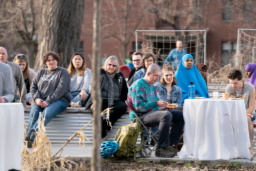
Gardeners gather for a meal and storytelling event in the garden.
Gazing out the west-facing upper windows of the Hagfors Center on Augsburg’s campus, you can’t miss benches, paths, and raised beds of Augsburg’s community garden. While the garden on the edge of campus has been cultivated since 2008, when the plans for the Hagfors Center for Science, Business, and Religion got underway, there was a distinct opportunity to preserve and re-imagine this unique community garden space. With support from the Medtronic Community Foundation, design guidance from O2 Design, and community-based input, the garden was rebuilt to make the space more accessible, inclusive, and visible.
Throughout the design process for the new garden space, gardeners and Augsburg staff centered the enduring principles and goals for this vital community connection space: grow food, build relationships, and learn together. The garden now has wider and defined pathways, clear plot boundaries, and a variety of raised and in-ground beds.
The re-designed garden just finished its second season of production. With over sixty individual plots and communal growing space cultivated by residents of Cedar-Riverside and Augsburg staff, faculty, and students, the newly rebuilt garden is continuing to offer a place for learning and building community.
About half of the members of Augsburg’s community garden are neighbors in Cedar-Riverside and Seward (six have a view of the garden from their homes across the street!), and about half are Augsburg staff, faculty, and students. Student groups, such as Hmong Women Together and the Augsburg Indigenous Student Association, tend portions of the communal gardening areas, and about ten students from TRIO Summer Bridge spent time learning in the garden over the 2019 growing season.
Individual gardeners are not the only people to utilize the garden; this fall, several professors teaching classes focused on food and sustainability are also capitalizing on the presence of the garden. From a history of food class, to a course on environmental connections to food, a chemistry AugSem, and a science of food and cooking class: the garden has increasingly become a laboratory for classroom learning on wide-ranging subjects related to growing and consuming food. Other classes utilize the garden in less formal ways, perhaps holding a class outside by The Loveliest of Trees, or sending students out for discussion as they walk the garden paths.
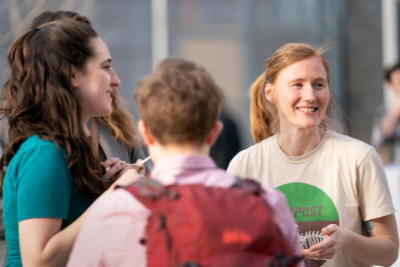
Campus Kitchen Coordinator Natalie Jacobson (left) and Chief Sustainability Officer Allyson Green (right) enjoy conversation at a garden event.
During the summer and fall of 2019, the garden began to utilize the Food Lab space in the Hagfors Center for potlucks and food preparation. Chief Sustainability Officer Allyson Green, who oversees the garden, remarked that the first session of gardeners gathering in the food lab over the summer was the highlight of the season; people got to know one another and shared cooking techniques and conversation as they made sambusas. This season also saw a student-led storytelling event in partnership with Mixed Blood Theater and food activist, LaDonna Redmond. As gardeners and others are living into the new space, opportunities for connecting and learning with and from each other are growing alongside the vegetables.
One challenge with the garden rebuild was impacted soil in the in-ground beds due to construction equipment. After the garden was initially built, gardeners were having a difficult time cultivating healthy root systems for their plants, requiring that all of the in-ground beds be dug up and the soil turned. Thankfully, dozens of students, several classes, and a few athletic teams answered the call, picking up shovels and making quick work of the beds that required turning.
When asked about how the garden fits into the overall sustainability commitments of Augsburg, Allyson noted that the garden is a visible demonstration of Augsburg’s commitment to caring for the place where Augsburg is located. By tending to our natural environment and building a place for community building, food access, and learning, the garden is an important aspect of Augsburg’s place-based and anchor institution work.
Allyson also noted her hopes for the garden. With twenty-five people on the waiting list, she hopes that the garden can continue to be a vital place on-campus for learning and relationship building that contributes to the well-being of the whole community. She dreams that the garden might be a model for cooperation and learning that can spread to other areas of campus, and even to other communities!
As a space that requires the cooperation of dozens of people who all have different ideas about ways of growing food, habits of organization and storage, and different cultures, personalities, and life stories, the garden is a unique place for experimentation, building community amongst difference, and finding a middle ground. Here’s to a successful growing season and many more to come!
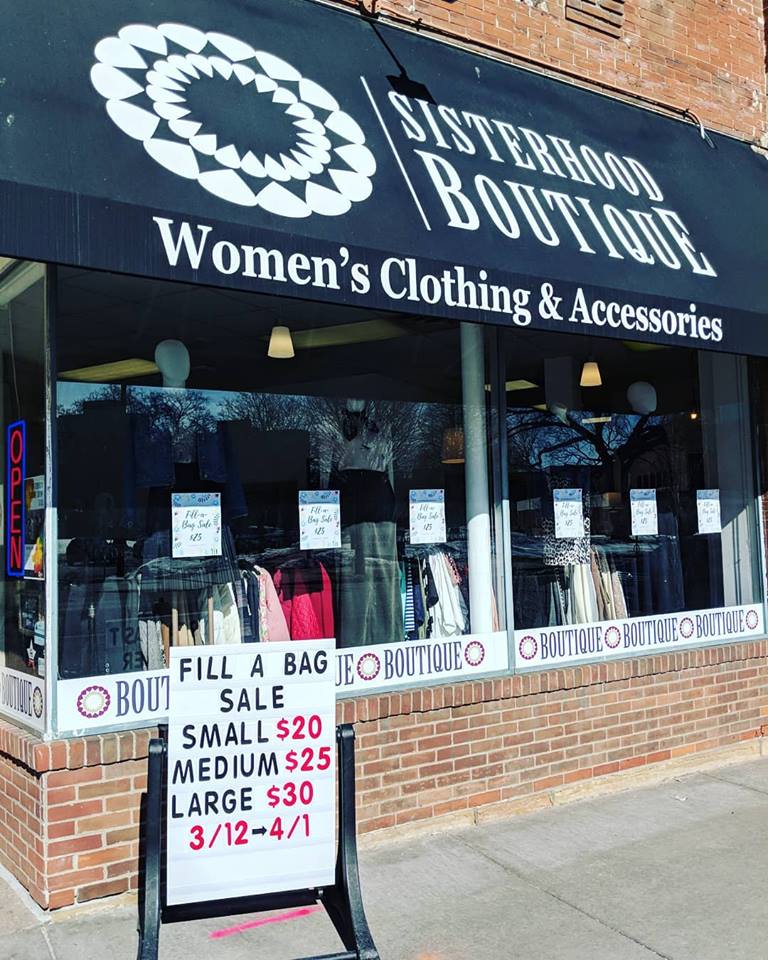
Sisterhood Boutique is a small thrift store with a big heart.
Located across the street from the Augsburg University campus, the Sisterhood Boutique stands as a symbol of empowerment for women. Started by young women who lived in Cedar-Riverside, the Sisterhood is described by shoppers as the “hidden gem” of the West Bank neighborhood. Donated clothing and jewelry is sold in a polished retail space, with all sales go towards a leadership program designed to help young women prepare for a career. The program includes various paid internships at the boutique where interns learn the skill sets necessary to run a business and become an entrepreneur. Augsburg students in the Sabo Center’s LEAD Fellows program have also worked at the Sisterhood.
One of the main events at the Sisterhood Boutique is their annual pop up fashion show. It is a collaborative, student-run event. Augsburg students, along with students from the U of M and St. Kate’s come together to coordinate the venue, models, and decorations, and to design the outfits. In the past, all items at the show were donated or altered by a fashion class at St. Kate’s. This year’s fashion show is coming up soon on Tuesday, March 5th, 2019, at the Augsburg University Hoversten Chapel, located in Foss Center. Doors open at 6, and the show begins at 7. Everyone is welcome, and the event is free of charge. Attendees are encouraged to bring along gently used clothing items to donate to the Sisterhood!
Learn more about the event by visiting the Sisterhood’s Facebook event page: Sisterhood Fashion Show
Community-based learning is a form of experiential learning directly connects students with the broader community and neighborhoods of which Augsburg is a part. Individual students and whole classes connect to community organizations through various means, including field trips, guest speakers, research, service learning, and public impact projects. These deliberately chosen experiences are guided by principles of mutual benefit for students and the community, are designed collaboratively with campus and community partners, and are based in deep and ongoing relationships with individuals and community groups. All community-based learning requires students to engage in meaningful reflection on their experiences.
Field Trips
A professor may plan a field trip for her course to a local organization or site so that students can experience first hand a context that might be referenced in class. Such a trip may offer opportunities to host discussions with local experts, understand an applied context, and to stimulate questions that may not otherwise occur to students in the classroom setting.
Examples
Religion classes tour houses of worship of different faith traditions, with tours conducted by practitioners of those traditions, some of which are in the Cedar-Riverside Neighborhood nearby to campus. These visits are followed by in-class discussion and a comparative reflection paper that prompts students to reflect on the visit as well the connection between visit themes and their own experience.
Students from a food science class visit a nearby beekeeping company who keep urban hives to learn about the science of honey production and about the economy of urban farming.
Guest Speakers
Guests from the local community may visit a relevant class session to share their experience and insight and engage in discussion with students.
Example
An organizer from a local labor rights organization visits a history class focused on 20th-century American labor rights movements.
Research
Research that is conducted as a partnership between traditionally trained “experts” and members of the community for the benefit of both.
Example
A group of students in a business course collaborate closely with a local youth social enterprise to do market research and develop a marketing plan. While the social enterprise ends up with a functional marketing plan that they can now implement, the students have learned applied skills for research and developing an end-product for a customer’s use while building connections with a community-based organization with connections to Augsburg and significant local impact.
Service Learning
Sometimes used interchangeably with community-based learning, service learning is a specific kind of learning activity in which students participate in and reflect on a service-oriented activity in the community. This may be a one-time “service project” experience, but more commonly involves ongoing involvement by the student in a community organization over the course of a semester (usually at least 20 hours). The activity is directly related to course content, and benefits the community.
Example
As part of the class, a student in an Social Work 100 class signs up to regularly serve meals to the after school program at Brian Coyle Community Center with the Campus Kitchen program.
Public Impact Project
Public impact projects are sustained experiences that integrate meaningful public engagement that is mutually beneficial to students and the community. Instruction and reflection in a community context enriches course content, teaches civic responsibility, builds community capacity and relationships, and often connects to university-wide community engagement initiatives.
Example
Students from Design+Agency, Augsburg’s embedded design studio, create design solutions for a variety of local non-profits and civic projects.
Interfaith Scholars collaborate with community members to put together monthly interfaith gatherings in the Cedar Commons space.
Whether you are planning a field trip, guest speaker, research, service-learning, or a public impact project, there are certain elements and factors to consider and incorporate. All community-based learning, from activity to long-term project, requires careful planning, connection to course objectives, collaboration with the community partner to identify need, intended impact, and responsibilities, as well as opportunities for quality reflection.
When planning for community-based learning, be sure to consider the following:
Consider Impact
Think about all facets of impact. For example, if you are taking your students to a community space–what do they need to know about the space beforehand to be respectful of the people there and the space itself? When asking an individual to come speak with your class, is there a way for the class to thank the presenter?
Community Partners are Co-Creators
Ensure that the activity or shared work has mutually beneficial outcomes for your students and the community or organization. Especially when planning longer term projects or research in a community-based context, the outcomes of the work should have value beyond student learning, and the need and intended product should be identified in conversation with the community partner. Collaborate with the community partner–whether that is an organization, business, etc–as a co-creator of the course design, learning outcomes, and/or research goals.
Engage in Relationship
Engage based upon relationship. Build on existing university connections (there are many–be in touch with us in the Sabo Center to learn more!), or use your own connections. For the sake of students, vet the organizations or people they may be working with. Establish a trusting relationship with a community group or organization before expecting a student to contribute time and energy.
Clear Parameters
Be sure to establish clear parameters for students about the connection between the community-based learning and the course’s educational goals, objectives, and learning outcomes. Offer clear guidance about what is to be accomplished and learned, and emphasize the student’s responsibility and the reality of the impact their actions might have.
Prepare
Prep students for what to expect and what is expected of them in the context of a community-based learning opportunity, whether that is a field trip or a long term project. Engage in reflection with students before the activity or project–what do they expect to learn? What do they want to learn? What are some things they think they know from the jump? Have students attend a scheduled community-based learning orientation with the Sabo Center, or coordinate with the Sabo Center to bring someone to do an orientation with your class.
Reflect
Quality reflection is essential for effective community-based learning, and for all experiential learning. Build in opportunities for structured and varied forms of reflection, and communicate clearly about how this reflection will be evaluated.
Want guidance for how to get started? Contact Director of Community Engagement Mary Laurel True (truem@augsburg.edu).