
Powerful Questions can be used to lead and connect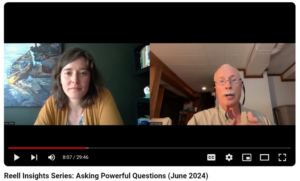
Introduction
Effective leadership isn’t just about giving answers. It’s about supporting others in action. One way to do this is by asking powerful questions. In the first episode of the Reell Insights Series about Asking Powerful Questions, Professor Tom Morgan explains how powerful questions can inspire curiosity, build trust, and drive meaningful conversations. This approach perfectly aligns with the Seeing Things Whole framework, which utilizes powerful questions to support leaders in gaining insights into their challenges.
Why Questions Matter
Powerful questions are important because they allow you to go beyond simple facts. They encourage you to think and reflect deeper on yourself and your experience. Questions like, “What’s the purpose of our current project?” or “How can we make a positive impact on the community?” can help leaders and teams see the bigger picture and connect simple actions to broader goals.
Building Trust with Questions
Morgan points out that good questions can be part of building trust within a team. Leaders who demonstrate curiosity through questions can make their team feel valued for their perspective. The result of this is the creation of a space where everyone feels safe: a space that contributes to and facilitates collaborations. These are key aspects of the Seeing Things Whole approach to fostering healthy organizations.
Connecting to Seeing Things Whole
Our framework encourages leaders to integrate their personal values with organizational goals to have a lasting impact on the whole community. Asking questions like, “How does this decision align with our core values?” or “What benefits does this bring to the community?” helps make sure that the action taken by the organization is aligned with its mission and values.
Some Practical Tips for Leaders
Be Very Clear About Your Purpose:
Let your team know the reasons why you’re asking a powerful question.
Listen Actively:
Show that you are truly interested and care about their response.
Encourage Openness and Collaboration:
Create a safe space where your team feels comfortable sharing their thoughts so they can collaborate more effectively.
Conclusion
We hope this session underscores a useful and effective tool for leaders. Asking powerful questions fosters deeper thinking, builds trust, and helps connect everyday actions to a larger purpose. By integrating this approach, leaders can create more engaged, thoughtful, and impactful organizations.


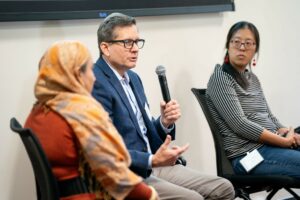 It was a gift to host the Reell Office of Seeing Things Whole’s first public event – Human-Centered Leadership for Meaningful Work. The lively panel conversation sparked curiosity for considering how to bring greater wholeness and meaning to organizations. Panelists included Najeeba Syeed, El-Hibri endowed chair and executive director of Interfaith at Augsburg University, Jun-Li Wang, associate director of Springboard for the Arts, and Kyle E. Smith, co-CEO of Reell Precision Manufacturing. Tom Henry, former CEO of Landry’s Bicycles, served as moderator.
 Those who attended the roundtable dialogue which featured a presentation from MNCEO’s Executive Director Kirsten Kennedy, began a conversation on what it means to build a more holistic business system. While there were no concrete answers, participants were curious about how to shift workplace cultures to ones that are more collaborative while also acknowledging the roles business can play in the larger community.
 See better what is and what could be.