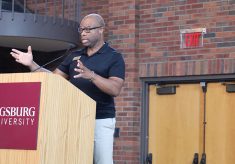


In a recent newscast, ICT (formerly Indian Country Today) interviewed Augsburg University Associate Professor Eric Buffalohead about persistent stereotypes of Native Americans in film. Buffalohead chairs the Department of American Indian, First Nations, and Indigenous Studies and is the co-editor, with Professor Elise Marubbio, of the book “Native Americans on Film: Conversations, Teaching, and Theory.”
“I’ve been teaching “American Indian in the Cinema” for going on 30 years, and people have asked me, what’s the solution to some of these problems?” said Buffalohead. “And it’s contemporary representations. The big theme that you walk away from my course with is that most of our images are stuck in time, meaning that they’re somewhere in the past. People don’t see us as contemporary—they see us as these images in the old West and very much stereotypes of plains or southwest Indians. They don’t see the real diversity of Indigenous people in the Americas.”
The conversation with anchor Aliyah Chavez also touched on expanding representations in television through shows like “Rutherford Falls” and “Reservation Dogs,” translation of major films into the Navajo and Comanche languages, and Professor Marubbio’s work on representations of Native women in film. Find the full interview in the ICT newscast archive (segment begins at 6:15).

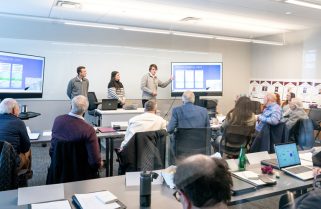
With her second grant from the Metropolitan Regional Arts Council, Susan Boecher [top], Art Department faculty member, taught a six-week photography workshop that partnered OverExposure, a media arts nonprofit, Augsburg College and Centro, an area social service organization.
On Friday, Aug. 22 at the Uptown Theatre, film alumnus Ben Katz ’08 (pictured left, red circle) will be screening “Bits,” an independent film about an awkward inventor who spends his days and nights obsessing over a mysterious project. Katz produced the film, and it stars Augsburg alumni Linnea Mohn ’04, Philip Mershon ’06, and Nancy Waldoch ’06.
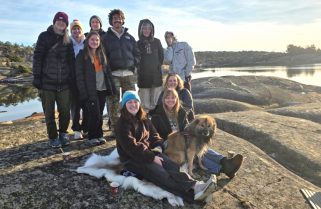
Last month, history professor Jacqui deVries and English/film professor Bob Cowgill led a group of 20 Augsburg students through Germany, Poland, and the Czech Republic. Using literature, film, architecture, and eyewitness accounts, students explored the aftermath of World War II to understand how people made sense of their suffering and now pay homage to the past.