

Two Augsburg undergraduate students, Ethiopia Kebede ’25 and Mitchel Munzing ’26, have been named 2025–26 Goldwater Scholars. The Goldwater Scholarship, one of the top undergraduate STEM awards in the country, recognizes outstanding students who intend to pursue research careers in the natural sciences, mathematics, and engineering.
Kebede, a physics major, aims to pursue a PhD in astrophysics with a focus in stellar physics and eventually teach at the undergraduate level. In addition to conducting space physics research at Augsburg with Professor Emeritus Mark Engebretson, she creates and shares free math videos via YouTube to address the shortage of STEM educators in remote places.
“One of my memories from grade school is rotating the handle of a generator in a physics lab,” said Kebede. “I remember feeling satisfied when the generator finally lit up the bulb attached to it. From then on, I enjoyed science as a clever way of solving problems. I am excited to pursue a lifelong career in the subject that I love—physics.”
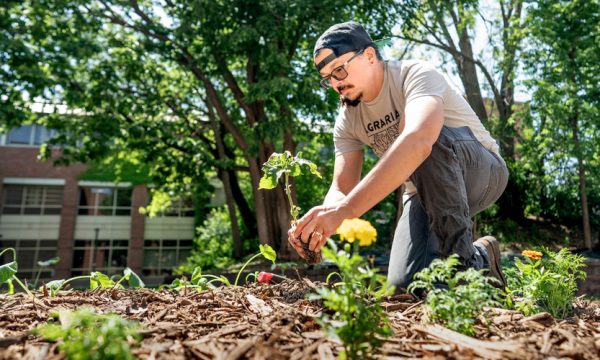
Munzing, a biochemistry major, intends to pursue a PhD to continue research in organic and green chemistry. Outside of the classroom, he is a member and incoming captain of the Augsburg men’s soccer team, where he has been recognized with the Ed Saugestad Award for outstanding student-athlete.
“This past summer I had the opportunity to conduct research in an organic chemistry lab with Dr. Michael Wentzel,” said Munzing. “While at the start the experiments I ran didn’t go as planned, eventually I was able to synthesize biologically significant compounds. Spending the necessary time to [become an expert in a specific field] requires patience, but the reward of discovery makes it worth it.”
This year, Augsburg is one of Minnesota’s top producers of Goldwater Scholars. Applicants for the Goldwater Scholarship are nominated by faculty, sponsored by their academic institutions, and selected by the Barry Goldwater Scholarship and Excellence in Education Foundation. Kebede and Munzing were chosen from a pool of 1,350 applicants nationwide.
“To have two winners is really terrific,” said Professor Jacqueline deVries, who supports students through the application process as director of major grants and fellowships in Augsburg’s Office of Undergraduate Research and Graduate Opportunity (URGO). “The Goldwater Scholarship is one of the most prestigious scholarships an undergraduate can win in science, engineering, and mathematics.”

“Music is more than organized sound; it can be a message from the heart of humanity,” according to Robert Stacke, Augsburg College associate professor of music. “Music can motivate a population in a manner that words alone cannot do. It is a powerful tool that can inspire political action and send its message to the world.”
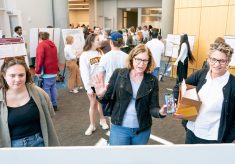
Nearly three dozen undergraduate students will present findings from their on-campus research during the
At the 2012 American Association for the Advancement of Science (AAAS) international meeting in Vancouver B.C., biology major Alex Sorum won the student poster competition in the medicine and public health category. Alex won with his poster titled, “Effects of Airway Epithelial Secretions on Pseudomonas aeruginosa Biofilm Formation” which presented the research he did as a Sundquist Scholar with biology assistant professor Jennifer Bankers-Fulbright during 2011.
The Augsburg College office of Undergraduate Research and Graduate Opportunity (URGO) today announced that Colin Irvine, associate professor of English, will serve as the URGO 2012 summer research coordinator, taking over most of the responsibilities previously performed by Dixie Shafer, URGO director.
This spring during Undergraduate Research Week, Jeremy Anthony, a senior mathematics major, represented Augsburg College in the Council on Undergraduate Research Posters on the Hill event. This event held each year in Washington, D.C. showcases the research of 75 undergraduate students from colleges and universities across the country.
Research isn’t all test tubes and laboratories. This summer at Augsburg, students will create music, study Medieval history, compare Minnesota theatres, and even attempt to determine if a BMI can be established for dogs. For the 2010 URGO summer research projects, students will spend 200 or 400 hours conducting research with faculty from Augsburg and other institutions. Many will present their findings in May 2011 at Zyzzogeton, Augsburg’s year-end festival of academic and artistic achievement.
This week, some of Augsburg’s undergraduate researchers will share the work they have been engaged in over the summer.
Some Augsburg students are discovering that summer isn’t just for working a few part-time jobs or perfecting one’s beach volleyball technique. This summer, 32 students will conduct research through the URGO program. And they’re not just studying algae growth. With their faculty mentors, this group is taking on topics like Minnesota’s percussion legends, saliva, Augsburg’s relationship with our neighbors, conspiracy fiction, aquatic insects, and the relationship between religiosity and depression…to name a few.