The Sabo Center’s Campus Kitchen program invites you to support our 2022 Give to the Max fundraiser. This year, we are raising funds for two important initiatives: The Augsburg Campus Cupboard and food access programming in Cedar-Riverside.
First, the Campus Cupboard provides free groceries to Augsburg students. Campus Cupboard use has rapidly expanded in the last three years, in response to increased food insecurity among Augsburg’s diverse student population. In 2019, an average of 50 students visited the Campus Cupboard to pick up free groceries each week. By September 2022, that average increased to 220 students per week. We regularly receive feedback from our students that the groceries we provide make a huge difference in their ability to access high-quality, healthy foods. Many students and their families now see this service as a critical piece of meeting their basic food needs.
In order to expand this work, we are raising funds to purchase culturally appropriate food items for our diverse student population. With your support we will be able to offer a wider variety of foods, providing our students with the specific staple foods they request regularly.
Second, we are seeking support for our food access and education work in our surrounding community of Cedar-Riverside. The Campus Kitchen program provides free meals, fresh produce, and cooking programming for our neighbors in Cedar-Riverside. A $60 donation covers supplies needed for one cooking class for neighborhood youth. Your donation will make a significant difference in our ability to meet the growing and diverse food needs of Augsburg’s student body and our neighbors in Cedar-Riverside.
Bill loved donating any money he had to SABO and helping with dishwashing, singing and sharing his joy for living.
He was quite the interesting character so I wanted to share some background on him, especially for any interested students and to expand people’s understanding and appreciation of mental illness.
Bill, William Kenneth Ogren, was born April 6, 1950 in Washington D.C. to proud parents Marjorie and Ken Ogren. Bill, and his two younger siblings James and Jan grew up in Northern Virginia. His father worked as an agricultural diplomat and the family moved to Paris, France in 1967. Bill graduated from the American School of Paris in 1969. While in France he explored The Netherlands, Italy, Spain, and worked a summer at Heathrow airport in London, England. He loved art and became friends with artists and enjoyed showing people around museums.
Both of Bill’s parents grew up on farms in Minnesota and so he chose Augsburg College to be near his beloved grandmother Emma Ogren. He went to Augsburg College in MPLS from 1969 to 1973. He was so well-spoken and well-liked that family and friends thought he might become a diplomat, like his father, or maybe a curator of a museum or art gallery.
But in 1972 his life radically changed. It became apparent that he had some kind of illness that changed his brain function. He couldn’t communicate or process information they way he used to. He was homeless for a while and lost contact with family. Nevertheless, Bill managed to come through this time with a focus on being kind, generous, and helpful. He rarely used a phone, no longer drove a car, and never used a computer in his life. But he could wash dishes, set up tables for banquets, and make people happy. He worked at restaurants and hotels, often receiving recognition as Employee of the Month and in 1977, Employee of the Year for the Registry Hotel in MPLS.
He reconnected with Augsburg College and was active in the campus ministry and the campus kitchen. He delivered meals with a song and enthusiasm. He loved getting to know visiting students and could remember everyone’s name and something significant about them.
When his mind no longer functioned as it used to, he opened his heart.
He died peacefully in his sleep on March 10, 2021 just shy of his 71rst birthday.
Graduated in 2019 – environmental studies major with an urban studies minor
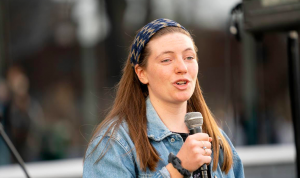
Nell Gerke (2019) holding and speaking into microphone at outdoor food event.
What sparked your interest in Campus Kitchen?
I joined Campus Kitchen through the LEAD Fellows Program; I talked with a woman who worked with Campus Kitchen at the time, and she talked about how much she got to work in the community, and I think that’s what really got me interested in it in the first place. I was already pretty interested in food systems, but the whole community aspect really sold me on CK.
What were the biggest challenges you faced working with Campus Kitchen?
Finding students to do shifts with me! When there wasn’t a social work class where students needed to fulfill hours or something like that, I didn’t see a lot of people signing up for Campus Kitchen volunteering.
What were some of the highlights of your time with CK?
I can say that usually if I went into a meal shift feeling funky, I usually felt out of the funk after the meal shift, so it was always very healing. I love working in the community garden– that was always a highlight. It felt really good to have that connection with the community, and I had never gardened before. So I learned so much from everyone around me all the time, which was very cool. I loved the garden. I loved hosting the Garden Party food storytelling event too.
Skills you gained?
I learned how to build community and relationships.
I learned to be pretty scrappy with making food, just because we would always wind up with random stuff, and that would be my dinner. Making something out of what you have around is a great skill- that’s how I still cook my meals.
What are you currently up to and does it connect to CK?
I work at a food Coop in Northfield, but I am also running for the Board of Directors, because I want to be more involved in my community and have a larger presence.
Other things involved you were involved with at Augsburg?
I played softball. I was a LEAD fellow. I was an RA briefly.
Many incredible student leaders have worked with Augsburg’s Campus Kitchen (CK) program over the years. Current CK student leaders Alana Goodson and Chouneng Khang interviewed several CK alumni to learn more about their experiences with the program.
Britta Andress
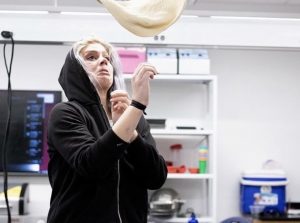
Britta Andress tosses pizza dough in the food lab.
Majored in sociology, graduated 2019
What sparked your interest in Campus Kitchen?
(Andress): I was in the LEAD Fellows program.
What were the biggest challenges you faced working with Campus Kitchen?
(Andress): Having to work within our budget was a challenge. We wanted to give the youth at the Brian Coyle Center better quality food but we were not able to afford it.
What were some of the highlights of your time with CK?
(Andress): The people, especially everyone on the Campus Kitchen student team working together and not being individualized/separated due to roles or titles.
Takeaways/Skills you gained?
(Andress): CK taught me that even small acts of awareness and change can have lasting impacts.
Giving back to the community is something I learned to really value.
What are you up to now? How does it connect to CK?
(Andress): Meal prep is definitely something I still use and will always use to this day. So don’t underestimate its value.
Other things you were involved with at Augsburg?
(Andress): I had a job outside of campus and was also a student research assistant for two of my professor independent research projects.
Advice for current, future, past CK interns/volunteers?
(Andress): I learned to enjoy the process and not to participate just for the result. A lot of times when people volunteer, they do it to have it on their resume or for class credit. With Campus Kitchen, it’s important to stay in the present and see the impact and change happen over time because making a difference isn’t always a linear process.
Many incredible student leaders have worked with Augsburg’s Campus Kitchen (CK) program over the years. Current CK student leaders Alana Goodson and Chouneng Khang interviewed several CK alumni to learn more about their experiences with the program.
Yasmin ‘2015: Biology Major and Religion Minor
What sparked your interest in Campus Kitchen?
I wanted to be a part of helping our neighbors in need.
I love what Campus Kitchen stands for! I admire its mission to serve the community that surrounds the campus by making healthy food accessible.
What was your role with CK?
My role was to help build sustainability and capacity building. I recruited volunteers, organized events that educated others about food equity and provided ways people could access healthy foods.
I attended food deliveries at sites like Ebenezer Towers and Brian Coyle.
I hosted an event where I invited special speaker LaDonna Redmond, a food justice advocate to discuss issues surrounding food equity.
I helped with fundraising through Give to the Max for Campus Kitchen.
I explored different modalities for volunteers to participate in reflection so that volunteers get a chance to understand the impact of their volunteering.
I worked in the community garden. I coordinated with gardeners about their plots and addressed any issues that they had.
What were some of the highlights of your time with CK?
I attended the Food Waste & Hunger Summit in Arkansas. I learned about different ways we can combat ending hunger and poverty. It was a fun road trip! At the end of my year of service, I also presented at the 2016 Nonprofit Leadership Conference about my experience with Campus Kitchen and Health Commons. The theme of the conference was courageous engagement across differences which fit perfectly with my experience!
I learned leadership, communication, time management, planning & organizing, teamwork, conflict resolution, empathy, adaptability & flexibility, networking, and cultural awareness.
What are you up to now? How does it connect to CK?
I’m attending the American University of Antigua School of Medicine. I’m currently in my 3rd year of clinical rotations in New York.
Working with Campus Kitchen solidified my pursuit in working in community health and focusing on serving underrepresented communities.
Advice for current, future, past CK interns/volunteers?
Get to know the community you’re serving by building relationships. Take time to listen to community members’ stories– their stories matter.
Don’t be afraid to ask questions if you have any cultural or religious differences when making food and delivering food with the community members. They love having conversations with students.
Because of the stay at home order to prevent the spread of COVID-19, student employees of the Sabo Center are writing about the work they do. This entry is from Ed Loubaki. If you would like to support Campus Kitchen’s work, feel free to donate through Augsburg’s donation page. You can designate your donation to Other>Campus Kitchen.
Hello, my name is Ed Loubaki, my pronouns are she/her/ hers. I am a first-year student and I work with the Campus Kitchen in the Sabo Center. Through Campus Kitchen, we work to provide food that is healthy and accessible. The Campus Cupboard food shelf is open every weekday, and it’s relieving for many Augsburg students that there’s a place on campus to access free food. Augsburg is quite fortunate to have Campus Kitchen because its students and surrounding comm
unity get to enjoy meals and fresh produce together. As a Campus Kitchen student employee, I love that we work to reduce food waste on campus and address food insecurity in our community. Campus Kitchen at Augsburg works hard to not only care for Augsburg, but also for the surrounding community at Ebenezer Tower Apartments, Trinity Lutheran Congregation, and the Brian Coyle Community Center.
My experience at Ebenezer Tower and the Brian Coyle Center has been beyond amazing. It did not take long to bond with community members. Every meal shift brings me joy. Each meal spices up the conversations, and sometimes it’s hard to leave. Hearing laughter here and there makes the job extra fun. At Ebenezer, I get to hear stories that soothe me and help me make better decisions in the future. These seniors are like the grandparents I never had; they make me feel like their own. Brian Coyle, on the other hand, has this energy that is incredible. You just can’t turn from it. At times, my urge to do work with Campus Kitchen increases because it doesn’t even feel like work – it feels like a great meal with friends and family. I’m looking forward to the time when we can gather again in-person to enjoy food and conversation together.
The Sabo Center is proud to co-sponsor this benefit, please join us.
The Cedar Cultural Center, Augsburg University, and KFAI present:
630 CEDAR AVE FIRE BENEFIT with Thunder Band, Brass Messengers, Becky Kapell and The Fat 6, Jack Klatt, Amjet Kemet, Tatum and Tessa, Ray Barnard & Clark Adams, and more
Saturday, January 11th, 2020 / Doors 7:00pm / Show 7:30pm
Standing Show
$10, $20, $30, $40, or $50
This is a standing show with an open floor. The Cedar always reserves a section of seats for patrons who require special seating accommodations. To request seating or other access accommodations, please go to their Access page.
Proceeds donated to 630 Cedar Fire Relief Committee. No one will be turned away due to lack of funds.
Can’t make it to the concert? You can still make a donation to support the families affected by the fire, here.
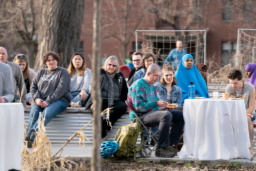
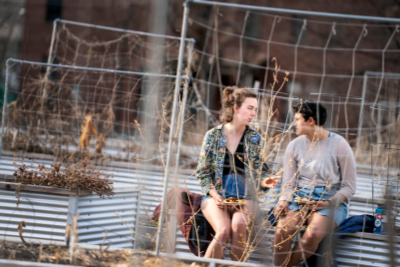
Gardeners gather for a meal and storytelling event in the garden.
Gazing out the west-facing upper windows of the Hagfors Center on Augsburg’s campus, you can’t miss benches, paths, and raised beds of Augsburg’s community garden. While the garden on the edge of campus has been cultivated since 2008, when the plans for the Hagfors Center for Science, Business, and Religion got underway, there was a distinct opportunity to preserve and re-imagine this unique community garden space. With support from the Medtronic Community Foundation, design guidance from O2 Design, and community-based input, the garden was rebuilt to make the space more accessible, inclusive, and visible.
Throughout the design process for the new garden space, gardeners and Augsburg staff centered the enduring principles and goals for this vital community connection space: grow food, build relationships, and learn together. The garden now has wider and defined pathways, clear plot boundaries, and a variety of raised and in-ground beds.
The re-designed garden just finished its second season of production. With over sixty individual plots and communal growing space cultivated by residents of Cedar-Riverside and Augsburg staff, faculty, and students, the newly rebuilt garden is continuing to offer a place for learning and building community.
About half of the members of Augsburg’s community garden are neighbors in Cedar-Riverside and Seward (six have a view of the garden from their homes across the street!), and about half are Augsburg staff, faculty, and students. Student groups, such as Hmong Women Together and the Augsburg Indigenous Student Association, tend portions of the communal gardening areas, and about ten students from TRIO Summer Bridge spent time learning in the garden over the 2019 growing season.
Individual gardeners are not the only people to utilize the garden; this fall, several professors teaching classes focused on food and sustainability are also capitalizing on the presence of the garden. From a history of food class, to a course on environmental connections to food, a chemistry AugSem, and a science of food and cooking class: the garden has increasingly become a laboratory for classroom learning on wide-ranging subjects related to growing and consuming food. Other classes utilize the garden in less formal ways, perhaps holding a class outside by The Loveliest of Trees, or sending students out for discussion as they walk the garden paths.
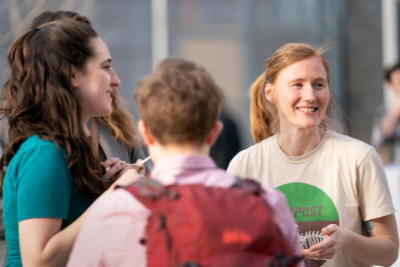
Campus Kitchen Coordinator Natalie Jacobson (left) and Chief Sustainability Officer Allyson Green (right) enjoy conversation at a garden event.
During the summer and fall of 2019, the garden began to utilize the Food Lab space in the Hagfors Center for potlucks and food preparation. Chief Sustainability Officer Allyson Green, who oversees the garden, remarked that the first session of gardeners gathering in the food lab over the summer was the highlight of the season; people got to know one another and shared cooking techniques and conversation as they made sambusas. This season also saw a student-led storytelling event in partnership with Mixed Blood Theater and food activist, LaDonna Redmond. As gardeners and others are living into the new space, opportunities for connecting and learning with and from each other are growing alongside the vegetables.
One challenge with the garden rebuild was impacted soil in the in-ground beds due to construction equipment. After the garden was initially built, gardeners were having a difficult time cultivating healthy root systems for their plants, requiring that all of the in-ground beds be dug up and the soil turned. Thankfully, dozens of students, several classes, and a few athletic teams answered the call, picking up shovels and making quick work of the beds that required turning.
When asked about how the garden fits into the overall sustainability commitments of Augsburg, Allyson noted that the garden is a visible demonstration of Augsburg’s commitment to caring for the place where Augsburg is located. By tending to our natural environment and building a place for community building, food access, and learning, the garden is an important aspect of Augsburg’s place-based and anchor institution work.
Allyson also noted her hopes for the garden. With twenty-five people on the waiting list, she hopes that the garden can continue to be a vital place on-campus for learning and relationship building that contributes to the well-being of the whole community. She dreams that the garden might be a model for cooperation and learning that can spread to other areas of campus, and even to other communities!
As a space that requires the cooperation of dozens of people who all have different ideas about ways of growing food, habits of organization and storage, and different cultures, personalities, and life stories, the garden is a unique place for experimentation, building community amongst difference, and finding a middle ground. Here’s to a successful growing season and many more to come!
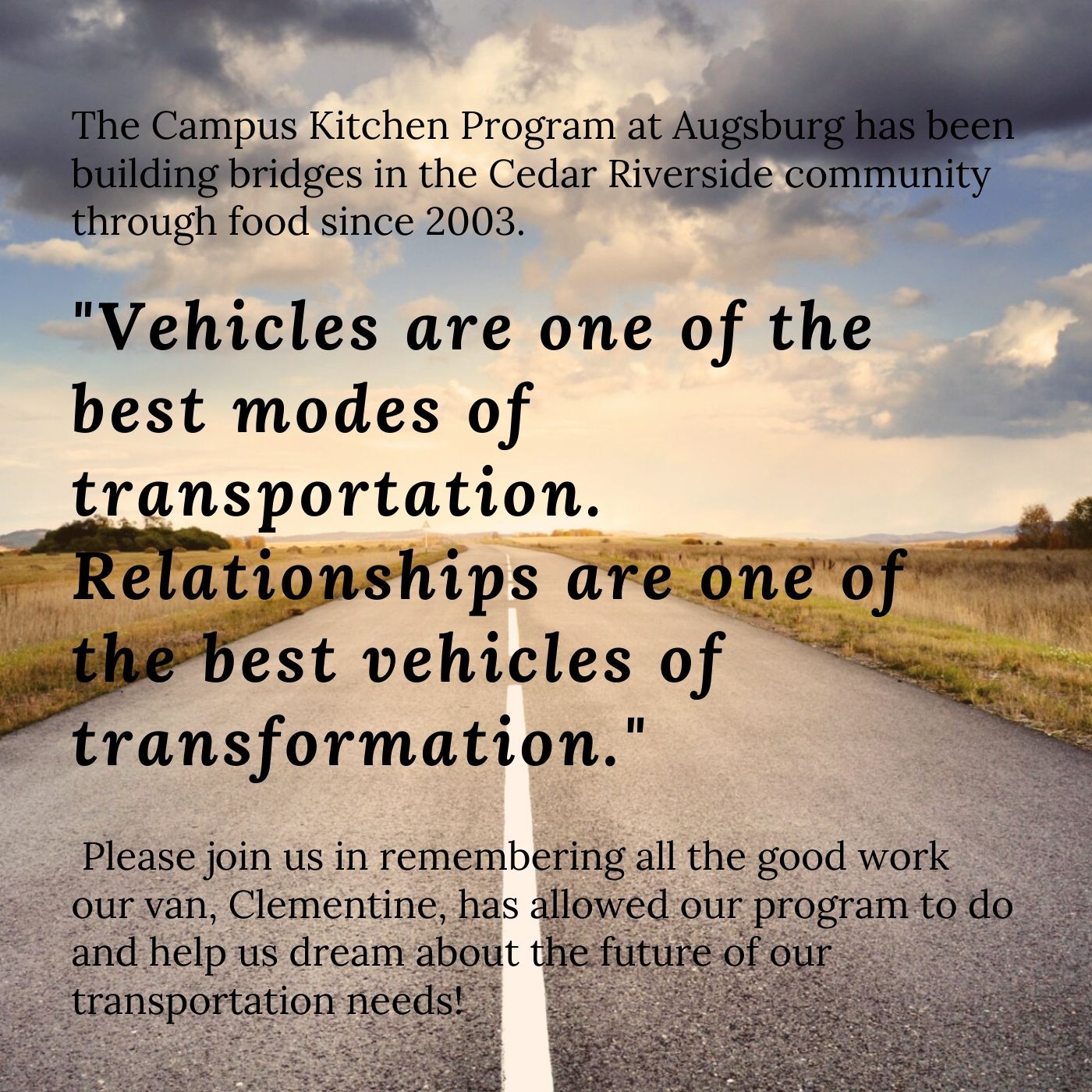
The Campus Kitchen Program has had one main source of transportation for more than 10 years, a minivan named Clementine. Our steadfast and beloved van (which was named by students) has become too worn to carry out our work, so we are in need of a new mode of transportation.
By the Numbers
This is some of what a van allows us to accomplish:
Six = the number of days each week Clementine is used to transport food, students, and staff.
100,000 = the number of meals Clementine has delivered to neighbors in need in the last 10 years.
27,996 = the number of pounds of recovered produce Clementine has hauled in one growing season from local farmers markets so it could be distributed to neighbors in Cedar-Riverside who have little access to fresh food.
Students on a meal delivery in Clementine’s younger days.
Help us Keep on Rolling
We know we’ll have to move on without Clementine, and when a van allows us to get so much done, we know we can’t go for very long without finding a replacement vehicle. Here’s how you can help:
Make a donation the old-fashioned way. Send a check to Augsburg University, Campus Kitchen Van Fund, 2211 Riverside Avenue, Minneapolis, MN 55454 Campus Box 10.
(This isn’t really the Campus Kitchen van, but you get the idea.)
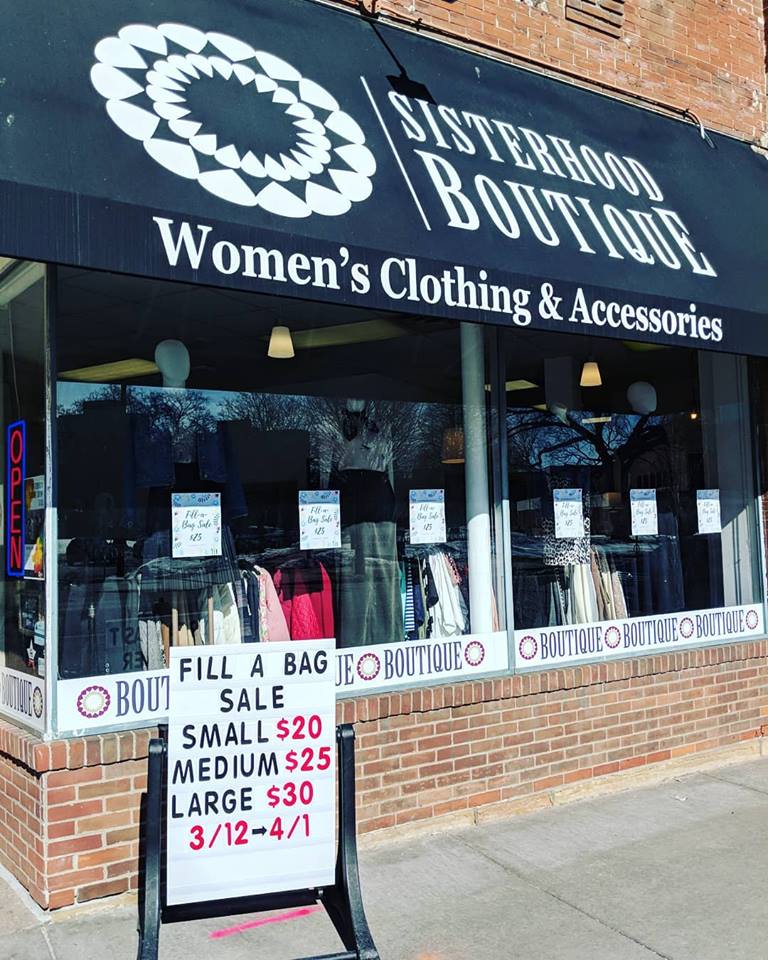
Sisterhood Boutique is a small thrift store with a big heart.
Located across the street from the Augsburg University campus, the Sisterhood Boutique stands as a symbol of empowerment for women. Started by young women who lived in Cedar-Riverside, the Sisterhood is described by shoppers as the “hidden gem” of the West Bank neighborhood. Donated clothing and jewelry is sold in a polished retail space, with all sales go towards a leadership program designed to help young women prepare for a career. The program includes various paid internships at the boutique where interns learn the skill sets necessary to run a business and become an entrepreneur. Augsburg students in the Sabo Center’s LEAD Fellows program have also worked at the Sisterhood.
One of the main events at the Sisterhood Boutique is their annual pop up fashion show. It is a collaborative, student-run event. Augsburg students, along with students from the U of M and St. Kate’s come together to coordinate the venue, models, and decorations, and to design the outfits. In the past, all items at the show were donated or altered by a fashion class at St. Kate’s. This year’s fashion show is coming up soon on Tuesday, March 5th, 2019, at the Augsburg University Hoversten Chapel, located in Foss Center. Doors open at 6, and the show begins at 7. Everyone is welcome, and the event is free of charge. Attendees are encouraged to bring along gently used clothing items to donate to the Sisterhood!
Learn more about the event by visiting the Sisterhood’s Facebook event page: Sisterhood Fashion Show