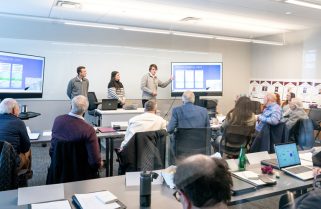

KARE 11 news recently aired a segment covering “Makers: Small to Big,” a series of workshops sponsored by the Augsburg College physics department. The workshops are open to the public but are designed to help educators incorporate hands-on physics and computer programming projects into their classroom activities.
The segment featured a coding workshop led by Nora Helf, a Master of Arts in Education student, who saw teachers using software to coordinate blinking LED lights. Helf was assisted by 10-year-old programmer Jack Tavakley who demonstrated some of the projects he has made.
Watch and read Teachers learn new technology to inspire students on the KARE 11 website.


Dozens—if not hundreds or even thousands—of physics experiments go on every day on the Augsburg College campus. Most of the time, however, no one hears about these experiments. No one knows if the experiments yielded favorable results that can be duplicated. No one knows if the experiments were a waste of time and resources. No one reports the results to anyone, and no one tracks the cost of the experiments.
At the end of March, junior physics majors Gottlieb Uahengo, Mohamed Sheikh-Mohamed, Amir Rose, and Fred Vedasto attended the National Society of Black Engineers (NSBE) conference in Pittsburgh, Pa. The conference included workshops and programming for grade school, collegiate, graduate, technical professional, and international entities of the Society. Their travel was funded through the NorthStar STEM Alliance, an initiative funded by the National Science Foundation (NSF) which is intended to double the number of African-American, Hispanic/Latino, Native American, Alaska Native and Pacific Islander students receiving baccalaureate degrees in science, technology, engineering, and math (STEM).
Nate Johnson didn’t take a typical path to becoming a physics major at Augsburg College.
Spotlight on Cynthia (Landowski) Jones, PhD ’81, Physics
Earlier this month, two students in professor Gary Egbert’s general physics lab went to the top of one of the tallest buildings in downtown Minneapolis to conduct a laboratory experiment. Ashley Gruhlke and Michael Schmit measured the change in atmospheric pressure with altitude from the 15th to the 54th floor of the 225 South Sixth Building. The building’s engineer, Frido Verkman, accompanied them.