bing pixel

You are invited: “From Nowhere to Now Here” Christensen Symposium 2022

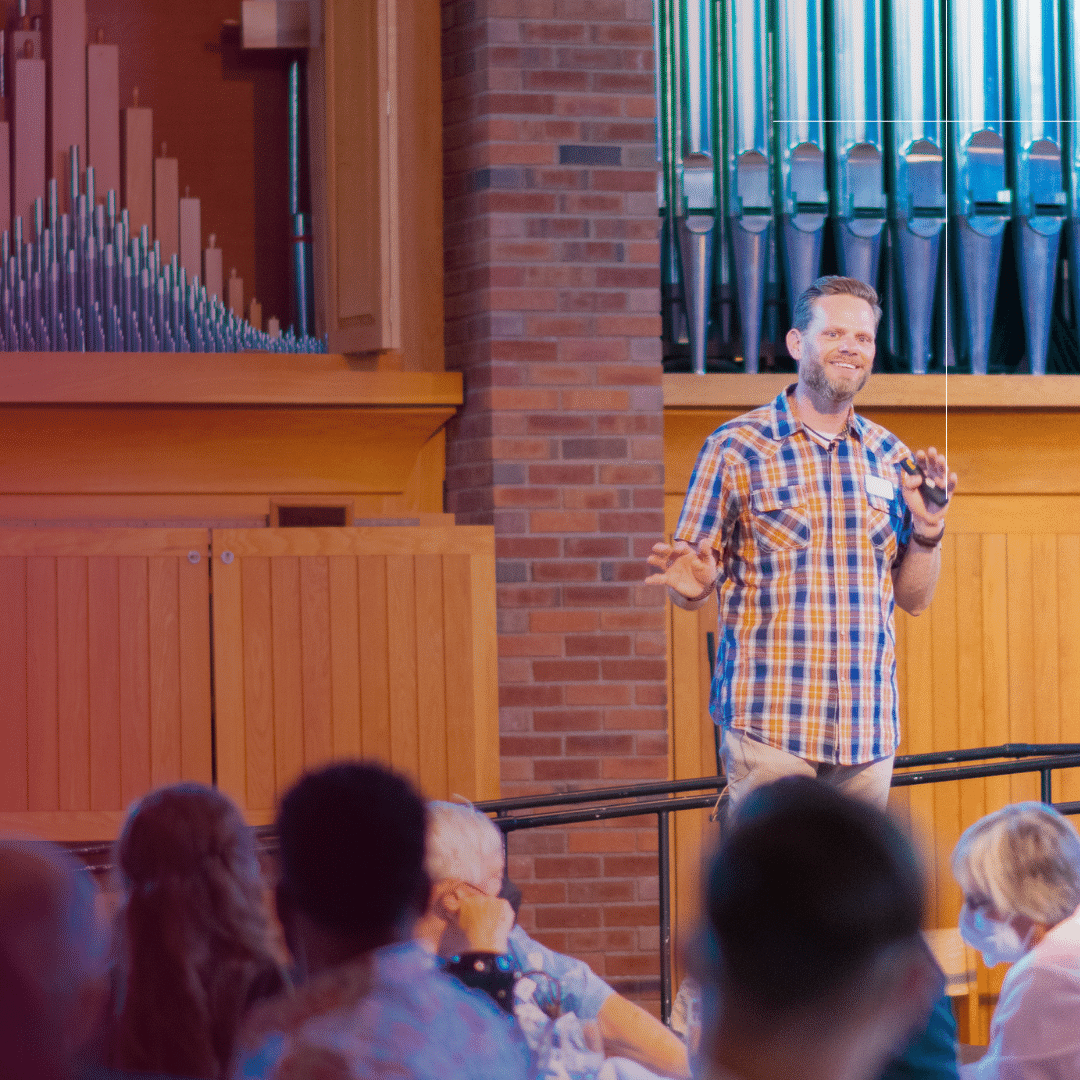
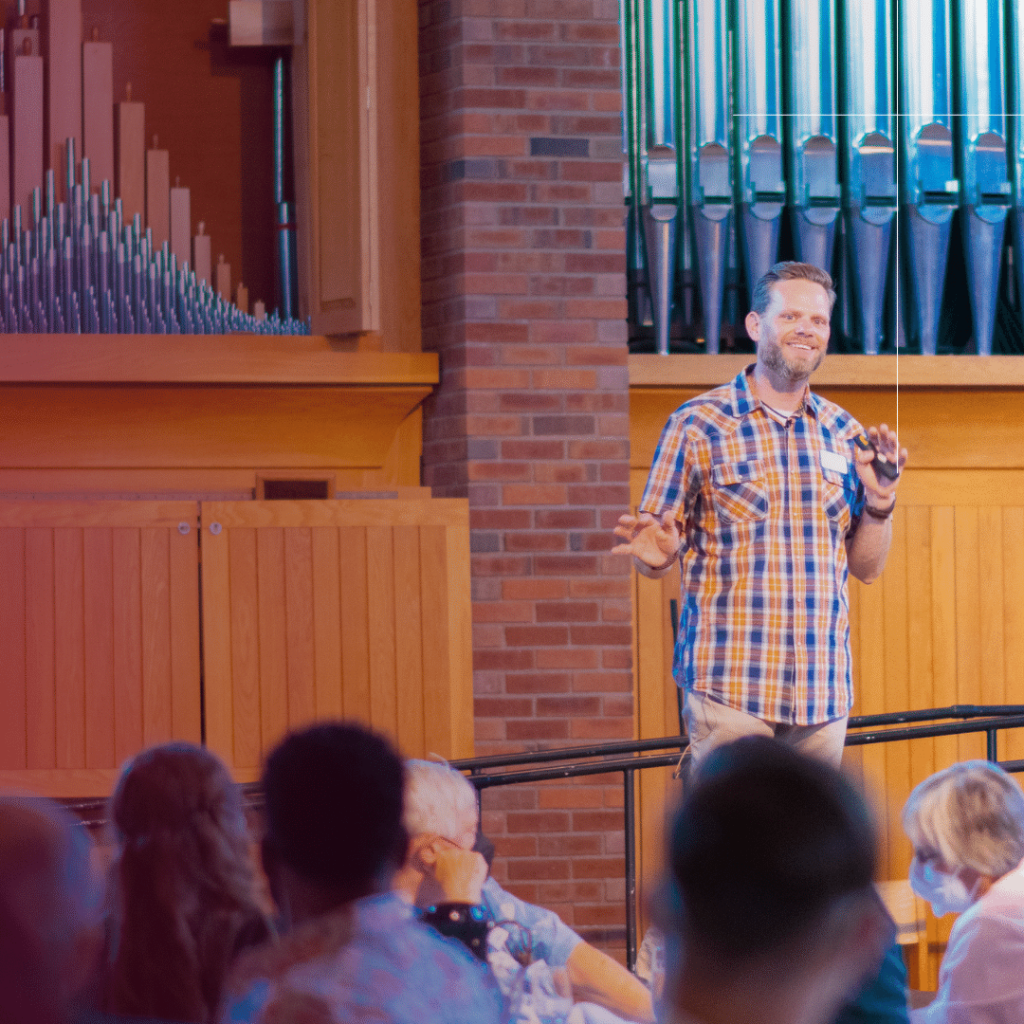
Jeremy Myers in front of a group of people in the chapel teaching. FROM NOWHERE TO NOW HERE

Jeremy Myers, PhD, Bernhard M. Christensen Professor of Religion and Vocation, Augsburg University

Join us for this year’s Christensen Symposium where we will dig deeper into the topics of vocation and public church.

Thursday, September 22
11 a.m. – 12 p.m.
Foss Center, Hoversten Chapel

The pandemic, rampant racism, unfettered injustices, environmental degradation, inflation – these are a few sources of the overwhelming sense of despair in our lives. We are anxious about our future. We desperately seek meaning, purpose, justice, and the common good but they seem to be nowhere in sight. Nowhere. But there is hope and potential for change if we can focus on the here and now. All we are promised is the here and now, and it is where we are called to live our lives. Now. Here.

Jeremy Myers is the Bernhard M. Christensen Professor of Religion and Vocation and the Executive Director of the Christensen Center for Vocation at Augsburg University. Myers earned his bachelor’s degree at the University of Minnesota and his master’s and PhD from Luther Seminary in St. Paul, Minnesota. He researches, writes, teaches, and organizes around the topics of vocation and public church. In addition to many articles and chapters, he is the author of Liberating Youth from Adolescence published by Fortress Press and is also a sought-after speaker. He has secured millions of dollars in grants to support the work of the Christensen Center for Vocation at Augsburg.
Our MAS Partner Nick Tangen “Let’s Get Real”

Last year, Augsburg University’s Riverside Innovation Hub and The Minneapolis Area Synod (MAS) both launched opportunities for congregations to be a part of a two-year learning community. We both are in the middle of the work with our first cycle of a two-year learning community. Over the last year and half, it has truly been a joy spending time learning with each other and from each other’s work. A highlight has been reading each other’s reflections and writings on how we engage in this work of being neighbor in our places and world.

This week, we want to highlight the most recent reflection Nick Tangen wrote “Let’s Get Real” from his experience at the ELCA Churchwide Assembly in Columbus, Ohio. He extends to us the invitation to join in the messiness, the vulnerability and realness that comes with wrestling with “What will need to die and rise again in order for each of us as the ELCA to embrace the reconciliation Jesus has set us free to participate in?”. We are grateful for this partnership and for Nick and his team to be in the work alongside us.

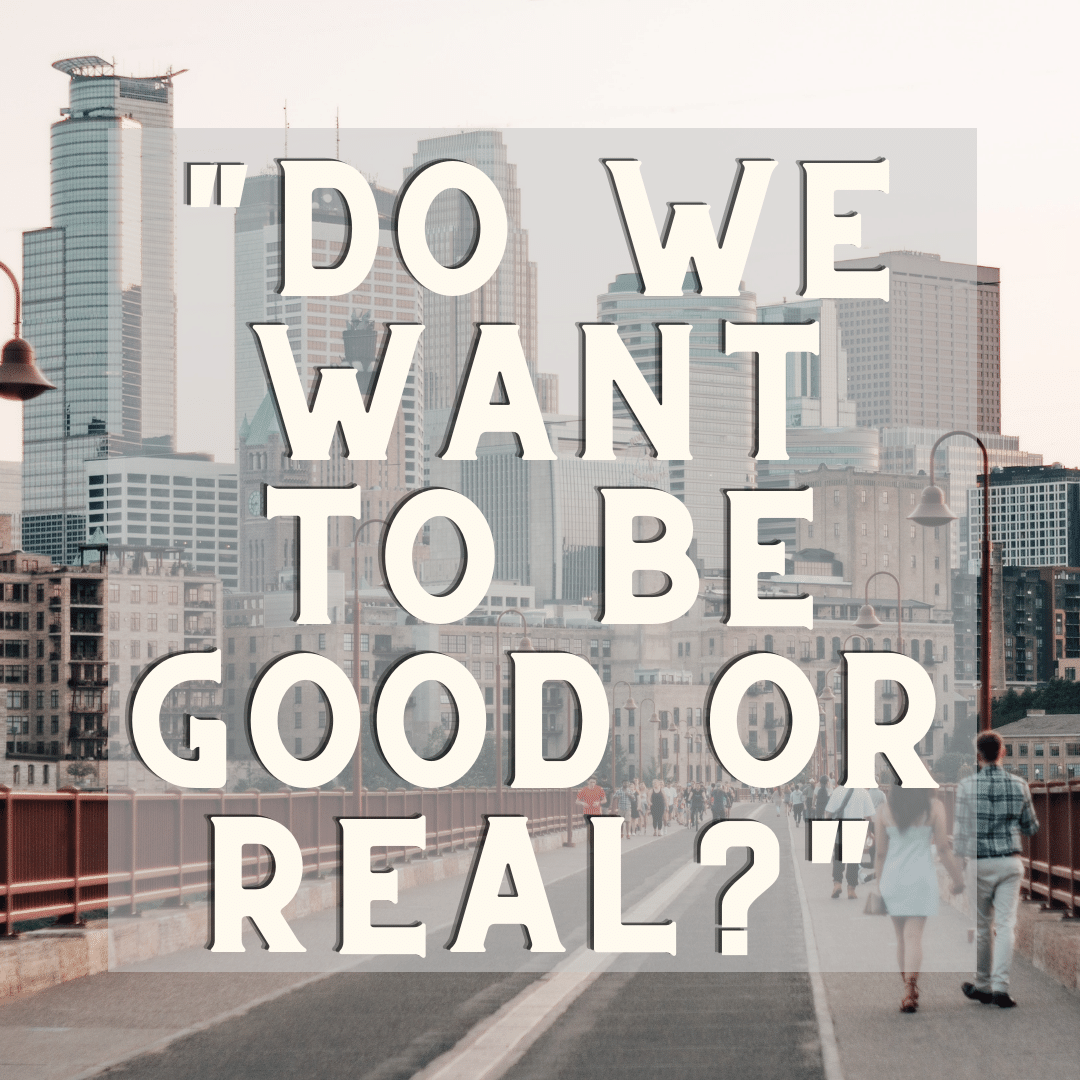
Stone arch bridge during the day background with gray box and "Do we want to be good or real?"“Retamoza’s words have been with me all week. In some ways this challenge captures so clearly my own discomfort with the work of the Assembly; did we want to be good or real? This is, I think, a real tension for us as a church – at all three expressions. It’s a tension ongoing for myself. I know my own desire to appear good, to fall into the trap of perfectionism and performance, and I know how limiting that is when trying to root out injustice and inequity in our life together.

This invitation into the vulnerability, the messiness, and the real-ness of confession and reconciliation stood in such stark contrast to the Assembly. The carefully curated plenaries with the steady march towards resolution felt oddly incongruous with the challenge to deeply listen to the cries of prophetic grief. While I am grateful for the provisions and memorials that the Assembly approved, it was the lament and experience of prophetic grief in worship and from the leaders of Iglesia Luterana Santa Maria Perigrina that my heart continues to return to. I feel both profoundly determined and deeply anxious about the church that I love.”

Read the entire blog post here on the Minneapolis Area Synod blog!

EZEKIEL AND THE PUBLIC CHURCH: EVERYTHING WILL LIVE WHERE THE RIVER GOES

by Ellen Weber and Jeremy Myers

Throughout this summer as we have gathered folks together around our work, the text from Ezekiel 47 continues to be a way to ground us before we begin. As our work shifts, taking time to remember these words re-grounds us in why public church matters through Ezekiel’s vision of God’s abundance.

Ezekiel’s Vision (Ezekiel 47:1–12, NRSV)

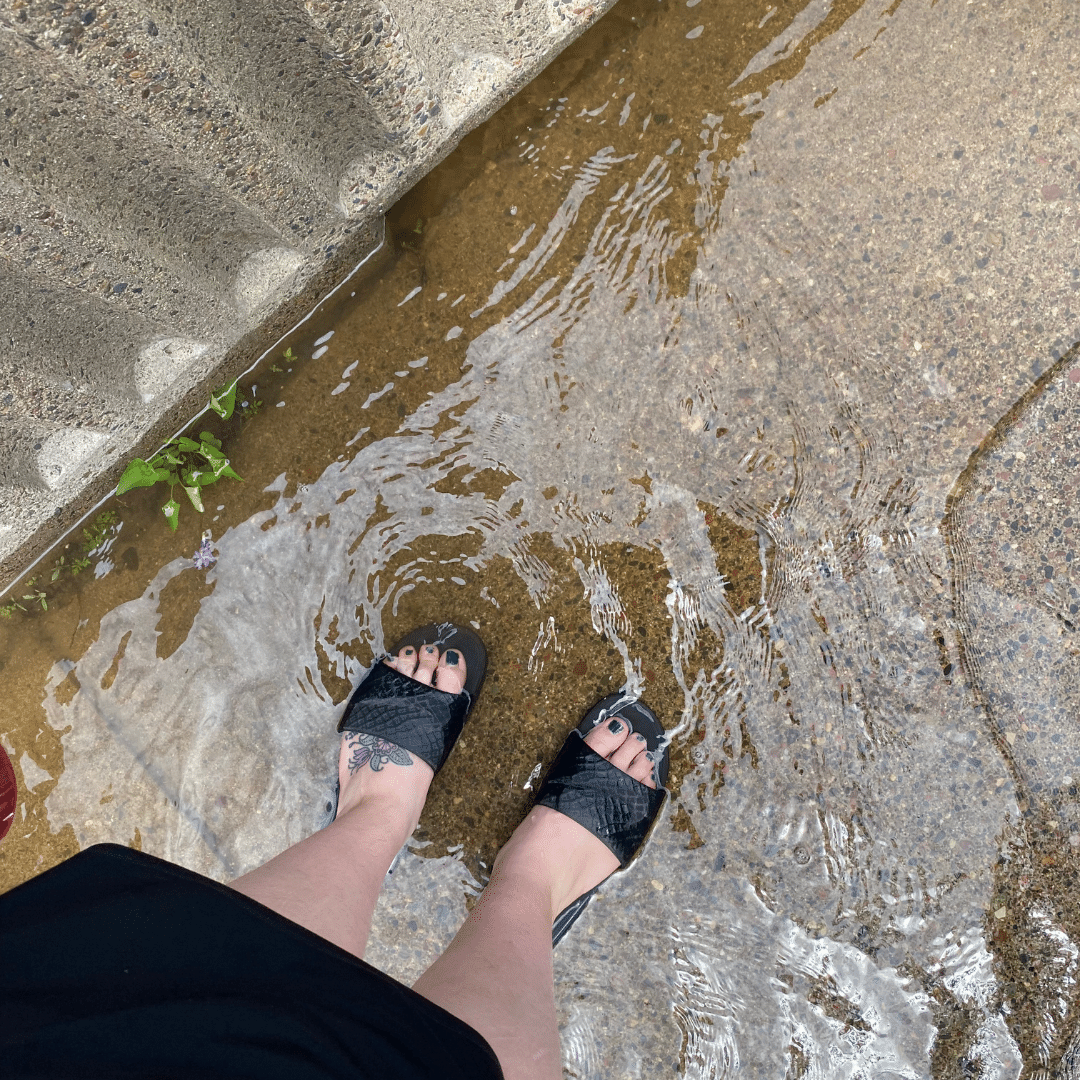
Individual stepping in water that is flowing by the side of a half-wall by the riverside. 1 Then he brought me back to the entrance of the temple; there, water was flowing from below the threshold of the temple towards the east (for the temple faced east); and the water was flowing down from below the south end of the threshold of the temple, south of the altar. 2 Then he brought me out by way of the north gate, and led me round on the outside to the outer gate that faces towards the east; and the water was coming out on the south side.

3 Going on eastwards with a cord in his hand, the man measured one thousand cubits, and then led me through the water; and it was ankle-deep. 4 Again he measured one thousand, and led me through the water; and it was knee-deep. Again he measured one thousand, and led me through the water; and it was up to the waist. 5 Again he measured one thousand, and it was a river that I could not cross, for the water had risen; it was deep enough to swim in, a river that could not be crossed. 6 He said to me, ‘Mortal, have you seen this?’

Then he led me back along the bank of the river. 7 As I came back, I saw on the bank of the river a great many trees on one side and on the other. 8 He said to me, ‘This water flows towards the eastern region and goes down into the Arabah; and when it enters the sea, the sea of stagnant waters, the water will become fresh. 9 Wherever the river goes, every living creature that swarms will live, and there will be very many fish, once these waters reach there. It will become fresh; and everything will live where the river goes. 10 People will stand fishing beside the sea from En-gedi to En-eglaim; it will be a place for the spreading of nets; its fish will be of a great many kinds, like the fish of the Great Sea. 11 But its swamps and marshes will not become fresh; they are to be left for salt. 12 On the banks, on both sides of the river, there will grow all kinds of trees for food. Their leaves will not wither nor their fruit fail, but they will bear fresh fruit every month, because the water for them flows from the sanctuary. Their fruit will be for food, and their leaves for healing.’

Ezekiel’s vision becomes an invitation to follow God’s jubilee as it flows into the world and and makes everything live where it flows. The Public Church Framework (below) provides faith communities with a way to do this, to become blessings for the entire land on which they are rooted rather than existing to serve their own purpose. We are Ezekiel, following the enigmatic divine tour guide along the river as we learn to see the breadth and depth of God’s love flowing away from the temple and into the world. Continue reading “EZEKIEL AND THE PUBLIC CHURCH: EVERYTHING WILL LIVE WHERE THE RIVER GOES”

“Shiloh goes into the unknown and…” A Vlog by Geo


Our very own Geoffrey Gill is a very talented videographer, so instead of a written blog post, he created a vlog sharing the story of one of our current learning partners, Shiloh Temple Brooklyn Park. We learn about their experience of accompaniment in Central Park. We hope you enjoy learning about their story and can watch a paradigm shift during their debrief discussion. 


Public Church Practices: Summer Neighborhood Prayer Walk

Outside. Sunshine. Gatherings in the backyard. Kids playing up and down the block. Time by the water. Schedules, full yet less scheduled. These describe summers in Minnesota to me. A time where more folks are out and engaging with each other while walking around the neighborhood. What could happen if we intentional went for a walk in our neighborhood paying attention to where joy was hanging out or where fear or anxiety was creeping in?

The Christensen Center for Vocation’s Riverside Innovation Hub is a learning community made local congregations who who gather together to learn how to be and become public church in their neighborhood contexts. We convene the congregations and then invite them to practice the artforms of the Public Church Framework in their contexts.

Accompaniment is the first artform of the Public Church Framework. It is the movement out into the neighborhood to hear the neighbors’ stories. In this movement, we learn to engage and listen to the neighbor for the neighbor’s sake.

The practice of a neighborhood prayer walk is a spinoff of the  Ignatian Awareness Examen, a contemplative prayer exercise that guides you through an examination of your day as you prayerfully seek moments of desolation (sorrow, brokenness, fear, anxiety, etc.) and moments of consolation (hope, life, courage, healing, joy, etc.).

We invite you this summer to join us in prayer walks around your own neighborhood. You can use this same framework as you walk through the neighborhood in which your faith community is situated, asking God to show you the places of desolation and consolation in that neighborhood. The general outline of that activity is to practice this by walking through the neighborhood, paying particular attention to consolation and desolation. Then, together, with people in your faith community or neighborhood, reflect on what you saw, felt, sensed and heard and map the locations of those places of consolation and desolation on a shared map. Continue reading “Public Church Practices: Summer Neighborhood Prayer Walk”

An Evening of Discernment by Kristina Frugé

On the evening of June 28 – at Augsburg University and on the interwebs of zoom technology – the Riverside Innovation Hub Learning Community gathered folks from over a dozen congregations for a hybrid learning event. These congregational members are currently involved in RIH’s two year partnership of exploring the call to be neighbor in our places. The learning arc of this partnership includes moving through and practicing the artforms of what we call the Public Church Framework

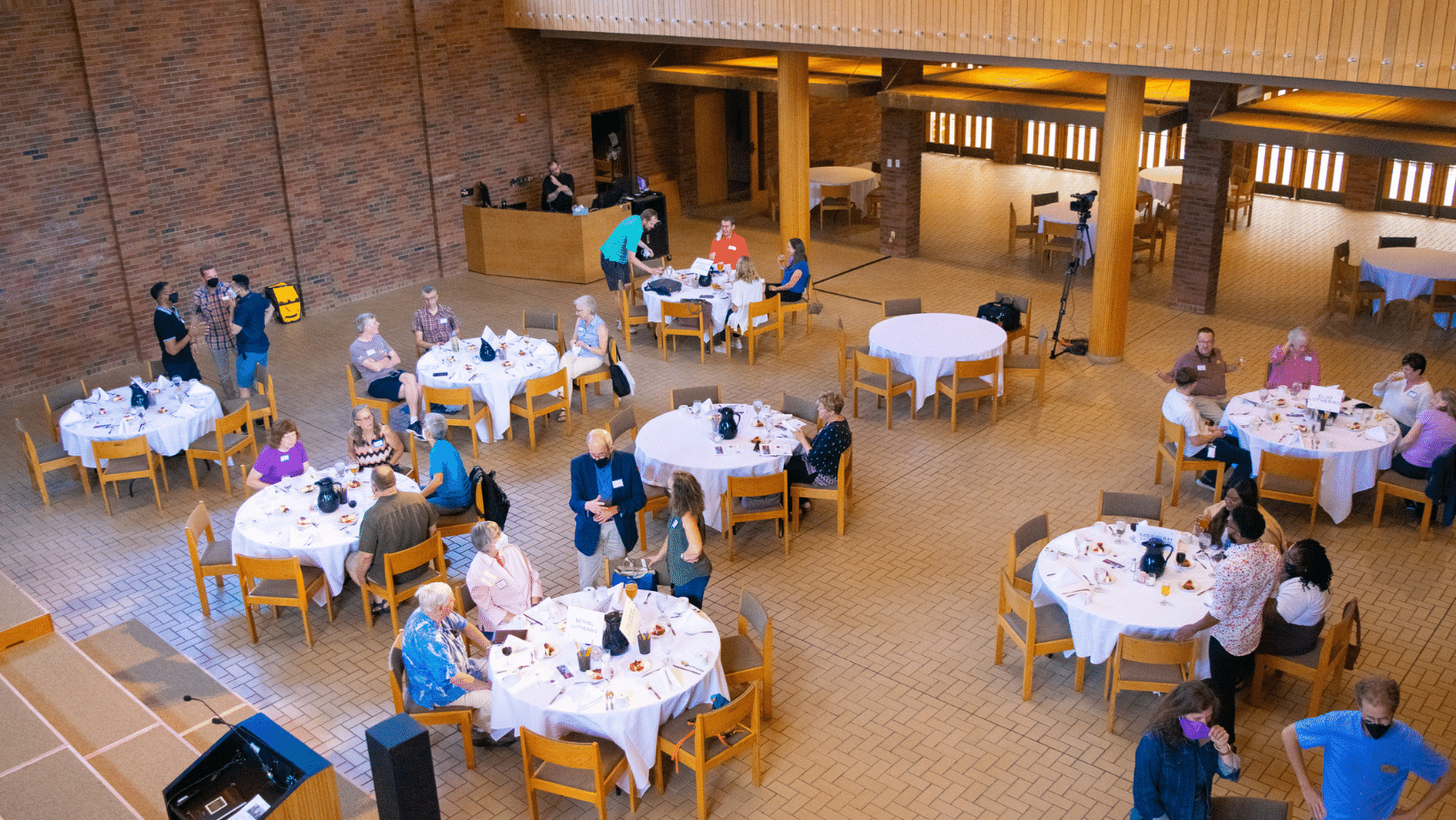
View from above of the Chapel of the Learning Event #4 of round tables with people sitting and standing around them.The flow of this process begins with accompaniment – which is listening in relationships and in our neighborhoods without an agenda but simply to hear our neighbor’ hopes and heartaches. Teams spent a good portion of the fall and winter focused on this artform, seeking out listening posts in their neighborhoods, doing prayer walks, inviting neighbors to one-to-ones and simply bringing curiosity to the geographical places near their churches. 

Next they began wondering about those stories alongside of their core theological convictions – we call this artform interpretation. Through the winter and spring teams asked the questions: What do the things we believe to be true about God have to say about our neighbors’ stories? What do our neighbors’ stories have to say about the things we believe to be true about God? Many of them began sharing these insights with other leaders in their congregations. 

This most recent gathering on a warm evening in June marked our fourth large group gathering and the midway point of our intentional learning relationships together around this neighborhood-oriented work. We spent time reflecting with one another about what we have been learning so far in accompaniment and interpretation. We shared encouragement with one another around the challenges and impact of this work. We also introduced a third artform – discernment. This is a communal process of listening for the nudge of the Spirit towards the right next faithful step, given what we have been learning so far from our neighbors’ and God’s story.   Continue reading “An Evening of Discernment by Kristina Frugé”

Stewarding Work with Hope and Lament by Amanda Vetsch


It’s sometimes strange to be a young adult that cares deeply about the church. I have so much hope for the possibility of a church that embodies God’s promises, and I lament the way in which the church has created, sustained, and participates in harm. 

So many of my peers who might consider themselves “Christian” have discerned that the institutional church isn’t something that they are willing to invest their energy or resources into any longer. We have often experienced church as a community that doesn’t live out the things it claims to believe in. When we’ve sought out a community of belonging that nourishes us and compels us to live our lives for the sake of the neighbor, we oftentimes found instead a place that intentionally or unintentionally perpetuates harm and exclusion, a place that continues to sustain white supremacy as the status quo, a community that prioritizes the privileged, and tokenizes people perceived as “other.”

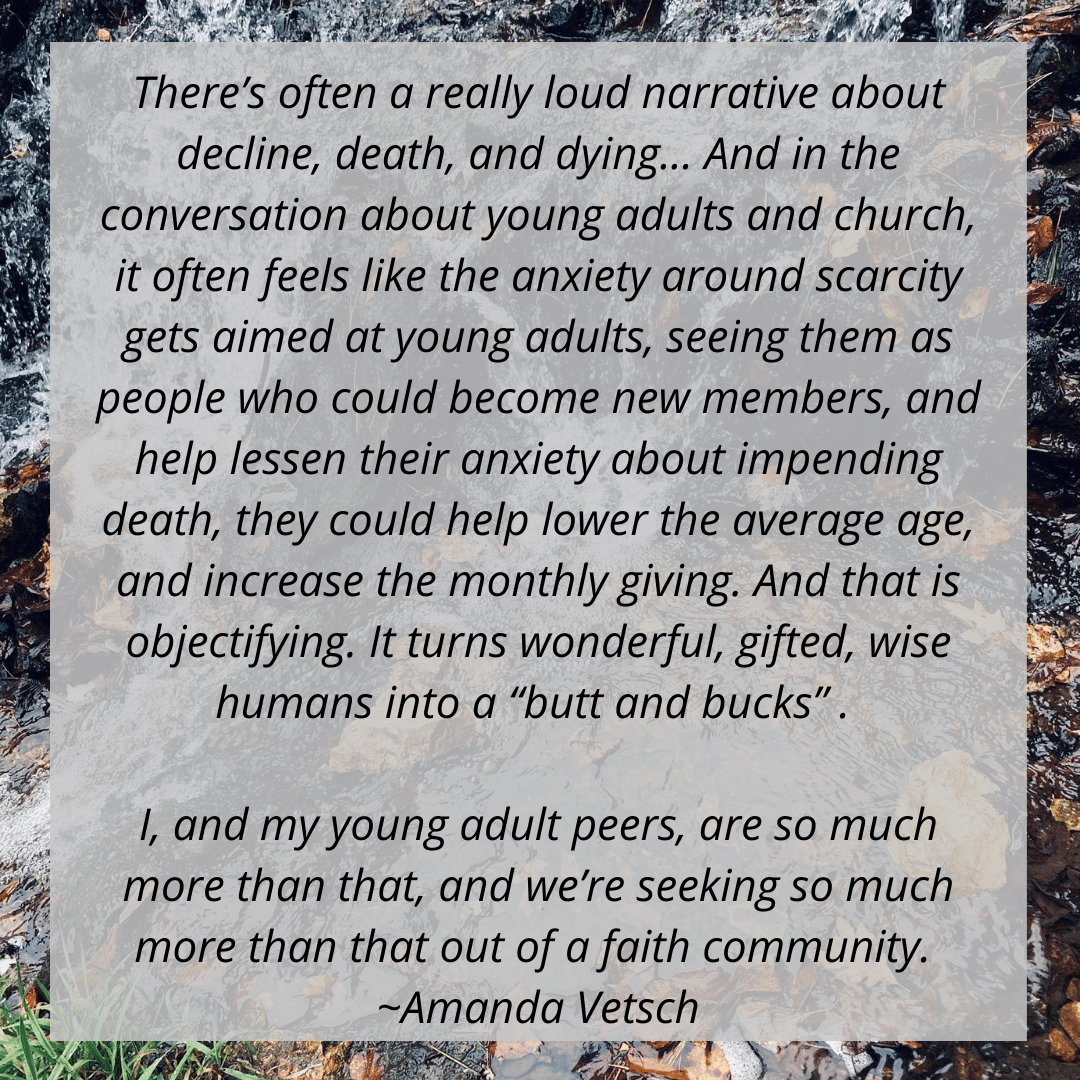
Background of water flowing over rocks from a river with text over it "There’s often a really loud narrative about decline, death, and dying... And in the conversation about young adults and church, it often feels like the anxiety around scarcity gets aimed at young adults, seeing them as people who could become new members, and help lessen their anxiety about impending death, they could help lower the average age, and increase the monthly giving. And that is objectifying. It turns wonderful, gifted, wise humans into a “butt and bucks” . I, and my young adult peers, are so much more than that, and we’re seeking so much more than that out of a faith community. ~Amanda Vetsch"There are definitely churches and communities that are practicing their beliefs, and are committed to dismantling the systems of oppression, and living into God’s promises. And yet there are so many more that so badly want people to join them, and haven’t quite figured out how to let go of a way of life that’s no longer serving them, and not in alignment with God’s vision. 

There’s often a really loud narrative about decline, death, and dying. This narrative is one that comes out of a scarcity mindset, rather than abundance. And in the conversation about young adults and church, it often feels like the anxiety around scarcity gets aimed at young adults, seeing them as people who could become new members, and help lessen their anxiety about impending death, they could help lower the average age, and increase the monthly giving. And that is objectifying. It turns wonderful, gifted, wise humans into a “butt and bucks” . I, and my young adult peers, are so much more than that, and we’re seeking so much more than that out of a faith community. 

Realistically, we’re not going to save the church, quite frankly many of us don’t want to. There are parts of the church that I think should die, especially the parts that are interwoven with white supremacy, and perpetuating an oppressive, harmful status quo. 

For the last couple of years, I’ve had the opportunity work alongside faith communities that are chasing after what it could look like to be part of God’s redemptive work in our world, here and now, and wondering about and practicing a way of life together that brings flourishing and life to everyone. Continue reading “Stewarding Work with Hope and Lament by Amanda Vetsch”

The Kin-dom of Heaven is like a Front Porch By Kristina Frugé 

Jesus can regularly be heard saying “the kin-dom of heaven is like…” and then offering an image, a story, a metaphor to root this vision to a place or experience. It is like a mustard seed, a lost coin, wheat among the weeds, a treasure in clay jars, the leaven that makes bread rise. Kin-dom or reign of God are of course, in themselves a kind of metaphor that reflect the ancient context of their teacher.  These metaphors speak to the audience – an agricultural community of peoples around the turn of the century – as Jesus seeks to stir the people’s imagination for the kind of world God desires them to experience and participate in. 

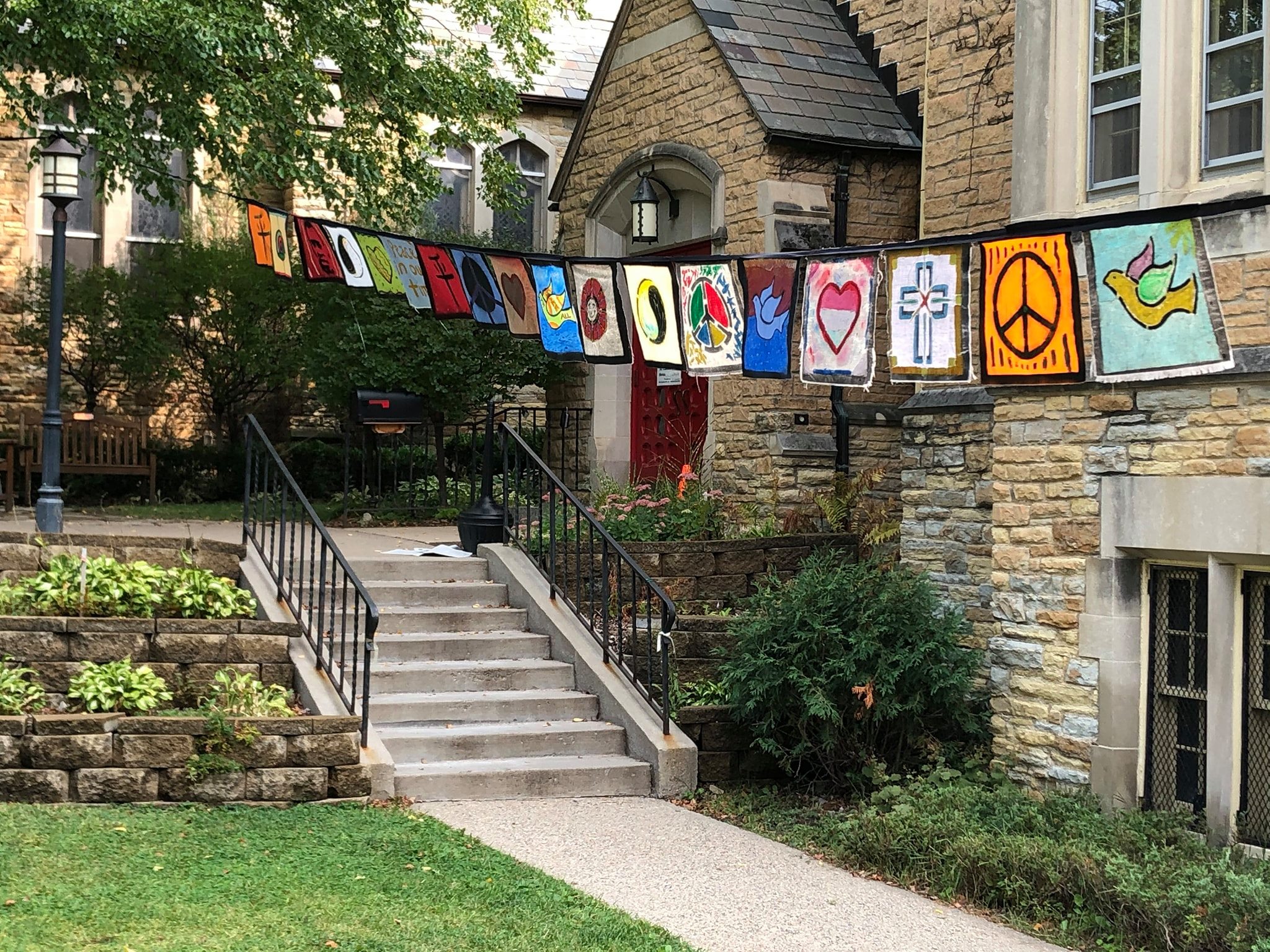
Sts. Luke and James red front door with peace flags hung up on a string across the front yard.

The Riverside Innovation Hub and the congregational partners we’ve been blessed to learn alongside these past several years, have been about this kin-dom of God work too. I cannot remember ever using this language explicitly with our congregational learning communities. But what we have been talking about and working towards is cultivating more places and relationships that reflect the ways God intends for us to be and be together. We’ve been chasing after that call, one relationship at a time, one walk through our neighborhoods at a time, one story or surprise at a time. 

Kin-dom metaphors may not quite fit our current context, but the idea of a front porch has caught our imagination as a helpful metaphor to encourage the relationship building work we are trying to be about. Relationships that shape stories that shape neighborhoods that look and feel a little bit more like God’s good intentions for a whole, flourishing and connected creation – one neighborhood block at a time. 

On one of these neighborhood blocks – at the corner of Colfax and W 46th St. in south Minneapolis – sits Sts Luke & James Episcopal Church. Also on this corner block exists a front porch of sorts. It wasn’t always there, but a few years ago the folks from this congregation began seeking out places to listen to their neighbors and some hints of an invitation began to stir among them. Continue reading “The Kin-dom of Heaven is like a Front Porch By Kristina Frugé “

Launching the V-Portfolio: Why Vocation is Important By Jon Bates

I just about thought that I knew all that I needed to know about the term vocation as I began my role as the V-Portfolio Coordinator with the Christensen Center for Vocation. Turns out, the more I’ve worked on the V-Portfolio, the more I have realized how helpful being precise about what vocation is, intentional of discerning one’s own vocation, and being honest with yourself is for me and for students of Augsburg University.

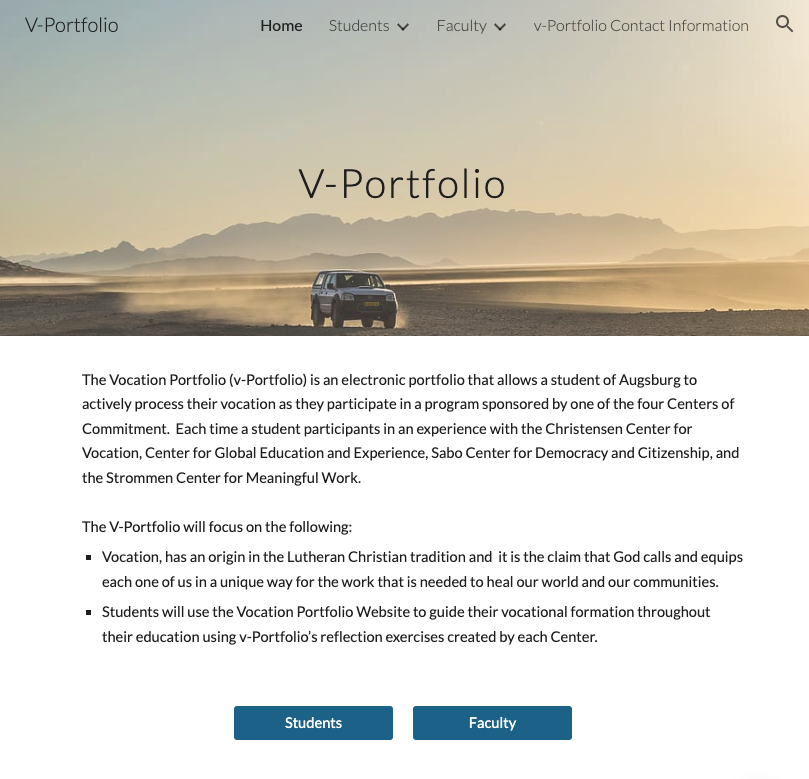
Screenshot of home page of the V-portfolio website. Image of a car off-roading in the wilderness with text below explaining what the V-Portfolio is. With my role as the V-Portfolio Coordinator, I have been furthering the work of the V-Portfolio alongside the directors with the centers of commitment at Augsburg University; the Sabo Center, Strommen Center, Center for Global Education & Experience, and the Christensen Center for Vocation. The V-Portfolio is essentially an online E-Portfolio but with a foundation of using vocation as the grounding for students, hence the title, Vocation Portfolio. 


Within the updated V-Portfolio website students are introduced or reintroduced to the term vocation, as it is defined as, “the way you are equipped, empowered, called, and driven to make our world a better place for all living things.” Colloquially vocation has been coined as a term that means the type of career or lifestyle one aspires to have. Vocation is something that happens in the future and begins with the individual. The V-Portfolio offers a different definition of vocation. As through the V-Portfolio, vocation is framed to focus on the present and is in response to the world, the neighbor. This is important work as our vocation is compelled to move because of the neighbor and that we get to decide how to respond using our own gifts, knowledge, and talents.

Continue reading “Launching the V-Portfolio: Why Vocation is Important By Jon Bates”

A Month for Reconnection: It’s Amanda and Geoffrey!

While summers can be hectic, they also can be a time to feel more grounded and to reconnect to our bodies and the earth. If we are quiet and listen, we can hear our bodies calling us to connect with the earth, which in turn is calling us back to each other. It can be a time to push back on the myth that we need to be always producing. Always checking the tasks of the list and making “progress”. 

With more people out and about rather than nestled inside, we are given the opportunity to meet those around us with our presence in new ways. This month we will be inviting you to reconnect in a variety of ways, with yourself, with your neighbor, with our initiatives, and even our CCV Staff! We have some recent changes with two of our staff members now in new roles and we would love for you to celebrate them with us! 

In case you haven’t met these two lovely individuals, it is a pleasure to introduce you to two amazing humans who are on our CCV staff. Amanda Vetsch and Geoffrey Gill. 

If you have the chance, please send them a congratulations via email or the next chance you see them!

Continue reading “A Month for Reconnection: It’s Amanda and Geoffrey!”